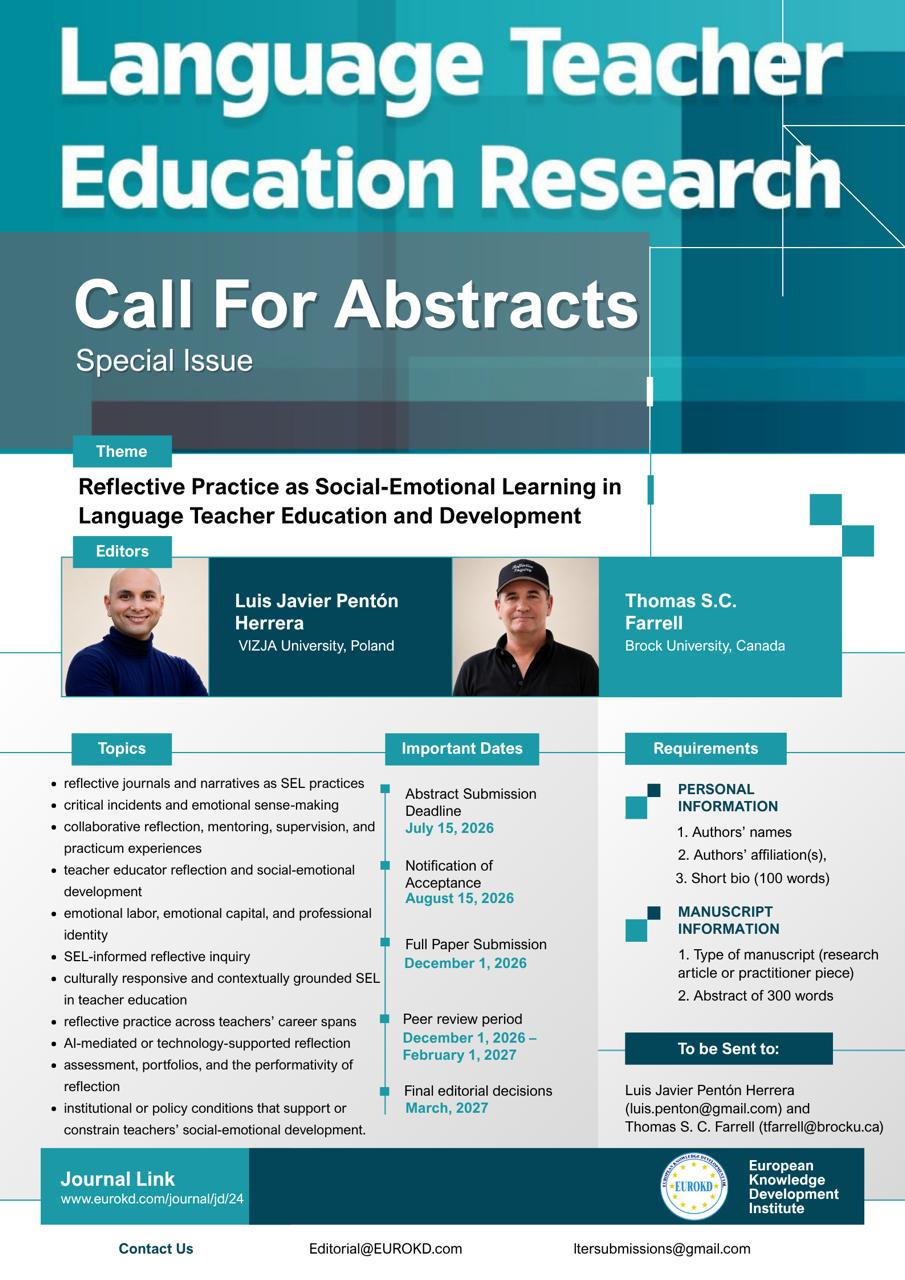
 Language Teacher Education Research
Call for Abstracts for Special Issue (2027)
Reflective Practice as Social-Emotional Learning in Language Teacher Education and Development
Guest-Editors:
Luis Javier Pentón Herrera
VIZJA University
Thomas S.C. Farrell
Brock University
Reflective practice and social-emotional learning have each become important, though often separately developed, areas of inquiry in language teacher education and development. Reflective practice is commonly understood as a systematic form of professional inquiry through which teachers examine experience, interpret pedagogical action, interrogate assumptions, and generate more informed possibilities for future practice (Dewey, 1933; Farrell, 2015, 2022; Schön, 1983). Yet the experiences teachers reflect on are never purely technical or cognitive; they are embedded in relationships, emotions, identities, institutional expectations, and the lived realities of teaching. It is at this intersection that social-emotional learning (SEL) becomes especially relevant. In language education, SEL has been described as a set of pedagogical approaches and processes that support the social, emotional, relational, and ethical dimensions of learning and teaching, including how individuals understand themselves, relate to others, participate in communities, and navigate the affective demands of educational life (Pentón Herrera & Martínez-Alba, 2021; Pentón Herrera, 2024). Furthermore, within language education, SEL has been positioned as a humanizing and holistic orientation that attends to the well-being of teachers and learners alike (Pentón Herrera, 2020; Pentón Herrera & Darragh, 2024).
This special issue begins from the premise that reflective practice and SEL should not be treated as disconnected domains in language teacher education. While reflective practice has often been framed as cognitive, technical, or professional inquiry (Kamali & Javahery, 2025; Xerri, 2025), and SEL as pedagogical support for teachers’ and learners’ social-emotional development (Elmeski & Bentahar, 2024; Hasper & Pentón Herrera, 2024), their intersections remain theoretically and empirically underexplored. We propose that reflective practice can function as social-emotional learning when it supports teachers and teacher educators in examining the social-emotional dimensions of teaching and learning, particularly how the social and emotional realities of teaching shape teachers’ and teacher educators’ professional understanding, pedagogical judgment, and ongoing development. From this perspective, reflection is not only a means of improving pedagogical practice; it is also a process through which teachers make sense of the social and emotional experiences that inform their learning. This framing invites scholarship that examines reflective practice as a social-emotional process in language teacher education and development.
In accordance with the Language Teacher Education Research Journal (LTER) guidelines, we invite research articles (qualitative, quantitative, and mixed) and practitioner inquiry contributions that examine reflective practice as social-emotional learning across pre-service, in-service, and continuing language teacher education contexts. Possible topics include, but are not limited to:
● reflective journals and narratives as SEL practices
● critical incidents and emotional sense-making
● collaborative reflection, mentoring, supervision, and practicum experiences
● teacher educator reflection and social-emotional development
● emotional labor, emotional capital, and professional identity
● SEL-informed reflective inquiry
● culturally responsive and contextually grounded SEL in teacher education
● reflective practice across teachers’ career spans
● AI-mediated or technology-supported reflection
● assessment, portfolios, and the performativity of reflection
● institutional or policy conditions that support or constrain teachers’ social-emotional development.
Please submit a proposal including: (1) authors’ names, (2) authors’ affiliation(s), (3) short bio (100 words), (4) type of manuscript (research article or practitioner piece), and (5) abstract of 300 words to the guest editors, Luis Javier Pentón Herrera (luis.penton@gmail.com) and Thomas S. C. Farrell (tfarrell@brocku.ca) by July 15th.
Important Dates
● Abstract/proposal submission deadline: July 15, 2026
● Notification of acceptance/rejection of proposals: August 15, 2026
● Full manuscript submission deadline: December 1, 2026
● Peer review period: December 1, 2026 – February 1, 2027
● Final editorial decisions: March, 2027
● Expected publication of the special issue: April 2027
References
Dewey, J. (1933). How we think: A restatement of the relation of reflective thinking to the educative process. D.C. Heath & Co Publishers.
Elmeski, M., & Bentahar, A. (2024). Exploring the integration of social-emotional learning in EFL pre-service teacher preparation in Morocco: A mixed-method study. Anglica. An International Journal of English Studies, 33(1), 125–150. https://doi.org/10.7311/0860-5734.33.1.07
Farrell, T. S. C. (2015). Promoting teacher reflection in second language education: A framework for TESOL professionals. Routledge.
Farrell, T. S. C. (2022). Reflective language teaching. Cambridge University Press.
Hasper, A., & Pentón Herrera, L. J. (2024). Activities for social-emotional learning: Developing social-emotional competences in the ELT classroom. Delta Publishing.
Kamali, J., & Javahery, P. (2025). Collaborative reflection as a means to improve teachers’ reflective skills: A community of practice perspective. Reflective Practice, 26(2), 246–261. https://doi.org/10.1080/14623943.2024.2426279
Pentón Herrera, L. J. (2020). Social-emotional learning in TESOL: What, why, and how. Journal of English Learner Education, 10(1), 1–16.
Pentón Herrera, L. J. (2024). Introduction to social-emotional learning in English language education: Mapping the landscape and reflecting on the way forward. Anglica. An International Journal of English Studies, 33(1), 5–18. https://doi.org/10.7311/0860-5734.33.1.01
Pentón Herrera, L. J., & Darragh, J. J. (2024). Social-emotional learning in English language teaching. University of Michigan Press.
Pentón Herrera, L. J., & Martínez-Alba, G. (2021). Social-emotional learning in the English language classroom: Fostering growth, self-care, and independence. TESOL Press.
Schön, D. A. (1983). The reflective practitioner: How professionals think in action. Basic Books.
Xerri, D. (2025). Enhancing reflective practice in language teacher education: Technology as a critical reflective partner. Technology in Language Teaching & Learning, 7(2), 103214. https://doi.org/10.29140/tltl.v7n2.103214