







Original Research
An Exploratory Analysis of the Scientific Production on Crowdfunding


- Abstract
- Full text
- Metrics
This study presents an exploratory analysis of the scientific production on crowdfunding, covering the period from 2010 to 2023. Utilizing data collected from the SciVerse Scopus database and analyzed with the Bibliometrix package, the research described the temporal evolution of publications, identified the most cited articles, and explored research networks through "Clustering by Coupling." The results show a significant increase in the number of publications on crowdfunding, especially after 2015, reflecting growing academic interest and the relevance of this financing method. The analysis identified three main clusters: crowdfunding and investments, business development and capital markets, crowdsourcing decision-making, and empirical analysis. These findings highlight the diversity and interdisciplinary collaboration within the field. The study concludes that crowdfunding not only democratizes access to capital but also promotes innovation and the building of supportive communities, making it an essential tool for modern entrepreneurship.
An Exploratory Analysis of the Scientific Production on Crowdfunding
|
João Guilherme Magalhães Timotio *, , Roberto César de Faria e Silva, Ramon Alves de Oliveira , Vânia Ereni Lima Vieira |
Faculty of Economics and Business, State University of Montes Claros, Brazil
Received 21 April 2024 Accepted 5 June 2024
ABSTRACT
This study presents an exploratory analysis of the scientific production on crowdfunding, covering the period from 2010 to 2023. Utilizing data collected from the SciVerse Scopus database and analyzed with the Bibliometrix package, the research described the temporal evolution of publications, identified the most cited articles, and explored research networks through "Clustering by Coupling." The results show a significant increase in the number of publications on crowdfunding, especially after 2015, reflecting growing academic interest and the relevance of this financing method. The analysis identified three main clusters: crowdfunding and investments, business development and capital markets, crowdsourcing decision-making, and empirical analysis. These findings highlight the diversity and interdisciplinary collaboration within the field. The study concludes that crowdfunding not only democratizes access to capital but also promotes innovation and the building of supportive communities, making it an essential tool for modern entrepreneurship.
Keywords: Scientific Production Crowdfunding, Financing, Access to Capital, Innovation
JEL Codes: G24, L26, O31, M13
Introduction
Crowdfunding is a modern financing approach that enables individuals to gather small amounts of money from many people, typically via the Internet, to support various projects and ventures. This method has transformed the landscape of entrepreneurship and philanthropy by providing an accessible and democratic means of raising capital. However, the concept of crowdfunding is not entirely new; it can be traced back to the early 1700s with the establishment of the Irish Loan Fund by Jonathan Swift, which provided microloans to low-income families in rural areas (Bradley III & Luong, 2014).
The evolution of crowdfunding is intertwined with technological advancements and the proliferation of the Internet. The modern form of crowdfunding began to gain significant traction in the early 2000s, coinciding with the launch of platforms like Kickstarter and Indiegogo. These platforms have since enabled the funding of a diverse range of projects, from innovative gadgets to artistic endeavors and social causes. Crowdfunding has democratized the investment process, allowing creators to bypass traditional financial intermediaries and engage directly with potential supporters (Mollick, 2014).
One of the significant advantages of crowdfunding is its ability to bridge the funding gap for early-stage ventures, particularly those focused on innovation. Traditional funding sources, such as venture capital and bank loans, often have stringent requirements and high entry barriers. Crowdfunding, on the other hand, allows entrepreneurs to bypass these obstacles and appeal directly to the public for support. This has been especially beneficial in times of financial crises, where access to capital becomes even more restricted (Hervé & Schwienbacher, 2019). Moreover, crowdfunding has expanded entrepreneurial financing access to regions and demographics typically underrepresented in venture capital funding, thereby fostering a more inclusive innovation ecosystem (Sorenson et al., 2016).
Additionally, crowdfunding promotes a participatory approach to innovation. Supporters often engage with the projects, providing feedback, suggestions, and even additional ideas, effectively participating in the product development process. This interaction can significantly enhance the quality and market readiness of the final product. Research indicates that the number of supporters a project attracts can indicate its future market success more than the total funds raised. This is because a larger number of supporters not only signifies broader support but also generates valuable word-of-mouth recognition and initial market validation (Stanko & Henard, 2017).
The role of crowdfunding in supporting social entrepreneurship and sustainable ventures is another notable development. Social entrepreneurs, who often face significant challenges in obtaining funding from traditional financial institutions, have found an effective alternative in crowdfunding. This form of financing aligns well with the goals of social ventures, as it allows them to raise funds while building a community of supporters invested in their mission. Studies have shown that sustainability-oriented projects tend to perform well on crowdfunding platforms, often achieving high levels of post-campaign success and longevity (Calic & Mosakowski, 2016).
Crowdfunding’s impact extends beyond financial support; it fosters a sense of community and shared purpose among supporters. This phenomenon is particularly evident in civic crowdfunding, where citizens collaborate to fund community projects, thereby enhancing civic engagement and social cohesion (Siver et al, 2015) . Additionally, the concept of “fanvestors” has emerged, where supporters of artistic projects not only provide financial support but also deeply engage with the creative process, reflecting a shift in how audiences interact with content creators (Galuszka & Bystrov, 2014).
Crowdfunding has also had a profound impact on entrepreneurship and innovation, providing a dynamic new avenue for raising capital and fostering creativity. By leveraging the Internet to connect with a broad base of potential funders, entrepreneurs can secure support from diverse backers. This method not only democratizes access to capital but also introduces a community aspect to project development. Crowdfunding platforms like Kickstarter and Indiegogo have been instrumental in this transformation, enabling countless innovative ideas to come to fruition that might have struggled to find funding through traditional means (Bradley III & Luong, 2014).
In conclusion, crowdfunding has revolutionized the landscape of entrepreneurship and innovation by providing accessible and community-driven funding options. It supports a wide range of projects, from tech startups to social ventures, and promotes a participatory culture where supporters contribute beyond financial resources. As crowdfunding continues to evolve, its impact on fostering innovation and supporting diverse entrepreneurial activities is likely to grow, becoming an increasingly important tool in the modern entrepreneur’s toolkit.
Based on the presented context, an exploratory analysis of the international scientific production on "crowdfunding" was conducted. Specifically, a general description of the collected data sample, an analysis of the evolution of publications over the time series, an analysis of the five most-cited articles in the sample by other works, and an examination of the existence of research networks on the topic were performed. The data were collected from SciVerse Scopus, and the applied method was bibliometric.
Literature review
Sources of funding for ventures
Financing is a primary concern for entrepreneurs when launching and expanding new businesses. Funding sources can be divided into two main categories: internal and external. Internal sources include the founders' own capital, known as “bootstrapping,” and capital from friends and family. This type of financing is crucial in the early stages of a venture, where risk is high and access to formal capital sources is limited (Gartner et al., 2012).
As the venture grows, other forms of financing become necessary. Angel investors are a popular option for early-stage startups. These investors are typically wealthy individuals who provide capital in exchange for equity in the company. Studies indicate that angel investors not only provide financing but also add value through mentorship and networks (Freear et al., 1995).
In addition to providing funding, angel investors often act as strategic partners, offering support in areas such as capacity building, management expertise, and mentorship. This can be particularly valuable in emerging markets where access to both funding and guidance is limited. A study conducted in Germany showed that government subsidies for angel investors significantly increased the likelihood of startups receiving angel funding and the amount of funding received (Berger & Gottschalk, 2021).
Angel investors are also crucial in mitigating adverse selection and moral hazard problems, which are common in early-stage investments. They tend to invest in ventures where they can exert significant influence over operational and strategic decisions, ensuring their interests align with those of the startup founders. Studies demonstrate that startups funded by well-connected angels are more likely to secure subsequent venture capital funding and achieve successful exits (Werth & Böert, 2011).
Angel investors are also known for their willingness to invest in emerging and high-tech sectors. Their ability to take on high risks and their active role in managing startups often lead to significant innovations and rapid growth of the funded companies. In many cases, the involvement of angels is crucial for startups to overcome the "valley of death," the critical phase between initial product development and successful commercialization (Dutta & Folta, 2016).
Another important source of funding is venture capital. Venture capital firms invest in companies with high growth potential in exchange for equity. They typically seek companies that can provide extraordinary returns on investment. Although venture capital is a valuable funding source, it is highly selective and usually reserved for companies that have already demonstrated some level of success and substantial growth potential (Maier II & Walker, 1987).
Venture capital investors play a crucial role in startup growth by providing capital, strategic guidance, and access to a valuable network of contacts. Studies show that venture capital is associated with significant increases in startup growth, measured by the number of employees and financial valuation across successive funding rounds (Davila et al., 2003).
The impact of venture capital extends beyond direct funding, promoting innovation and economic development. Research indicates that an increase in the supply of venture capital is correlated with a higher number of new firms, job creation, and aggregate income growth in U.S. metropolitan areas (Samila & Sorenson, 2011).
Public funding options, such as government grants and co-investment programs, also play a crucial role in promoting innovation and supporting the development of new businesses. These programs aim to provide capital, encourage research and development, and facilitate the transition of startups from the conception stage to the market. Studies show that government grants can double the likelihood of a company receiving subsequent venture capital funding and have significant positive impacts on patent generation and revenue achievement (Howell, 2017).
Programs like the U.S. Small Business Innovation Research (SBIR) demonstrate the effectiveness of government grants in promoting innovation. Studies indicate that an SBIR award not only increases the likelihood of subsequent funding but also improves innovation outcomes, such as patent production and the commercialization of new technologies. These effects are more pronounced in companies facing greater financial constraints, highlighting the importance of grants for early-stage innovative companies (Howell, 2017).
Furthermore, government grants serve as a quality signal to private investors. For example, startups receiving prestigious research grants are significantly more likely to attract subsequent venture capital funding. This effect is particularly important for startups with fewer patents, as the grants can compensate for the lack of other quality indicators, reducing investor uncertainty about the potential of the developed technology (Islam et al., 2018).
However, the effectiveness of grants can vary depending on the context and structure of the programs. In some cases, government grants may not improve innovation efficiency in certain high-tech industries, especially when used as substitutes for private R&D funding. This scenario is evident in China, where government grants have been found to negatively impact innovation efficiency in some high-tech industries (Hong et al., 2016).
Additionally, government venture capital (GVC) funds have been established worldwide to fill the capital gap for young, innovative companies. However, the effectiveness of these programs can be controversial, with some countries experiencing more success than others. For instance, the Australian Innovation Investment Fund is often cited as a successful GVC initiative, highlighting the importance of appropriate investment process design to achieve positive outcomes (Colombo et al., 2016).
Apart from these options, the development of new technologies and the emergence of fintech have created additional funding opportunities. Crowdfunding platforms, for example, have proven effective in connecting entrepreneurs with a large number of small investors democratizing access to capital (Bonini et al., 2019). The following subsection presents some concepts and works on the topic.
Crowdfunding
Crowdfunding is a collective financing method that uses online platforms to connect entrepreneurs with potential investors. This funding approach has gained popularity as an alternative to traditional financing methods, offering entrepreneurs direct access to a broad base of small investors. One of the main advantages of crowdfunding is the ability to test and validate business ideas directly with the market, thereby reducing risks and increasing the chances of commercial success (Mollick, 2014).
Crowdfunding can be divided into several categories, including donations, rewards, loans (crowdlending), and equity crowdfunding. Reward-based crowdfunding is one of the most common forms, where investors receive products or services in exchange for their financial support. In contrast, equity crowdfunding allows investors to acquire equity stakes in a company, offering a potential return in the event of the venture's success (Bradley III & Luong, 2014).
Research indicates that the quality of the project and the founder’s personal network are crucial factors for success in crowdfunding. Interaction with supporters not only helps to raise funds but also provides valuable feedback that can improve product development and increase market awareness. Indeed, the number of backers a campaign attracts can be more indicative of its future market success than the total amount of funds raised (Stanko & Henard, 2017).
Crowdfunding has also proven to be an effective tool for supporting social and sustainable ventures. These projects, which often face significant challenges in obtaining financing from traditional financial institutions, find crowdfunding to be an effective alternative for raising funds and building a community of supporters committed to their mission. Studies show that sustainability-oriented projects tend to perform well on crowdfunding platforms, often achieving high levels of post-campaign success (Calic & Mosakowski, 2016).
In summary, crowdfunding offers an innovative and inclusive approach to venture financing, promoting a collaborative environment where entrepreneurs can not only raise capital but also validate their business ideas and engage directly with their customers.
Methodology
The data used to achieve the objectives were collected from the SciVerse Scopus database, specifically searching for the term "crowdfunding" in the titles, abstracts, and keywords of the articles available on the platform. While no initial year was set for the search, the final year was limited to 2023, considering that the current year (2024) has not yet concluded. The decision was made to work exclusively with journal articles due to their higher reliability and quality, as they undergo a rigorous double-blind peer review process. The data were downloaded in CSV format and processed in RStudio using the “bibliometrix” package.
The “bibliometrix” package, developed for the R language, is an open-source tool designed to conduct comprehensive bibliometric analyses and scientific mapping. It allows researchers to perform a variety of analyses, including bibliographic coupling, co-citation analysis, and keyword analysis. A study by Aria and Cuccurullo (2017) highlights that bibliometrix supports a recommended workflow for conducting bibliometric analyses, making it a flexible and continuously updatable tool due to its integration with other statistical packages.
In this study, the bibliometrix package was used to describe the collected sample, analyze the temporal evolution of publications over the time series, identify the five most-cited articles in the sample (i.e., the most relevant in the literature on the subject), and finally, to identify the composition of the research network on the topic.
Results
Initially, the results of the sample description are presented in Table 1.
Sample Description
|
Description |
Results |
|
Timespan |
2010: 2024 |
|
Sources (Journals) |
568 |
|
Papers |
1682 |
|
Document Average Age |
3.84 |
|
Average citations per doc |
32.41 |
|
References |
81391 |
|
Authors |
3290 |
|
Co-Authors per Doc |
2.77 |
|
International co-authorships % |
33.41 |
The data sample spans a period of 15 years, indicating a comprehensive and longitudinal analysis of publications on "crowdfunding." A total of 568 different journal sources were utilized, demonstrating the diversity and breadth of the literature on the subject. A total of 1682 articles were analyzed, representing a significant amount of available literature on crowdfunding.
The average age of the documents is 3.84 years, suggesting that most publications on crowdfunding are relatively recent. This not only highlights the current relevance of research in the field but also indicates a dynamic and active environment of academic production. The relatively recent nature of crowdfunding research can be attributed to the emergence and popularization of crowdfunding platforms in the past decade. Since the early 2000s, crowdfunding has gained prominence as a viable alternative to traditional financing methods, spurring a proliferation of academic studies aiming to understand its implications, advantages, and challenges (Mollick, 2014).
The contribution of 3290 authors to the analyzed articles demonstrates an active and diverse research community. On average, each article has approximately 2.77 co-authors, indicating a trend towards collaborative research. About 33.41% of the articles result from international co-authorships, underscoring the global nature of crowdfunding research. Collaboration among researchers is a growing phenomenon that is well-documented in scientific literature. Katz and Martin (1997) emphasize that co-authorship is an important indicator of scientific collaboration. However, it is not a comprehensive measure, as collaboration can occur at various levels, such as interinstitutional and international. Melin and Persson (1996) argue that the increase in collaboration among nations and research institutions over the past two decades is driven by both the internal dynamics of science and scientific policy initiatives. Davidson Frame and Carpenter (1979) found that international co-authorship is strongly influenced by extra-scientific factors such as geography, politics, and language, in addition to promoting a higher number of publications and a more significant impact on the global scientific community.
The analysis then proceeded to examine the temporal evolution of research over the considered time series, with the results presented in Figure 1.
Figure 1.
The temporal evolution of research on crowdfunding
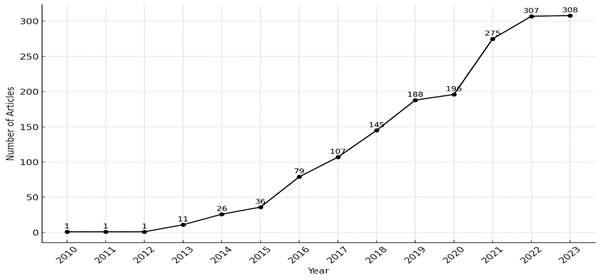
The temporal evolution of publications on crowdfunding, as depicted in Figure 1, shows a significant increase in academic interest over the years. The detailed analysis below highlights this growing trend and its implications.
In the early years of the analyzed period (2010-2014), the number of publications on crowdfunding was relatively low, with only one article published annually until 2012, and a slight increase to 11 articles in 2013 and 26 in 2014. This initial growth can be attributed to the emergence of the first platforms and the initial recognition of this method as a viable alternative to traditional financing. Early studies in this phase primarily focused on defining the concept and conducting preliminary analyses of successful case studies (Weigmann, 2013).
From 2015 onwards, a more pronounced increase in the number of publications was observed, with the number of articles growing from 36 in 2015 to 188 in 2019. This period represents an accelerated growth phase in crowdfunding research as more data became available and researchers began to delve deeper into the dynamics, impacts, and best practices associated with crowdfunding. Studies during this period addressed topics such as investor motivation, types of crowdfunding, and the economic and social impact of this funding modality (Simons et al., 2019).
Between 2020 and 2023, the number of publications grew, reaching 308 articles in 2023. This period reflects a maturation phase in crowdfunding research, with the number of published studies stabilizing at a high level. This continuous and significant growth can be attributed to the establishment of crowdfunding as a consolidated field of study and the increasing importance of this financing method in various sectors, especially during economic and health crises like the COVID-19 pandemic, which underscored the relevance of crowdfunding for emergency and innovation initiatives. Recent studies highlight that crowdfunding has been crucial in providing funding to sectors facing difficulties and promoting innovation in response to emerging challenges (Johnston & Wang, 2022).
In summary, the analysis of the temporal evolution of publications on crowdfunding indicates growing and sustained interest in academia, with the field maturing and diversifying over the years. This pattern reflects the increasing relevance and impact of crowdfunding as an innovative financial and social tool.
The five most-cited articles from the sample are presented in Table 2. These articles were identified using the "Most Global Cited Documents" feature of the Bibliometrix package, which helps highlight the articles that have had the greatest impact on the academic community by being frequently referenced by other works. Through citation analysis, researchers can identify the foundational and most influential articles in a specific area, allowing for a deeper understanding of the most significant trends and contributions (Aria & Cuccurullo, 2017).
The article “The Dynamics of Crowdfunding: An Exploratory Study” by Mollick, published in 2014, is a landmark in crowdfunding literature. This study explores the factors influencing the success of crowdfunding campaigns, highlighting the importance of project preparation and community involvement. Mollick found that projects with presentation videos and frequent updates are more likely to succeed, and he emphasized the significance of the proposer’s social network. This work laid a solid foundation for future research and is widely cited for its innovative and detailed approach (Mollick, 2014).
The five most-cited articles from the sample
|
Title |
Authors |
DOI |
Total Citations |
Citations per Year |
|
|
The Dynamics of Crowdfunding: An Exploratory Study |
Mollick, E. |
10.1016/j.jbusvent.2013.06.005 |
2493 |
226.64 |
|
|
Crowdfunding: Tapping the Right Crowd |
Belleflamme, P., Lambert, T., Schwienbacher, A. |
10.1016/j.jbusvent.2013.07.003 |
1528 |
138.91 |
|
|
Signaling in Equity Crowdfunding |
Ahlers, G. K. C., Cumming, D. J., Günther, C., Schweizer, D. |
10.1111/etap.12157 |
1140 |
114 |
|
|
Entrepreneurial Teams and New Venture Performance: Evidence from... |
Colombo, M. G., Franzoni, C., Rossi-Lamastra, C. |
10.1111/etap.12118 |
707 |
70.7 |
|
|
Some Simple Economics of Crowdfunding |
Agrawal, A., Catalini, C., Goldfarb, A. |
10.1111/jems.12093 |
627 |
62.7 |
|
Additionally, Mollick identified that geography plays a significant role in the success of crowdfunding. Projects located in regions with high startup density and entrepreneurial activity tend to be more successful, suggesting that local context can influence campaigns. This analysis has been fundamental in understanding how different factors interact within the crowdfunding ecosystem, making it an essential reference for scholars and practitioners interested in crowdfunding strategies (Mollick, 2014).
The article “Crowdfunding: Tapping the Right Crowd” by Belleflamme, Lambert, and Schwienbacher, published in 2014, discusses the motivations and behaviors of investors in crowdfunding campaigns. They propose that project founders should focus on attracting the "right crowd" to maximize success. The study highlights two main crowdfunding models: rewards and equity. While the former attracts investors seeking tangible benefits, the latter attracts those looking for financial returns. This distinction is crucial for founders when planning their campaign strategies (Belleflamme et al., 2014).
Furthermore, they explore the impact of crowdfunding on cost structures and decision-making processes within companies. They suggest that crowdfunding can reduce transaction costs and provide valuable market information, helping founders adjust their products or services before the official launch. This article has been fundamental in understanding how crowdfunding can be integrated into business and innovation strategies, significantly contributing to the literature on alternative financing (Belleflamme et al., 2014).
The article “Signaling in Equity Crowdfunding” by Ahlers et al., published in 2015, examines how signals sent by founders affect the success of equity crowdfunding campaigns. The authors use signaling theory to argue that clear and reliable information about the founding team’s experience, market growth potential, and financial transparency are essential for attracting investors. This study pioneers the application of signaling theory to the context of equity crowdfunding, offering valuable insights into how founders can enhance their chances of success (Ahlers et al., 2015).
They also discuss the importance of detailed information disclosure and effective communication with investors. They found that campaigns providing regular and detailed updates tend to generate greater investor trust and increase the likelihood of success. This article significantly contributes to understanding the dynamics of equity crowdfunding, emphasizing the importance of transparency and proactive communication for campaign success (Ahlers et al., 2015).
In the study “Internal Social Capital and the Attraction of Early Contributions in Crowdfunding,” Colombo, Franzoni, and Rossi-Lamastra, published in 2015, explore how the composition of entrepreneurial teams affects the performance of new ventures funded by equity crowdfunding. They argue that diverse teams with complementary skills and relevant experience are more likely to succeed. The study also highlights that gender diversity and the inclusion of members with international experience are positive factors for startup performance (Colombo et al., 2015).
Moreover, Colombo et al. (2015) investigate how team cohesion and task clarity influence startup success. They found that teams with a well-defined structure and effective communication tend to overcome challenges more efficiently, resulting in better performance. This article is an important contribution to the literature on startup management and crowdfunding, offering practical guidelines for forming and managing entrepreneurial teams (Colombo et al., 2015).
The article “Some Simple Economics of Crowdfunding” by Agrawal, Catalini, and Goldfarb, published in 2014, analyzes the basic economic aspects of crowdfunding, discussing how transaction costs, information asymmetry, and network effects influence campaign success. They propose that crowdfunding can solve some problems associated with traditional financing, such as the difficulty of access to capital for early-stage entrepreneurs and the lack of information for investors (Agrawal et al., 2014).
They also explore how crowdfunding platforms can create new markets and promote innovation. They suggest that crowdfunding not only facilitates the financing of innovative projects but also allows founders to validate their ideas directly with consumers, reducing market failure risk. This article offers a comprehensive view of the economic benefits of crowdfunding and is essential for understanding the impact of this financing modality on the economy and innovation (Agrawal et al., 2014).
The five most-cited articles on crowdfunding provide a comprehensive and detailed overview of the dynamics and impacts of this financing method. Mollick (2014) emphasizes the importance of preparation and community involvement for campaign success, while Belleflamme et al. (2014) discuss investor motivations and crowdfunding models, highlighting the importance of the "right crowd." Ahlers et al. (2015) apply signaling theory to equity crowdfunding, stressing the need for transparency and effective communication. Colombo et al. (2015) explore the composition of entrepreneurial teams and their impact on startup performance, emphasizing diversity and cohesion. Finally, Agrawal et al. (2014) analyze the economic aspects of crowdfunding, demonstrating how it can address traditional financing problems and promote innovation. These studies collectively elucidate the critical factors for crowdfunding success and its transformative role in venture financing.
The final step of the analysis involved investigating the existence of research networks using the “Clustering by Coupling” tool of the bibliometrix package.
“Clustering by Coupling” refers to a technique used to group research documents based on their shared bibliographic references, known as bibliographic coupling. This approach identifies documents that frequently cite the same sources, suggesting that they address related or complementary topics. Bibliographic coupling is effective in detecting emerging research clusters and analyzing the connections between different study areas. It provides a detailed view of knowledge networks and collaboration dynamics within a specific scientific field. Glí (2012) describes how this methodology can be combined with text-mining techniques to identify and label emerging topics, providing a robust and detailed analysis. Note: a table with these results can be obtained from the supplementary files of this work and are shown in Figure 2.
Research Networks on Crowdfunding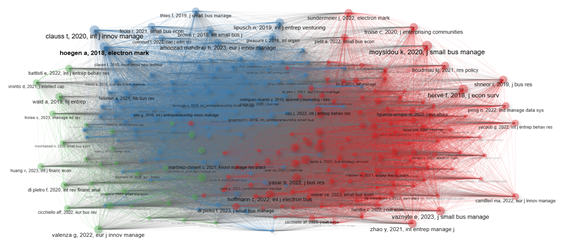
The Blue Cluster focuses on studies related to crowdfunding and investments. This cluster includes research exploring the economic foundations of crowdfunding, its applications in investments, and its interactions with other financing methods. Articles such as those by Mollick (2014) and Agrawal et al. (2014) are representative of this cluster, analyzing how crowdfunding can serve as an effective tool for raising capital and encouraging innovation. These studies demonstrate that crowdfunding can reduce transaction costs and offer new financing opportunities for entrepreneurs.
The Green Cluster highlights research focused on business development, capital markets, and cross-platform integration. This cluster includes studies investigating how crowdfunding can be integrated into business development strategies and how it interacts with traditional capital markets. Articles by Belleflamme et al. (2014) and Colombo et al. (2015) are examples within this group, exploring how crowdfunding can complement traditional financing methods and assist in developing new businesses. This cluster reflects the interconnection between crowdfunding and business development, emphasizing the importance of well-defined strategies for campaign success.
The Red Cluster groups studies on crowdsourcing, decision-making, and empirical analysis. This cluster includes research applying empirical methods to understand how decisions are made in the context of crowdfunding and how crowdsourcing can be utilized to optimize campaigns. Articles by Ahlers et al. (2015) and Jovanović (2019) are representative of this group, focusing on how clear signals and transparent information can influence investor decisions. These studies contribute to understanding decision-making dynamics in crowdfunding and the importance of empirical analysis to improve campaign effectiveness.
Through the analysis of clustering by coupling, it is evident that research on crowdfunding is strongly interconnected, with distinct sub-themes that complement and enrich the overall understanding of the field. The presence of multiple articles in specific clusters indicates a high degree of cross-citation and reference sharing, reflecting the collaborative and interdisciplinary nature of crowdfunding research. This method allows the identification of not only the central topics but also how they evolve and interconnect over time, providing a comprehensive view of trends and future directions in crowdfunding research.
Conclusions and implications
The exploratory analysis of scientific production on crowdfunding has revealed a significant evolution of academic interest in this field over the past 15 years. Initially, publications on crowdfunding were sparse, but from 2015 onwards, there has been a marked increase in the number of studies. This reflects the growing importance of crowdfunding as a viable alternative to traditional financing methods. This surge in interest can be attributed to the emergence of crowdfunding platforms like Kickstarter and Indiegogo, which democratized access to capital by allowing entrepreneurs, artists, and organizations to raise funds directly from the public.
The collected data indicate that research on crowdfunding is a dynamic and rapidly developing field, with an average document age of 3.84 years. This field has attracted a diverse and collaborative research community, with 3,290 authors contributing to the literature and a significant percentage of international co-authorships (33.41%), highlighting the global and interdisciplinary nature of the research.
Through clustering by coupling analysis, it is evident that research on crowdfunding is strongly interconnected, with distinct sub-themes that complement and enrich the overall understanding of the field. The presence of multiple articles in specific clusters indicates a high degree of cross-citation and reference sharing, reflecting the collaborative and interdisciplinary nature of crowdfunding research.
Moreover, the five most-cited articles on crowdfunding provide a comprehensive and detailed overview of the dynamics and impacts of this financing method. Mollick (2014) emphasizes the importance of preparation and community involvement for campaign success, while Belleflamme et al. (2014) discuss investor motivations and crowdfunding models, underlining the importance of attracting the "right crowd." Ahlers et al. (2015) apply signaling theory to equity crowdfunding, stressing the need for transparency and effective communication. Colombo et al. (2015) explore the composition of entrepreneurial teams and their impact on startup performance, highlighting the importance of diversity and cohesion. Finally, Agrawal et al. (2014) analyze the economic aspects of crowdfunding, demonstrating how it can address traditional financing problems and promote innovation.
In summary, the analysis shows that crowdfunding not only democratizes access to capital but also promotes innovation and the building of supportive communities. Research on crowdfunding is constantly evolving, with new areas of study emerging and contributing to a deeper and more comprehensive understanding of this phenomenon. As crowdfunding continues to develop, its impact on fostering innovation and supporting diverse entrepreneurial activities is likely to grow, making it an indispensable tool in the modern entrepreneur's arsenal.
References
Agrawal, A., Catalini, C., & Goldfarb, A. (2014). Some Simple Economics of Crowdfunding. Innovation Policy and the Economy, 14(1), 63-97. http://dx.doi.org/10.1086/674021
Ahlers, G. K. C., Cumming, D., Günther, C., & Schweizer, D. (2015). Signaling in Equity Crowdfunding. Entrepreneurship Theory and Practice, 39(4), 955-980. https://doi.org/10.1111/etap.12157
Aria, M., & Cuccurullo, C. (2017). Bibliometrix: An R-Tool for Comprehensive Science Mapping Analysis. Journal of Informetrics, 11(4), 959-975. https://doi.org/10.1016/j.joi.2017.08.007
Belleflamme, P., Lambert, T., & Schwienbacher, A. (2014). Crowdfunding: Tapping the Right Crowd. Journal of Business Venturing, 29(5), 585-609. https://doi.org/10.1016/j.jbusvent.2013.07.003
Berger, M., & Gottschalk, S. (2021). Financing and Advising Early Stage Startups: The Effect of Angel Investor Subsidies. ZEW-Centre for European Economic Research Discussion Paper (21-069). https://dx.doi.org/10.2139/ssrn.3927255
Bonini, S., Capizzi, V., & Cumming, D. (2019). Emerging Trends in Entrepreneurial Finance. Venture Capital, 21(2-3), 133-136. https://doi.org/10.1080/13691066.2019.1607167
Bradley III, D. B., & Luong, C. (2014). Crowdfunding: A New Opportunity for Small Business and Entrepreneurship. The Entrepreneurial Executive, 19(95).
Calic, G., & Mosakowski, E. (2016). Kicking off Social Entrepreneurship: How a Sustainability Orientation Influences Crowdfunding Success. Journal of Management Studies, 53(5), 738-767. http://dx.doi.org/10.1111/joms.12201
Colombo, M. G., Cumming, D. J., & Vismara, S. (2016). Governmental Venture Capital for Innovative Young Firms. The Journal of Technology Transfer, 41, 10-24. http://doi.org/10.1007/s10961-014-9380-9
Colombo, M. G., Franzoni, C., & Rossi-Lamastra, C. (2015). Internal Social Capital and the Attraction of Early Contributions in Crowdfunding. Entrepreneurship Theory and Practice, 39(1), 75-100. http://dx.doi.org/10.1111/etap.12118
Davidson Frame, J., & Mark P. C. (1979). International Research Collaboration. Social Studies of Science, 9(4), 481-497. https://doi.org/10.1177/030631277900900405
Davila, A., Foster, G., & Gupta, M. (2003). Venture Capital Financing and the Growth of Startup Firms. Journal of Business Venturing, 18(6), 689-708. https://doi.org/10.1016/S0883-9026(02)00127-1
Dutta, S., & Folta, T. B. (2016). A Comparison of the Effect of Angels and Venture Capitalists on Innovation and Value Creation. Journal of Business Venturing, 31(1), 39-54. https://doi.org/10.1016/j.jbusvent.2015.08.003
Freear, J., Sohl, J. E., & Wetzel Jr., W. E. (1995). Angels: Personal Investors in the Venture Capital Market. Entrepreneurship & Regional Development, 7(1), 85-94. https://doi.org/10.1080/08985629500000005
Galuszka, P., & Bystrov, V. (2014). The Rise of Fanvestors: A Study of a Crowdfunding Community. First Monday. http://dx.doi.org/10.5210/fm.v19i5.4117
Gartner, W. B., Frid, C. J., Alexander, J. C. (2012). Financing the Emerging Firm. Small Business Economics, 39(3), 745-761. http://dx.doi.org/10.1007/s11187-011-9359-y
Glí, W. (2012). Bibliometric Methods for Detecting and Analysing Emerging Research Topics. Profesional de La Información/Information Professional, 21(2), 194-201. http://dx.doi.org/10.3145/epi.2012.mar.11
Hervé, F., & Schwienbacher, A. (2019). Crowdfunding and Innovation. Contemporary Topics in Finance: A Collection of Literature Surveys, 331-349. http://dx.doi.org/10.1002/9781119565178.ch11
Hong, J., Feng, B., Wu, Y., & Wang, L. (2016). Do Government Grants Promote Innovation Efficiency in China’s High-Tech Industries? Technovation, 57, 4-13. http://dx.doi.org/10.1016/j.technovation.2016.06.001
Howell, S. T. (2017). Financing Innovation: Evidence from R&D Grants. American Economic Review, 107(4), 1136-1164. https://www.jstor.org/stable/44251589
Islam, M., Fremeth, A., & Marcus, A. (2018). Signaling by Early Stage Startups: US Government Research Grants and Venture Capital Funding. Journal of Business Venturing, 33(1), 35-51. https://doi.org/10.1016/j.jbusvent.2017.10.001
Johnston, K., & Wang, K. (2022). The Role of Crowdfunding in Delivering Entrepreneurship within the Hospitality Sector: A Case Study Analysis (pp. 582-589). European Conference on Innovation and Entrepreneurship. http://dx.doi.org/10.34190/ecie.17.1.732
Jovanović, T. (2019). Crowdfunding: What Do We Know so Far? International Journal of Innovation and Technology Management, 16(01), 1-25. http://dx.doi.org/10.1142/S0219877019500093
Katz, J. S., & Martin, B. R. (1997). What Is Research Collaboration? Research Policy, 26(1), 1-18. http://dx.doi.org/10.1016/S0048-7333(96)00917-1
Maier II, J. B., & Walker, D. A. (1987). The Role of Venture Capital in Financing Small Business. Journal of Business Venturing, 2(3), 207-214. https://doi.org/10.1016/0883-9026(87)90009-7
Melin, G., & Persson, O. (1996). Studying Research Collaboration Using Co-Authorships. Scientometrics, 36(3), 363-377. https://doi.org/10.1007/BF02129600
Mollick, E. (2014). The Dynamics of Crowdfunding: An Exploratory Study. Journal of Business Venturing, 29(1), 1-16. http://dx.doi.org/10.1016/j.jbusvent.2013.06.005
Samila, S., & Sorenson, O. (2011). Venture Capital, Entrepreneurship, and Economic Growth. The Review of Economics and Statistics, 93(1), 338-349. https://doi.org/10.1162/REST_a_00066
Simons, A., Kaiser, L. F., & vom Brocke, J. (2019). Enterprise Crowdfunding: Foundations, Applications, and Research Findings. Business & Information Systems Engineering, 61(1), 113-121. https://doi.org/10.1007/s12599-018-0568-7
Sorenson, O., Assenova, V., Li, G. C., Boada, J., & Fleming, L. (2016). Expand Innovation Finance via Crowdfunding. Science, 354(6319), 1526-1528. https://doi.org/10.1126/science.aaf6989
Stanko, M. A., & Henard, D. H. (2017). Toward a Better Understanding of Crowdfunding, Openness and the Consequences for Innovation. Research Policy, 46(4), 784-498. https://doi.org/10.1016/j.respol.2017.02.003
Stiver, A., Barroca, L., Minocha, S., Richards, M., & Roberts, D. (2015). Civic crowdfunding research: Challenges, opportunities, and future agenda. New Media & Society, 17(2), 249–271. https://doi.org/10.1177/1461444814558914
Weigmann, K. (2013). Tapping the Crowds for Research Funding: Crowdfunding, a Common Practice to Support Projects in the Arts, Music or Gaming, Has Also Attracted the Attention of Scientists. EMBO Reports, 14(12), 1043-1046. http://dx.doi.org/10.1038/embor.2013.180
Werth, J. C., & Böert, P. (2011). Co-Investment Networks of Business Angels and the Performance of Their Start-up Investments. International Journal of Entrepreneurial Venturing, 5(3), 2013. http://dx.doi.org/10.2139/ssrn.1977970

Page 1 of
Download Count : 54
Visit Count : 314
Keywords
Scientific Production Crowdfunding; Financing; Access to Capital; Innovation


Author(s) Information





How to cite this article:
Magalhães-Timotio, J. G., Silva, R. C. F., Oliveira, R. A., & Vieira, V. E. L. (2024). An Exploratory Analysis of the Scientific Production on Crowdfunding. New Challenges in Accounting and Finance, 11, 14-28. https://doi.org/10.32038/NCAF.2024.11.02
Acknowledgments
Not applicable.
Funding
Not applicable.
Conflict of Interests
No, there are no conflicting interests.
Open Access
This article is licensed under a Creative Commons Attribution 4.0 International License, which permits use, sharing, adaptation, distribution and reproduction in any medium or format, as long as you give appropriate credit to the original author(s) and the source, provide a link to the Creative Commons license, and indicate if changes were made. You may view a copy of Creative Commons Attribution 4.0 International License here: http://creativecommons.org/licenses/by/4.0/