







Original Research
Enhancing Brand Loyalty in Tanzanian Public Higher Education Institutions


- Abstract
- Full text
- Metrics
In the competitive environment of Tanzanian public higher education, maintaining a competitive edge requires an innovative approach to institutional branding. This article focuses on understanding the elements that influence brand loyalty among local students, particularly university image, perceived teaching quality, self-efficacy, and intention. Grounded in the Theory of Planned Behavior, the research employed proportionate random sampling to select participants and distributed 1,000 questionnaires across five public universities in Tanzania, receiving 400 valid responses for analysis using Structural Equation Modeling. The results indicated significant direct effects of university image, perceived teaching quality, and intention on brand loyalty, while self-efficacy exhibited no statistically significant impact. The findings underscored the critical role of perceived teaching quality and university image in shaping student loyalty toward a university's brand. Additionally, the study highlights the importance of intention as a mediating factor in influencing brand loyalty. These insights contribute to enhancing institutional branding strategies in Tanzanian public higher education. The study also offers practical recommendations and identifies areas for future research to strengthen branding and foster loyalty among students.
Enhancing Brand Loyalty in Tanzanian Public Higher Education Institutions
Hellena Mohamedy Mushi
Department of Business Studies, Mzumbe University Mbeya Campus College, Tanzania
ABSTRACT:
In the competitive environment of Tanzanian public higher education, maintaining a competitive edge requires an innovative approach to institutional branding. This article focuses on understanding the elements that influence brand loyalty among local students, particularly university image, perceived teaching quality, self-efficacy, and intention. Grounded in the Theory of Planned Behavior, the research employed proportionate random sampling to select participants and distributed 1,000 questionnaires across five public universities in Tanzania, receiving 400 valid responses for analysis using Structural Equation Modeling. The results indicated significant direct effects of university image, perceived teaching quality, and intention on brand loyalty, while self-efficacy exhibited no statistically significant impact. The findings underscored the critical role of perceived teaching quality and university image in shaping student loyalty toward a university's brand. Additionally, the study highlights the importance of intention as a mediating factor in influencing brand loyalty. These insights contribute to enhancing institutional branding strategies in Tanzanian public higher education. The study also offers practical recommendations and identifies areas for future research to strengthen branding and foster loyalty among students
Keywords: Self-Efficacy, University Image, Perceived Teaching Quality, Brand Loyalty
The global higher education sector is undergoing significant changes driven by globalization, intensifying competition among institutions (Liu, 2024; Nguyen & Saleem, 2024). To sustain themselves in this dynamic environment, institutions must adopt new strategies, particularly in branding (Dalik, 2024; Sullivan et al., 2024). Branding has become essential due to rising competitiveness across national and global levels (Chalupa & Sousa, 2025; Jiang & Xiao, 2024; Liu et al., 2023; Singh, 2024) Beyond competition, branding enhances the value of academic and non-academic offerings, providing a competitive edge (Long & Lijia, 2024). A strategic branding approach helps universities establish unique positions on the global stage (Dangaiso et al., 2022; Hardcastle et al., 2025; Jasper, 2024; Khan, 2024).
This article examines the factors influencing brand loyalty in Higher Education Institutions (HEIs) in Tanzania, addressing gaps in academic knowledge. It focuses on how university image, self-efficacy, and perceived teaching quality shape student attitudes and commitment, offering insights into the complex phenomenon of student brand loyalty. Guided by the Theory of Planned Behaviour (TPB), the study explores the connections driving student allegiance to their institutions. HEIs in Tanzania symbolize hope for the nation's future but face significant challenges, particularly in securing financial resources Matembo et al., (2024), which limits their ability to provide quality infrastructure, research opportunities, and competitive faculty salaries. Additionally, maintaining consistent quality remains a critical challenge for these institutions.
Maintaining curriculum relevance, ensuring faculty proficiency, and applying rigorous assessments demand continuous attention (Vuong et al., 2024). Bridging the access gap between urban and rural areas remains a challenge, as many Tanzanian youth in remote regions face obstacles to pursuing higher education (Mazana, 2024). Promoting research culture and innovation is crucial for global relevance but is often hindered by limited funding and support (Matembo et al., 2024; Mzenzi, 2022). Aligning educational programs with the growing job market is vital to produce employable graduates (Amani, 2022a; Kessy, 2020). In Tanzania, understanding the factors that drive student loyalty, such as university image, self-efficacy, emotional brand attachment, and intention, is essential. Exploring these interconnections provides valuable insights into fostering loyalty among local students in public universities (Shehzadi et al., 2021; Zhai, 2022). This journal article examines university image, self-efficacy, emotional brand attachment, and intention. Additionally, it investigates the relationship between the behavioral intention and brand loyalty of local students to their university.
Literature Review
This literature review explores the key factors influencing brand loyalty among students in Tanzanian public higher education institutions (PubHEIs), focusing on university image, perceived teaching quality, and self-efficacy. Grounded in the Theory of Planned Behavior (TPB), it examines how these elements shape students' perceptions and intentions, ultimately fostering loyalty to their institutions. By analyzing the impact of these variables, the review highlights the complex relationship between student satisfaction and institutional loyalty, providing valuable insights for enhancing the competitive positioning of Tanzanian PubHEIs.
Brand Loyalty
Both behavioral and attitudinal components of brand loyalty in higher education represent students' dedication to sticking with a particular course or school. According to Aziz et al. (2024), devoted students are more likely to collaborate with the university, spread good word of mouth, recommend it to others, and intend to continue their education there. In this case, student retention is a crucial indicator of institutional performance and aligns with student loyalty (Nguyen & Saleem, 2024). Since keeping students ensures institutional viability, successful universities prioritize student retention more than new enrollments (Liu, 2024; Minh et al., 2025). Retention and loyalty are crucial as institutions compete more to draw in eligible students. Retention and loyalty are significantly influenced by students' satisfaction with the quality of the services they receive (Abbas, 2019; Nguyen & Saleem, 2024) Contented students are more likely to remain enrolled, stay motivated, spread the word about the school, and possibly return for additional coursework all of which foster loyalty and aid in the expansion of the university (Long & Lijia, 2024).
Prior research highlights how crucial it is for HEIs to cultivate enduring relationships, retain students, and cultivate loyalty. By emphasizing student happiness with services, relationship marketing, which sees students as clients, is frequently recommended as a tactic to accomplish this (Sullivan et al., 2024). Because devoted alumni support institutions through employment possibilities and positive recommendations, student loyalty gives HEIs a steady financial foundation (Dalik, 2024). Additionally, studies reveal that branding has a big impact on international students' decisions to enroll, emphasizing its function in building loyalty (Shegia & Facultad, 2024). There is not much research on branding and student loyalty in Tanzania despite the country's HEIs growing quickly. HEIs can differentiate their goods and obtain a competitive edge by comprehending the elements that influence brand loyalty (Vuong et al., 2024). This study uses the Theory of Planned Behavior to investigate the factors that influence brand loyalty in HEIs.
Brand Intention and Brand Loyalty
Directing our attention towards the concept of "brand intention," scholarly research in the field of marketing posits a mutually beneficial connection between consumer brand intention and brand loyalty, as indicated by studies conducted by Pancić et al. (2023) and Irshad et al. (2024). The study conducted by Gardiana et al. (2023) sheds light on the emerging concept of brand intention in the field of marketing literature, with a specific focus on consumer behavior. The significance of behavioral intention in influencing re-patronage intentions has been emphasized in recent research conducted by Long and Lijia (2024) and Nguyen et al. (2024). Therefore, the pursuit of fostering deliberate brand conduct among customers presents itself as a commendable undertaking. Therefore, the present study aims to address the existing empirical void by examining the underlying factors influencing local students’ intention toward their desired university. The aforementioned aim has the potential to function as a guiding principle that directs individuals towards exhibiting brand loyalty, thereby increasing their inclination to make greater investments, provide recommendations, and participate in positive word-of-mouth communication (Carvalho, 2019; Wu et al., 2022). Despite the limited number of empirical studies examining consumer intention toward a specific brand (Amani, 2022b; Mohamedy, 2023; Mushtaque et al., 2022; Singh, 2024), the present study aims to address this research gap. In the pursuit of comprehending the subject matter at hand, we propose the following hypothesis:
H1: There is a significant correlation that exists between the intention to purchase a particular brand and the level of loyalty towards that brand.
Self-Efficacy and Intention
In the context of this article, self-efficacy is identified as a crucial factor that significantly impacts the prediction of customer intents and behaviors. According to Latip et al. (2022), self-efficacy plays a crucial role in the experiences of local students as they navigate the academic and cultural obstacles encountered during their enrollment in HEIs. Despite the increasing amount of scholarly study dedicated to students from Tanzania enrolled in HEIs, there is a conspicuous scarcity of published studies that thoroughly investigate this crucial intersection (Ndiango et al., 2024). Unfortunately, the relationship between self-efficacy and branding remains an area that has not been extensively explored, and there is a scarcity of research that provides a comprehensive understanding of their interplay (Efendi et al., 2021).
H2: There is a positive correlation between self-efficacy and intention.
This hypothesis posits that students’ self-efficacy or confidence in their abilities significantly impacts their intentions toward branding. As students navigate the challenges of local HEIs, self-efficacy plays a crucial role in their academic and cultural adjustment, as well as in shaping their brand intentions. By exploring this previously underexamined link, this research aims to deepen the understanding of how self-efficacy influences both academic and branding dynamics within Tanzanian HEIs.
Self-Efficacy and Brand Loyalty
Within the complex domain of service marketing, the interconnections of consumer self-efficacy provide a captivating storyline. Numerous scholarly investigations in this particular field, as demonstrated by Efendi et al. (2021), have provided evidence that individuals who possess a high level of self-efficacy are more likely to exhibit positive responses toward the services they experience. Individuals who possess strong self-efficacy beliefs tend to demonstrate superior performance and outperform their peers (Campbell & Batista, 2023; Shone et al., 2024). Embark upon the domain of branding when the narrative undergoes further elaboration. According to Deng et al. (2022), brands play a significant role in accompanying customers as they go through the various problems encountered during their lives, establishing a deep connection with individuals on a personal level. The authors of this study suggest that there is a potential link between customer engagement with a particular brand and the enhancement of their self-efficacy, which refers to an individual's belief in their ability to succeed in given circumstances (Bandura et al., 2003).
The interdependent association between brand and self-efficacy establishes a foundation for the development of brand loyalty. In addition to its impact on the service business, self-efficacy plays a significant role in other areas of academic research, such as technology adoption, where it serves as a strong indicator of behavioral intention (Elnadi & Gheith, 2021; Rosli & Saleh, 2022). The significance of self-efficacy in influencing human behavior is emphasized, as highlighted in the influential research conducted by Fishbein and Ajzen (1975). Given the compelling context, the current study aims to elucidate the complex relationship between self-efficacy and brand loyalty. This study aims to investigate whether self-efficacy, which has the potential to empower individuals and improve their performance, also plays a role in promoting brand loyalty.
H3: There is a noteworthy correlation between self-efficacy and brand loyalty.
This hypothesis posits that individuals with a high level of self-efficacy are more inclined to develop enduring brand loyalty. The objective is to explore the interconnectedness between self-efficacy and brand loyalty, with the intention of enhancing the comprehension of human behavior in the realm of brand involvement.
Perceived Teaching Quality and Intention
The primary focus of this study is on the notion of perceived quality, which serves as a defining factor in the comprehensive evaluation made by international students regarding the level of teaching quality offered by public higher education institutions. This evaluation typically results in the classification of the teaching quality as either excellent or superior (Nguyen & Saleem, 2024). Within the esteemed realm of academia, the notion of quality can be succinctly encapsulated as the convergence of a student's contentment with the pinnacle of instructional excellence (Li, 2024; Liu, 2024; Singh, 2024; Sullivan et al., 2024; Vuong et al., 2024). Research conducted in the field of education, as demonstrated by Dalik (2024), presents an opportunity for business schools with strong teaching quality and learning outcomes to actively promote these strengths, contributing to a shift in the prevailing narratives about reputation to focus on these key aspects of business education. Hence, the concept of perceived teaching quality assumes a crucial role in the construction of brand loyalty.
H4: There is a positive relationship between perceived quality of teaching and intention.
This hypothesis posits that there is a positive relationship between local students' perceptions of teaching quality as good or superior and their intentions toward the brand. The objective is to unravel the complex relationship between perceived teaching quality and brand intention, thus illuminating the trajectory towards a more profound comprehension of the dynamics within the educational and branding domains of public higher education institutions.
University Image and Intention
Within the field of academia, the notion of image, which is frequently emphasized in profit-oriented businesses, has often been marginalized within non-profit institutions such as educational facilities (Long & Lijia, 2024). Against this contextual backdrop, the research endeavors to address the existing gap by examining the significant role of university image and its influence on brand loyalty through intention (Nguyen et al., 2024). The importance of university image cannot be overlooked, as emphasized by Feng (2024). The authors astutely observe that a bad portrayal might function as a cautionary symbol, capable of eliciting emotional responses and impacting feelings of allegiance. However, the significance of this crucial relationship has received limited attention within the framework of higher education establishments.
H5: There is positive relationship between university image and brand intention.
Theoretical Framework
At its essence, this theory suggests that the perception and portrayal of a university, regardless of being favorable or unfavorable, significantly impact individuals' attitudes and intentions towards the brand of that institution. In this scholarly endeavor, our objective is to explore the complex relationship between university image and brand intention, shedding light on the subtle dynamics inside the realm of education. This study is conducted at a significant point in time, aligning with the Tanzanian government's strong initiatives to encourage and enhance local HEIs as attractive options for studying. Tanzania's obvious goals revolve around its ambitions to position itself as the educational hub of the region. Within the given scenario, the article is highly relevant and opportune, as it aims to provide valuable suggestions to legislators and university marketing managers.
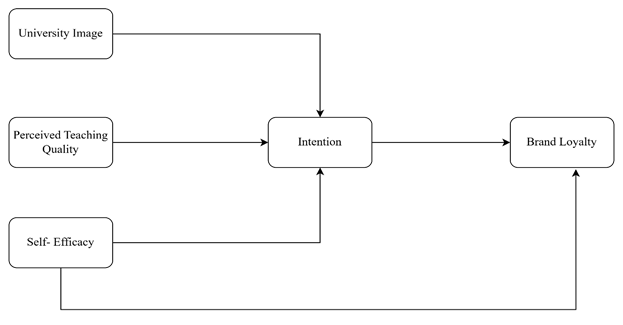
Through a systematic analysis of the components comprising the Theory of Planned Behavior (TPB) developed by Ajzen (1985), namely attitude (University image), subjective norm (Perceived instruction quality), perceived behavior control (self-efficacy), behavioral intention, and brand loyalty, the objective is to navigate uncharted territory. In this scholarly endeavor, the objective is to shed light on the trajectory leading to a more profound comprehension of the complex interplay of variables that shape student loyalty towards brands inside the higher education institutions of Tanzania. Therefore, the elements of the TPB including attitude (University image), subjective norm (Perceived teaching quality), perceived behavior control (self-efficacy), behavioral intention, and brand loyalty, were selected for the article. Figure 1 represents the Conceptual Framework.
Conceptual Framework
Method
Study Design
The journal article employed a cross-sectional design. This design was chosen for several reasons. Traditionally, in consumer research, the cross-sectional design is more relevant than other types of research design. A self-administered questionnaire was utilized to obtain the data, and probability sampling was employed instead of non-probability sampling (Sekaran & Bougie, 2016), and analysis was done through the use of SMART PLS 4 (Hair & Alamer, 2022).
Population and Sampling
Random sampling is used in this study's quantitative research to gather data. By guaranteeing that the sample size from each stratum corresponds to its population proportion, proportionate stratified sampling improves precision without incurring additional expenses. With an estimated 30,0000 students (TCU, 2023). There were five universities for data collection data as follow: Ardhi University, University of Dar es Salaam, Muhimbili University of Health and Allied Sciences, Mzumbe University, and Sokoine University of Agriculture. The target population consists of local students ages 18 and up who are enrolled in public universities in Mainland Tanzania (Tanzania Commission for Universities [TCU], 2024). These universities reflect the larger national population by providing a range of programs and representing different socioeconomic categories (TCU, 2023). 1,000 questionnaires were distributed across five public universities in Tanzania, receiving 400 valid responses for analysis using Structural Equation Modeling.
Unit of Analysis
The analysis focuses on individual local students enrolled in public universities in Tanzania. Questionnaires were distributed to students with over a year of experience at their current institution, including both undergraduate and postgraduate students studying full- or part-time. These students were selected for their familiarity with university facilities and environment, enabling them to provide insights into factors influencing brand loyalty. This approach aligns with prior service marketing research in higher education, which considers semester and education levels (Ramli, 2016).
Data Collection Procedure
Marketing experts frequently employ intercept surveys to gather participant opinions and experiences. In earlier research, intercept surveys have been related to random sampling as well as convenience sampling because they reduce demographic characteristic variations (Kotler et al., 2022). This study employed an intercept survey to gather data.
Measures
This journal article looked at five constructs. These include brand loyalty, self-efficacy, intention, perceived teaching quality, and university image. Each construct was measured using items that were changed to fit the current study's setting and derived from earlier studies. A summary of the items and their sources is provided in Table 1.
Measurement Units
|
Variables (Measurement Tool) |
Number of items |
Reliability |
Sources |
|
University image |
7 items |
AVE > 0.5, CR-Coefficient > 0.70, α = 0.922 |
|
|
Perceived teaching quality |
7 items |
AVE > 0.5, CR-Coefficient > 0.70, α = 0.91 |
|
|
Self-Efficacy |
10 |
AVE > 0.5, CR-Coefficient > 0.70, α = 0.94 |
|
|
Intention |
8 |
AVE > 0.5, CR-Coefficient > 0.70, α = 0.859 |
|
|
Brand loyalty |
8 |
AVE > 0.5, CR-Coefficient > 0.70, α = 0.904 |
In Table 1: All the measurements are adapted from the source shown in the table.
Ethical Considerations
The Directorate of Research and Postgraduate Studies (DRPS) at Mzumbe University, through its ethical and research committee, granted approval for this study before the commencement of data collection. Furthermore, written consent from respondents to participate in the survey was obtained at the outset. The study adhered to ethical guidelines by acknowledging all data sources and ensuring the respondents' anonymity.
Results
The Findings section of this study is divided into two critical components, each offering valuable insights into the research outcomes and their broader implications. These components include the Measurement Model Evaluation, and Evaluation of the Structural Model. The Measurement Model Evaluation serves as the foundation for assessing the reliability and validity of the constructs employed in the study. Using metrics such as Composite Reliability (CR) and Average Variance Extracted (AVE), this subsection evaluates the robustness of the research model. These measures ensure that the constructs are both consistent and capable of capturing the intended theoretical concepts. By establishing the reliability and validity of the model, this subsection strengthens the credibility of the study’s findings and provides a solid basis for subsequent analysis.
Measurement Model Evaluation
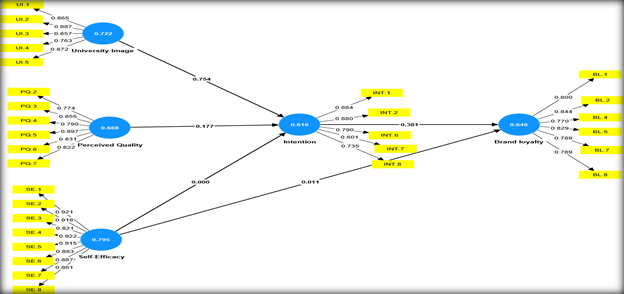
In Table 2, the outer loadings of the observed variables for each latent construct were examined to assess indicator reliability. Loadings greater than .70 are considered acceptable, indicating that the indicators reliably measure their respective constructs (Hair & Alamer, 2022). These values demonstrate excellent indicator reliability. All loadings were within the acceptable range, confirming the construct's measurement reliability and validity. Figure 2 shows the measurement model.
Measurements Model
Outer Loadings- Matrix
|
Brand loyalty |
Intention |
Perceived Quality |
Self-Efficacy |
University Image |
|
|
.80 |
|||||
|
.84 |
|||||
|
.77 |
|||||
|
.82 |
|||||
|
.78 |
|||||
|
.78 |
|||||
|
.88 |
|||||
|
.88 |
|||||
|
.79 |
|||||
|
.70 |
|||||
|
.73 |
|||||
|
.77 |
|||||
|
.85 |
|||||
|
.79 |
|||||
|
.89 |
|||||
|
.83 |
|||||
|
.82 |
|||||
|
.92 |
|||||
|
.91 |
|||||
|
.82 |
|||||
|
.92 |
|||||
|
.91 |
|||||
|
.88 |
|||||
|
.88 |
|||||
|
.86 |
|||||
|
.86 |
|||||
|
.88 |
|||||
|
.85 |
|||||
|
.76 |
|||||
|
.87 |
|||||
In Table 3 the constructs demonstrate strong reliability, as evidenced by high Cronbach's alpha and composite reliability values. The AVE scores further confirm convergent validity, with all values exceeding the recommended threshold of .50 (Fornell & Larker, 1981). These results indicate that the measurement model is reliable and valid, providing a strong foundation for subsequent structural analysis.
Construct Reliability and Validity
|
|
Cronbach's alpha |
Composite reliability (rho _a) |
Composite reliability (rho c) |
Average variance extracted (AVE) |
|
Brand loyalty |
.89 |
.89 |
.91 |
.64 |
|
Intention |
.84 |
.87 |
.88 |
.61 |
|
Perceived Quality |
.90 |
.91 |
.92 |
.68 |
|
Self-Efficacy |
.96 |
.96 |
.96 |
.79 |
|
University Image |
.90 |
.91 |
.92 |
.722 |
In Table 4, the results demonstrate that all constructs meet the Fornell-Larcker criterion for discriminant validity. Each construct's square root of AVE is greater than its correlations with other constructs, indicating that the constructs are distinct and measure different concepts effectively (Fornell & Larker, 1981).
Discriminant Validity -Fornell -Lacker Criterion
|
|
Brand loyalty |
Intention |
Perceived Quality |
Self-Efficacy |
University Image |
|
Brand loyalty |
.80 |
||||
|
Intention |
.37 |
.78 |
|||
|
Perceived Quality |
.28 |
.56 |
.82 |
||
|
Self-Efficacy |
-.10 |
-.29 |
-.41 |
.89 |
|
|
University Image |
.39 |
.84 |
.51 |
-.30 |
.85 |
Evaluation of the Structural Model
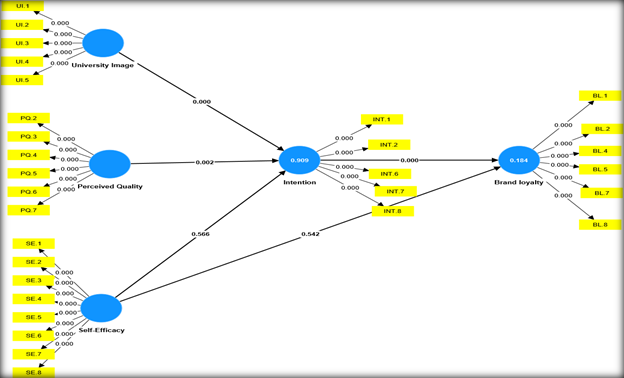
The structural model provides the results of the path coefficients, specifically, Hypotheses H1 to H5. These findings, as shown in Table 5, support the existence of a substantial association between the intention to enroll in Public Higher Education Institutions (PubHEIs) and brand loyalty.
In Table 5 the results reveal significant positive relationships for H1, H4, and H5, emphasizing the influence of Intention on Brand Loyalty, Perceived Quality on Intention, and University Image on Intention. However, H2 and H3 are not supported, suggesting that Self-Efficacy does not significantly influence Intention or Brand Loyalty in this model. The aforementioned findings shed light on the complex network of relationships within the structural model (Figure 3), emphasizing the interaction between different elements that impact students' intents and loyalty towards Public Higher Education Institutions (PubHEIs).
Path Coefficient – Mean, STDEV-T-Statistics-P Values
|
|
Original sample (O) |
M |
SD |
t |
p |
|
H1: Intention -> Brand loyalty |
.43 |
.44 |
.05 |
8.09 |
.000 |
|
H4: Perceived Quality -> Intention |
.15 |
.15 |
.05 |
3.03 |
.002 |
|
H3: Self-Efficacy -> Brand loyalty |
.03 |
.03 |
.05 |
.60 |
.542 |
|
H2: Self-Efficacy -> Intention |
.01 |
.01 |
.03 |
.57 |
.566 |
|
H5: University Image -> Intention |
.86 |
.86 |
.03 |
24.79 |
.000 |
Structural Model
In Table 6 the results indicate that the predictors of Intention explain a substantial proportion of its variance. whereas the predictors of Brand Loyalty explain a smaller but significant proportion. These findings provide valuable insights into the strengths and weaknesses of the structural model's explanatory capacity.
R-Square
|
|
Original sample (O) |
M |
SD |
t |
p |
|
Brand loyalty |
.18 |
.19 |
.04 |
4.32 |
.000 |
|
Intention |
.90 |
.91 |
.03 |
28.36 |
.000 |
Discussion
Intentions and Brand Loyalty
The hypothesis H1, which proposes a substantial correlation between intention and brand loyalty, has garnered robust empirical evidence. The statistical analysis revealed a strong and significant relationship between intention and brand loyalty (t = 8.09, p < .001), indicating a large impact of intention on brand loyalty. Consequently, H1 was completely confirmed (Irshad et al., 2024). Hardcastle et al. (2025) emphasize the importance of understanding evolving student expectations to develop effective communication strategies that boost engagement. Abbas (2019) frames higher education institutions as service providers, with students as customers, supported by accreditation bodies and consultancy firms for informed decision-making. Sang and Cuong (2025) highlight the strategic importance of delivering exceptional brand experiences to enhance customer loyalty. This study aligns with the insights of (Hardcastle et al., 2025; Irshad et al., 2024; Sang & Cuong, 2025).
Self-Efficacy and Intentions
The article findings of hypothesis H2, which propose a substantial association between self-efficacy and intention, did not receive empirical backing. The statistical analysis revealed that the path coefficient between self-efficacy and Intention did not reach statistical significance (t = .57, p > .1). Consequently, H2 was rejected. Nurhikmah et al. (2023) highlight that students with higher self-efficacy in computer skills consistently achieve better learning outcomes compared to those with lower self-efficacy and that blended learning significantly enhances academic performance in higher education. Similarly, Cooper-larsen (2020) emphasizes that using AI technology effectively boosts students' self-efficacy in sales presentations while also improving key vocal delivery skills such as pitch, pace, volume, and pauses. This study is contrary to studies (Dwi Lestari et al., 2022; Latip et al., 2022; Ndiango et al., 2024; Pérez-Fuentesa et al., 2020) which underscore self-efficacy as a significant predictor of motivation, effort, performance, perseverance, retention, and enrollment.
The interplay between self-efficacy and intentions emerges through the competencies and determination of local students. With robust self-efficacy, these students navigate academic, social, and financial challenges effectively, deriving greater satisfaction from their university experience. Their prior academic achievements further bolster loyalty to their institutions. Ramuthivheli, (2022) supports the idea that satisfaction with institutional services influences students' enrollment intentions. While self-efficacy is important, universities must also address students' diverse needs by offering guidance on regulations, codes of behavior, and exam protocols. This approach helps create a supportive environment that nurtures self-efficacy, fostering a more empowered and committed student community. The study underscores the significant impact of self-efficacy on students' goals and long-term dedication, highlighting the essential role of universities in supporting students' intellectual development.
Self-Efficacy and Brand Loyalty
The present journal article aims to explore the relationship between self-efficacy and brand loyalty, focusing on the unexplored aspects of this association. During the investigation of hypothesis H3, the results of the study deviated from anticipated findings, as they failed to reveal a statistically significant association between self-efficacy and brand loyalty. H3, which proposed a substantial association between self-efficacy and brand loyalty, encountered a comparable outcome. The statistical analysis revealed that the path coefficient between self-efficacy and brand loyalty did not reach statistical significance (t = .76, p > 0.1). Consequently, H3 was rejected. The present finding, which is somewhat surprising, seems to contradict previous studies (Campbell & Batista, 2023; Efendi et al., 2021; Omoro & Possi, 2022; Rosli & Saleh, 2022; Samuel & Warner, 2021; Shone et al., 2024). These earlier studies had established associations between self-efficacy and loyalty or behavior. Nevertheless, it is important to acknowledge that previous studies have predominantly concentrated on the perception of self-efficacy, which includes motivation and problem-solving ability, as significant determinants of behavioral intention. However, this study could not provide direct validation of the correlation between self-efficacy and loyalty or conduct.
An analysis of descriptive data reveals that Tanzanian public university students, primarily aged 18 to 25, face challenges like academic pressures, financial stress, and time management while being separated from family support. Emotional support from universities, along with social and familial connections, is key to fostering student loyalty. While self-efficacy does not directly correlate with brand loyalty, emotional attachment mediates this relationship. Students with low self-confidence may struggle but targeted university initiatives can help build essential skills. Addressing academic challenges through interventions like time management training can empower students. These findings highlight the importance of emotional bonds and institutional support in enhancing student loyalty, challenging traditional assumptions about self-efficacy and brand loyalty.
Perceived Teaching Quality and Intentions
This study examines the relationship between perceived teaching quality and student intentions. On the other hand, H4, which posits a substantial correlation between perceived teaching quality and intention, received robust empirical backing. The overall impact of perceived teaching quality on intention was shown to be statistically significant (t = 3.03, p < 0.001), indicating a substantial relationship between these two variables. Consequently, H4 was unequivocally confirmed. These findings align with prior research by Feng (2024). A key factor in fostering a strong emotional connection between students and their universities is their favorable perception of teaching quality and learning experiences. Notably, the ability of educators to make courses engaging by incorporating innovative methods, effective use of technology, and captivating instructional resources emerged as critical. Strategies such as the use of information and communication technology (ICT) and creative pedagogy enhanced students' learning experiences and deepened their emotional ties to their institutions. These practices also allowed international students to derive genuine satisfaction from their educational journeys. The study was contrary to the current findings (Dalik, 2024)
This study highlights the crucial role of perceived teaching quality in shaping students' perceptions and fostering emotional connections with their institutions. Beyond meeting academic standards, universities must enhance teaching quality to improve alumni employability. Factors like lectures, assessment methods, and academic support significantly influence teaching excellence and emotional attachment. Perceived teaching quality is a key predictor of emotional brand attachment in higher education, aligning with Fishbein and Ajzen (1975). Theory of Planned Behavior. High-quality instruction and enriching experiences shape students' attitudes and intentions, with exceptional teaching fostering strong ties to universities. The research underscores the transformative impact of exemplary teaching on student intentions and emotional loyalty.
University Image and Intentions
This study explored the relationship between university image and individual intention, revealing the empirical evidence strongly supports H5, indicating a substantial correlation between University Image and intention. The overall impact of University Image on Intention was found to be highly significant (t = 24.79, p < .001), providing strong evidence of a significant association between university image and intention. Thus, it may be concluded that H5 has been conclusively confirmed. Aligned to prior researchers (Elansari & Alzubi, 2024; Khan, 2024; Nguyen & Saleem, 2024; Shegia & Facultad, 2024) which affirmed the significant influence of image on intention, the current results did support this hypothesis. While respondents generally viewed public universities positively, as indicated by favorable mean scores, this perception did strongly predict their intentions. Notably, factors such as future employment opportunities, degree recognition, and university rankings had minimal impact on loyalty. Instead, safety, tranquility, and financial considerations, including tuition fees and living costs, emerged as key influences on student commitment. These findings challenge established notions, offering new insights into the complexities of student loyalty in Tanzanian higher education and addressing a gap in marketing literature related to nonprofit organizations. The current findings are contrary to Liang et al (2024) findings.
Conclusion
This article explores the complex relationship between local students' perceptions of university services, focusing on brand loyalty and student retention in Tanzanian public higher education institutions. The study examines how university image, perceived teaching quality, and self-efficacy influence students' intentions and loyalty. The findings highlight the significant impact of university image and teaching quality, with self-efficacy found to be insignificant. Intention is identified as a key predictor of brand loyalty. The study emphasizes the importance of universities enhancing their image, improving teaching quality, and strengthening connections with local students to foster brand loyalty. It suggests that universities should adopt strategies to build lasting emotional ties, ensuring sustained student allegiance and long-term institutional success.
References
Abbas, S. A. (2019). Brand loyalty of higher education institutions. Marketing and Management of Innovations, 23529(2), 1–45. https://doi.org/10.21272/mmi.2019.1-04
Ajzen, I. (1985). From intentions to actions: A theory of planned behavior. In J. Kuhl & J. Beckman (Eds.), Action control: From cognition to behavior (pp. 11-39). Berlin: Springer-Verlag.
Amani, D. (2022a). Demystifying factors fueling university brand evangelism in the higher education sector in Tanzania: A social identity perspective. Cogent Education, 9(1). https://doi.org/10.1080/2331186X.2022.2110187
Amani, D. (2022b). The student psychological contract as a predictor of university brand evangelism in Tanzanian higher education: Insights from social exchange theory. International Journal of African Higher Education, 9(2), 151–170. https://doi.org/10.6017/ijahe.v9i2.15379
Aziz, M. W. A. El, Tantaw, P., Arslan, M., & Nagdy, H. M. (2024). Impact of social media marketing on brand loyalty, through the mediating role of customer experience : An applied study in the Egyptian private hospitals. Journal of Elecrtrical Systems, 20(5s), 1736–1746. https://doi.org/10.52783/jes.2508
Bandura, A., Caprara, G. V., Barbaranelli, C., Gerbino, M., & Pastorelli, C. (2003). Role of affective self-regulatory efficacy in diverse spheres of psychosocial functioning. Child Development, 74(3), 769–782. https://doi.org/10.1111/1467-8624.00567
Campbell, C. W., & Batista, B. (2023). To peer or not to peer: A controlled peer-editing intervention measuring writing self-efficacy in South Korean higher education. International Journal of Educational Research Open, 4(December 2022), 100218. https://doi.org/10.1016/j.ijedro.2022.100218
Carvalho, L. (2019). Understanding the importance of EWOM on higher education institutions’ brand equity. Journal of Marketing for Higher Education, 31(2), 261–279. https://doi.org/10.1080/08841241.2020.1788196
Chalupa, M. J., & Sousa, B. B. (2025). Digital Branding and Relational Marketing in Online Consumer Loyalty. In Impacts of Technology on Operations Management: Adoption, Adaptation, and Optimization (pp. 293-312). IGI Global.
Cooper-larsen, D. (2020). Using an artificial real-time response audience in online sales education to improve self-efficacy in sales presentations: an online classroom innovation. Atlantic Marketing Journal, 9(2). https://digitalcommons.kennesaw.edu/amj/vol9/iss2/2
Dalik, A. G. (2024). Reputation management at highly ranked business schools in the United States [Doctoral dissertation, University of Pennsylvania]. https://www.proquest.com/openview/088010c1186188c7158e58df5f3a0848/1.pdf?cbl=18750&diss=y&pq-origsite=gscholar
Dangaiso, P., Makudza, F., & Hogo, H. (2022). Modelling perceived e-learning service quality, student satisfaction and loyalty. A higher education perspective. Cogent Education, 9(1). https://doi.org/10.1080/2331186X.2022.2145805
Deng, L., Liu, F., He, J., Yin, W., & Kong, X. (2022). Exploring the influences of virtual brand community members ’ interaction on brand loyalty. South African Journal of Information Management, 26(1), 1–13. https://doi.org/10.4102/sajim.v26i1.1814
Dwi Lestari, E., Rizkalla, N., & Purnamaningsih, P. (2022). The Effect of perceived university support, entrepreneurial self-efficacy and proactive personality in promoting student entrepreneurial intention in Indonesia. Journal of Management and Business Education, 5(2), 169–197. https://doi.org/10.35564/jmbe.2022.0011
Efendi, A., Asdar, M., Parawansa, D., & Reni, A. (2021). The effect of self-efficacy and students' expertise on value co-creation activity at higher education in Makassar. International Journal of Innovative Science and Research Technology, 6(6), 1408-1413. https://ijisrt.com/assets/upload/files/IJISRT21JUN1101.pdf
Elansari, H., & Alzubi, A. (2024). The impact of United Nations Sustainable Development Goals on customers ’ perceptions and loyalty in the banking sector : A multi-mediation approach. Sustainabiity, 16(8276). https://doi.org/10.3390/su16188276
Elnadi, M., & Gheith, M. H. (2021). Entrepreneurial ecosystem, entrepreneurial self-efficacy, and entrepreneurial intention in higher education: Evidence from Saudi Arabia. International Journal of Management Education, 19(1), 100458. https://doi.org/10.1016/j.ijme.2021.100458
Feng, J. (2024). Factors influencing the quality of higher vocational education in Chengdu during the COVID-19. Human Sciences, 16(2), 10–20.
Fishbein, A., & Ajzen., I. (1975). Belief, attitude, intention, and behavior: An Introduction to Theory and Research. Philosophy and Rhetoric, 10 (2), 130–132.
Fornell, C., & Larker, D. (1981). Evaluating structural equation models with unobservable variables and measurement error. Journal of Marketing Research, 18(1), 39–50.
Gardiana, M. D., Rahmanto, A. N., & Satyawan, I. A. (2023). International branding of higher education institutions towards world-class universities: Literature study in 2017-2022. Journal of Social and Political Sciences, 6(1). https://doi.org/10.31014/aior.1991.06.01.392
Hair, J. F., & Alamer, A. (2022). Partial Least Squares Structural Equation Modeling (PLS-SEM) in Second language and education research: Guidelines using an applied example. Research Methods in Applied Linguistics, 1(100027).
Hardcastle, K., Edirisingha, P., Cook, P., & Sutherland, M. (2025). The co-existence of brand value co-creation and co-destruction across the customer journey in a complex higher education brand. Journal of Business Research, 186(September 2024), 114979. https://doi.org/10.1016/j.jbusres.2024.114979
Irshad, O., Ahmad, S., & Mahmood, S. (2024). Fostering purchase intentions through CSR and service quality : The role of customer satisfaction, brand loyalty, and admiration. Sustainabiity, 16(10584), 1–20. https://doi.org/10.3390/su162310584
Jasper, K. (2024). Exploring How higher education administrators can overcome narrowing net tuition revenues to remain viable–A qualitative study. Trevecca Nazarene University. Available from Publicly Available Content Database. (2911060941).
Jiang, S., & Xiao, F. (2024). How teachers contribute to the sustainability of the university brand : Evidence from China. Sustainability, 16(3793), 1–17. https://doi.org/10.3390/su16093793
Kessy, A. T. (2020). Higher education and prospects of graduates’ employability in Tanzania. Journal of Education and Practice, 11(9), 177–187. https://doi.org/10.7176/JEP/11-9-19
Khan, S. R. (2024). The role of corporate identity in university brand image : A case of private universities of Pakistan. Business & Economic Review, 16(1), 29-44. https://doi.org/10.22547/BER/16.1.2
Kotler, P., Keller, K. L., Ang, S. H., Tan, C. T., & Leong, S. M. (2022). Marketing management: an Asian perspective. Pearson Education.
Latip, M. S. A., Masliana Tamrin, I. N., Rahim, F. A., Latip, & Abdul, S. N. N. (2022). Factors affecting e-learning acceptance among students : The moderating effect of self-efficacy. International Journal of Information and Education Technology. https://doi.org/10.18178/ijiet.2022.12.2.1594
Li, A. (2024). The investigation on student satisfaction and loyalty toward online learning during COVID-19: A Case study of a university in Chengdu, China. Human Sciences, 16(1), 89–98.
Liang, J., & Zhang, S., & Lu, L. (2024). Research on the influence of cultural memory in agricultural heritage on brand loyalty. Sustanability, 16(4162). https://doi.org/10.3390/su16104162
Liu, Y. (2024). Factors affecting undergraduate students ’ satisfaction and loyalty with independent institutions in Sichuan, China. AU-GSB e-Journal, 17(2), 164–173. https://doi.org/10.14456/augsbejr.2024.39
Liu, Y., Nam, B. H., & Yang, Y. (2023). Revisiting symbolic power and elite language education in China: a critical narrative ethnography of the English education major at a top language university in Shanghai. Educational Review, 0(0), 1–27. https://doi.org/10.1080/00131911.2023.2184774
Long, L., & Lijia, L. (2024). What drives repurchase retention in music training institutions ? examining the roles of customer satisfaction, perceived value, and service quality. PLoS ONE, 19, 1–19. https://doi.org/10.1371/journal.pone.0312087
Matembo, V., Loisulie, P., & Gabrieli, P. (2024). Exploring predominant marketing strategies for branding higher education institutions in Tanzania. Journal of Management and Policy Issues in Education, 1(2), 22-42. https://doi.org/10.58548/2024.jmpie12.2242
Mazana, M. Y. (2024). Mathematics teaching and learning activity model for blended instructions in Tanzanian higher education [Doctoral dissertation, Itä-Suomen yliopisto].
Minh, H. H. T., Thi, L. T., My, L. N. T., & Trung, K. N. (2025). Strategic brand management in higher education institutions. In building organizational capacity and strategic management in academia. IGI Global, 519–552.
Mohamedy, H. (2023). Catalysts of actual purchase behavior: A theory of planned behavior analysis for local brand products in Tanzania. International Business, Economics and Law Conference, 35–49.
Mushtaque, I., Awais-E-Yazdan, M., & Waqas, H. (2022). Technostress and medical students’ intention to use online learning during the COVID-19 pandemic in Pakistan: The moderating effect of computer self-efficacy. Cogent Education, 9(1). https://doi.org/10.1080/2331186X.2022.2102118
Mzenzi, S. I. (2022). Analysis of the governance frameworks of public universities in Tanzania: What is known and needs knowing? Business Management Review, 25(1), 15–41. https://doi.org/10.56279/bmrj.v25i1.2
Ndiango, S., Kumburu, N. P., & Jaffu, R. (2024). Research self-efficacy and research productivity: evidence from academics in Tanzanian public higher education institutions. Journal of Applied Research in Higher Education, 16(2), 510–522. https://doi.org/10.1108/JARHE-09-2022-0308
Nguyen-Viet, B., Tran, C. T., & Ngo, H. T. K. (2024). Corporate social responsibility and behavioral intentions in an emerging market: The mediating roles of green brand image and green trust. Cleaner and Responsible Consumption, 12(October 2023), 100170. https://doi.org/10.1016/j.clrc.2024.100170
Nguyen, H. V., & Saleem, M. (2024). The influence of service quality on student satisfaction and student loyalty in Vietnam : the moderating role of the university image. Journal of Trade Science, 12(1), 37–59. https://doi.org/10.1108/JTS-12-2023-0032
Nguyen, T. D., Yaghi, M., Ganesh, G., Blankson, C., Paswan, A. K., & Pavur, R. (2024). Diversity, equity, inclusion, and brand outcomes: a case of higher education. Journal of Product & Brand Management, 33(8), 949–967. https://doi.org/10.1108/JPBM-05-2023-4545
Nurhikmah, H. B., Saman, A., & Mawarni, S. (2023). Blended learning and computers self-efficacy (Vol. 1). Atlantis Press SARL. https://doi.org/10.2991/978-2-494069-35-0
Omoro, M., & Possi, M. (2022). Teachers’ inclusive classroom practices: The role of self-efficacy and demographic variables. Papers in Education and Development (PED), 40(2), 51–69.
Pancić, M., Serdarušić, H., & Ćućić, D. (2023). Green marketing and repurchase intention: stewardship of green advertisement, brand awareness, brand equity, green innovativeness, and brand innovativeness. Sustainability (Switzerland), 15(16). https://doi.org/10.3390/su151612534
Pérez-Fuentesa, M. del C., Núñeza, A., Moleroa, M. del M., Núñez, J. J. G. P. R., & C., J. (2020). The role of anxiety in the relationship between self-efficacy and math achievement. Psicología Educativa, 26, 7–13.
Ramli, M. (2016). Determinants of brand loyalty in public higher education institutions in Malaysia: the mediating role of emotional brand attachment. https://doi.org/10.1073/pnas.98.3.848
Ramuthivheli, I. L. (2022). The influence of generation Y students’ perceptions of brand communication, service quality and brand satisfaction on brand loyalty in technical and vocational education training colleges in Gauteng [Master's thesis, Vaal University of Technology, South Africa].
Rosli, M. S., & Saleh, N. S. (2022). Technology enhanced learning acceptance among university students during Covid-19: Integrating the full spectrum of Self-Determination Theory and self-efficacy into the Technology Acceptance Model. Current Psychology, 0123456789. https://doi.org/10.1007/s12144-022-02996-1
Samuel, T. S., & Warner, J. (2021). “I Can Math!”: Reducing math anxiety and increasing math self-efficacy using a mindfulness and growth mindset-based intervention in first-year students. Community College Journal of Research and Practice, 45(3), 205–222. https://doi.org/10.1080/10668926.2019.1666063
Sang, V. M., & Cuong, M. C. (2025). The influence of brand experience on brand loyalty in the electronic commerce sector: the mediating effect of brand association and brand trust. Cogent Business and Management, 12(1). https://doi.org/10.1080/23311975.2024.2440629
Sekaran, U., & Bougie, R. J. (2016). Research methods for business: a skill building approach. John Wiley & Sons.
Shegia, B. Y., & Facultad, C. V. F. R. (2024). Determinants of brand equity in Ecuadorian private universities. International Review of Management and Marketing, 14(5), 67–73. https://doi.org/10.32479/irmm.16701
Shehzadi, S., Nisar, Q. A., Hussain, M. S., Basheer, M. F., Hameed, W. U., & Chaudhry, N. I. (2021). The role of digital learning toward students’ satisfaction and university brand image at educational institutes of Pakistan: a post-effect of COVID-19. Asian Education and Development Studies, 10(2), 276–294. https://doi.org/10.1108/AEDS-04-2020-0063
Shone, E. T., Weldemeskel, F. M., & Worku, B. N. (2024). The role of students’ mathematics perception and self-efficacy toward their mathematics achievement. Psychology in the Schools, 61(1), 103–122. https://doi.org/10.1002/pits.23033
Singh, S. (2024). Impact of service quality, relational trust and attitude on the intention to pursue higher education within a country, than abroad. International Journal of Educational Management, 38(7), 2034–2049. https://doi.org/10.1108/IJEM-06-2023-0300
Sullivan, H. O., Polkinghorne, M., Chapleo, C., & Cownie, F. (2024). Contemporary branding strategies for higher education. Encyclopedia, 4, 1292–1311.
Tanzania Commission for Universities [TCU]. (2024). University institutions approved to operate in Tanzania as of February 22, 2024 (Issue January).
TCU. (2023). Vital Stats on University Education in Tanzania 2022. In The Tanzania Commission for Universities. https://doi.org/10.1080/07311768308800049
Vuong, B., Chi, H., Luc, D. A., Yuan, S., & Liu, Y. (2024). The moderating effect of the school’s policies on school’s characteristics and university’s brand equity in Viet Nam. International Review of Management and Marketing, 15(1), 168–178. https://doi.org/10.32479/irmm.17565
Wu, S. H., Huang, S. C. T., & Tsai, C. Y. D. (2022). Lifelong good soldiers of higher education institutions: driving factors and obstructions of alumni loyalty. Service Business, 16(2), 331–357. https://doi.org/10.1007/s11628-021-00475-4
Zhai, W. (2022). The antecedents of student satisfaction and loyalty in public universities in Zhejiang, China. AU-GSB e-Journal, 15(2), 196–205.

Page 1 of
Download Count : 42
Visit Count : 336
Keywords
Self-Efficacy; University Image; Perceived Teaching Quality; Brand Loyalty


Author(s) Information

How to cite tis article
Mushi, H. M. (2025). Enhancing brand loyalty in Tanzanian public higher education institutions. Marketing and Branding Research, 12(1), 21-38. https://doi.org/10.32038/mbr.2025.12.01.02
Acknowledgments
Not applicable.
Funding
Not applicable.
Conflict of Interests
No, there are no conflicting interests.
Open Access
This article is licensed under a Creative Commons Attribution 4.0 International License, which permits use, sharing, adaptation, distribution and reproduction in any medium or format, as long as you give appropriate credit to the original author(s) and the source, provide a link to the Creative Commons license, and indicate if changes were made. You may view a copy of Creative Commons Attribution 4.0 International License here: http://creativecommons.org/licenses/by/4.0/