






Original Research
The Employee Suggestion System with an Approach to Reduce Organizational Silence: A Meta-Synthesis Study


- Abstract
- Full text
- Metrics
In today's complex organizational environments, silence is widely recognized as a critical barrier to innovation, productivity, and effective decision-making. This silence often stems from a fear of negative consequences, a lack of trust in leadership, hierarchical organizational cultures, and the absence of transparent and secure communication channels. Employees who refrain from speaking up may do so to avoid conflict, retaliation, or marginalization, which diminishes feedback loops, creativity, and active engagement within organizations. When strategically designed and well-executed, suggestion systems provide a structured, anonymous, and supportive mechanism for capturing employee voice. These systems play a vital role in disrupting the silence cycle and fostering a culture of participation. This study employed a qualitative meta-synthesis method to review and integrate findings from 35 scientific articles focused on organizational silence and employee suggestion systems. Articles were selected using rigorous screening criteria and assessed through CASP to ensure methodological soundness. The analysis revealed that silence arises due to managerial, individual, and cultural causes. It also highlighted how suggestion systems act not merely as feedback tools, but as strategic enablers of organizational learning and adaptive behavior.
Taher Javadi*, Farzad Sattari Ardabili
Department of Management, Ard.C, Islamic Azad University, Ardabil, Iran
ABSTRACT:
In today's complex organizational environments, silence is widely recognized as a critical barrier to innovation, productivity, and effective decision-making. This silence often stems from a fear of negative consequences, a lack of trust in leadership, hierarchical organizational cultures, and the absence of transparent and secure communication channels. Employees who refrain from speaking up may do so to avoid conflict, retaliation, or marginalization, which diminishes feedback loops, creativity, and active engagement within organizations. When strategically designed and well-executed, suggestion systems provide a structured, anonymous, and supportive mechanism for capturing employee voice. These systems play a vital role in disrupting the silence cycle and fostering a culture of participation. This study employed a qualitative meta-synthesis method to review and integrate findings from 35 scientific articles focused on organizational silence and employee suggestion systems. Articles were selected using rigorous screening criteria and assessed through CASP to ensure methodological soundness. The analysis revealed that silence arises due to managerial, individual, and cultural causes. It also highlighted how suggestion systems act not merely as feedback tools, but as strategic enablers of organizational learning and adaptive behavior.
KEYWORDS: Organizational Silence, Suggestion System, Meta-Synthesis Approach, Organizational Culture, Rewarding Suggestions
Organizational silence is an important concept in organizational behavior and management (Brinsfield & Edwards, 2020; Ghanbari & Beheshti Rad, 2017). In environments where a culture of silence prevails, opportunities for organizational learning and innovation are frequently missed, distrust becomes widespread, and leadership decisions often lack diverse and critical perspectives (Dedahanov et al., 2016).
Recent research has offered deeper insights into the nature of silence in various settings. Zou et al. (2025) identified four types of silence among nurses: defensive, disregardful, acquiescent, and prosocial. They argue that silence is often a psychological and cultural response to perceived risks or systemic barriers. Song and Cho (2025) employed a hierarchical linear model to demonstrate that factors such as organizational size, mentoring systems, intrinsic motivation, and surface acting have a significant influence on different types of silence, particularly in public service environments. Additionally, Mahar et al. (2024) emphasized that transformational leadership, mediated by trust in leadership, significantly reduces organizational silence and promotes proactive voice behavior, especially in resource-limited settings. Collectively, these findings highlight the importance of comprehensive strategies that include leadership development, employee support, and organizational reforms to address the complex nature of workplace silence.
Van Dyne et al. (2003) describe silence as a multidimensional construct comprising acquiescent, defensive, and prosocial types, each driven by distinct motives. These silences differ from mere silence, as they are shaped by contextual factors such as authoritarian leadership and a lack of transparency.
Leaders who react negatively to employee feedback or do not promote open communication can undermine trust and heighten fears of retaliation, ultimately encouraging employee silence (Knoll et al., 2016; Tanhaei et al., 2018). A lack of an inclusive communication climate fostered by managers increases staff anxiety and disengagement (Petrič & Orehek, 2024; Salavatian et al., 2017). At the individual level, concerns such as fear of criticism, worries about negative repercussions, and perceived job insecurity deter employees from voicing their opinions. Additionally, job burnout significantly contributes to silence by diminishing involvement in organizational discussions (Alhojairi et al., 2024; Takhsha et al., 2020). Cultural factors are also crucial. In a closed organizational environment where expressing concerns is neither encouraged nor considered safe, norms of silence are reinforced (Morrison & Milliken, 2000). In such cultures, critique and feedback are often perceived as disloyalty or dissent, thereby perpetuating organizational silence (Dupret, 2019; Yu et al., 2022).
The suggestion system is recognized as an effective management tool for reducing organizational silence by fostering psychological safety—an environment where employees feel safe to share ideas without fearing negative consequences (Edmondson, 1999; Focus HR, 2024). When combined with recognition and rewards, such systems promote participation and encourage open communication across all organizational levels.
By delivering transparent and motivating feedback, such systems have the potential to shift organizational culture from silence to dialogue and open interaction (Sharma et al., 2021). When well-designed, suggestion systems reinforce the perception that employee input is valued and has an impact on shaping organizational decisions (Sarwono & Tao, 2024).
These systems hold significant value in environments characterized by a culture of silence. By guaranteeing confidentiality and reducing the anxiety associated with potential repercussions, employees feel more empowered to express their concerns and ideas (Dupret, 2019; Yu et al., 2022). In organizations that implement digital suggestion platforms, the usability and accessibility of these tools are crucial for their success. Features such as user-friendly designs and options for anonymous submissions help mitigate psychological and procedural obstacles, thereby increasing employee engagement and involvement (Tanhaei et al., 2018).
Necessity of Research
Although organizational silence is widely recognized as a barrier to innovation and participation, existing research often examines it in isolation, either through managerial, individual, or cultural perspectives. Despite scattered references to suggestion systems, few studies have systematically investigated their role as a structured approach to reducing silence. The literature lacks an integrated model that combines psychological safety, participation incentives, and communication mechanisms within suggestion systems.
Additionally, previous findings are fragmented and vary across contexts, providing limited theoretical clarity on how suggestion systems mitigate silence in practice. Consequently, organizational leaders lack practical frameworks for designing and implementing effective voice-enabling structures.
This study addresses this gap by employing a qualitative meta-synthesis approach to synthesize insights from 35 empirical studies. It aims to create a comprehensive conceptual framework that demonstrates how suggestion systems can foster openness, establish trust, and ultimately mitigate organizational silence.
Literature Review
Organizational silence is a complex phenomenon in which employees intentionally withhold opinions, concerns, or suggestions due to fear of negative repercussions, a lack of trust, or organizational norms that discourage dissent (Brinsfield & Edwards, 2020; Dedahanov et al., 2016). This behavior disrupts communication, suppresses innovation, and undermines effective decision-making (Shojaie et al., 2011; Dehkharghani et al., 2022). Research has identified various triggers of silence, including authoritarian leadership (Mehdizadeh et al., 2024), job insecurity (Alhojairi et al., 2024), and rigid hierarchical structures (Erfanian Khanzadeh, 2021).
In contrast, suggestion systems serve as organized management tools that enable employees to share their ideas, feedback, and concerns in a psychologically safe and constructive manner (Afkhami Ardakani et al., 2021; Sharma et al., 2021). When these systems are well-designed with features such as confidentiality, constructive feedback, and meaningful rewards, they foster a culture of openness and trust (Edmondson, 1999; Sarwono & Tao, 2024). They not only promote proactive communication but also serve as early warning systems for spotting organizational issues (Dupret, 2019; Yu et al., 2022).
Empirical evidence indicates that well-implemented suggestion systems boost organizational performance, increase employee engagement, and foster a more participatory culture (Buech et al., 2010; Hashemi et al., 2012). They enhance employees’ sense of ownership and responsibility, promoting continuous improvement and innovation (Fallah et al., 2014).
Although the benefits of suggestion systems are recognized, most studies have focused only on their effects in specific or limited settings. A thorough synthesis that combines these findings and examines how suggestion systems help reduce organizational silence is missing, underscoring the need for this meta-synthesis.
Recognizing the importance of these two concepts, numerous studies have examined the factors that contribute to organizational silence and how suggestion systems can help mitigate it. However, these studies often look at the two concepts separately or only within limited organizational settings, which results in a fragmented understanding. There is a clear gap in the literature for a unified framework that explains how suggestion systems can systematically reduce silence and boost employee engagement.
This study addresses that gap by conducting a meta-synthesis of Persian and English articles from 2010 to 2024, as shown in Table 1.
Analysis and Review of Persian and English Articles Published Between 2010 and 2024.
|
Ref. |
Research Objective |
Methodology |
Key Findings |
|
Investigate the impact of organizational silence on reducing team collaboration and organizational performance. |
Quantitative, Case Study |
Organizational silence leads to reduced team performance and decreased organizational productivity. |
|
|
Identify factors affecting employee organizational silence in the media sector. |
Qualitative, Content Analysis |
Lack of managerial transparency and fear of criticism were identified as the main factors of organizational silence. |
|
|
Provide a model for examining the consequences and antecedents of organizational silence. |
Qualitative, Grounded Theory |
Organizational silence reduces trust and increases distrust within organizations. |
|
|
Analyze the phenomenon of organizational silence from employees' perspectives. |
Qualitative, Phenomenology |
Authoritarian management style and closed organizational climate reinforce employee silence. |
|
|
Investigate the relationship between organizational silence and practical communication components. |
Quantitative, Survey |
Lack of effective communication leads to the spread of organizational silence. |
|
|
Examine the role of suggestion systems in reducing organizational silence. |
Mixed Methods |
Suggestion systems reduce organizational silence by creating a safe environment. |
|
|
Identify factors affecting the successful implementation of suggestion systems. |
Quantitative, Survey |
Rewarding and transparent processes are key factors in the success of suggestion systems. |
|
|
Analyze the role of creativity training in increasing the effectiveness of suggestion systems. |
Quantitative, Quasi-Experimental |
Creativity training increases employee participation in suggestion systems. |
|
|
A comprehensive review of components affecting the productivity of suggestion systems. |
Qualitative, Review |
Simple design, transparent feedback, and reward provision enhance the efficiency of suggestion systems. |
|
|
Analyze the role of mental health in using suggestion systems. |
Qualitative, Content Analysis |
Employee mental health has a direct impact on their participation in suggestion systems.
|
|
|
Ref. |
Research Objective |
Methodology |
Key Findings |
|
Investigate the possibility of implementing participatory management through suggestion systems. |
Quantitative, Survey |
Suggestion systems can lay the groundwork for participatory management in organizations. |
|
|
Identify the challenges of organizational silence in human resource management. |
Qualitative, Grounded Theory |
Organizational silence leads to reduced transparency and decreased interactions within organizations. |
|
|
Examine the role of suggestion systems in improving organizational transparency. |
Quantitative, Survey |
The use of suggestion systems enhances organizational transparency and efficiency. |
|
|
Identify the dimensions and components of organizational silence. |
Mixed Methods |
Managerial, individual, and cultural factors directly impact organizational silence. |
|
|
Examine organizational silence as a potential for organizational change |
Qualitative, Theorizing |
Silence can be used as a tool for positive changes in organizations. |
|
|
Examine employee voice and organizational silence in organizational behavior. |
Review, Theoretical Analysis |
Employee silence often stems from power structures and a lack of transparency in organizations. |
|
|
Analyze the role of silence as a mediator between organizational factors and stress. |
Quantitative, Survey |
Organizational silence can significantly increase employee stress levels. |
|
|
Analyze the infrastructures of organizational silence and provide solutions to reduce it. |
Qualitative, Content Analysis |
Closed organizational culture and lack of managerial support are the main factors of organizational silence. |
|
|
Review organizational silence and provide research suggestions. |
Review, Literature Analysis |
More research is needed to understand organizational silence in different environments better. |
|
|
Examine the impact of perceived job risk on organizational conflicts. |
Quantitative, Survey |
Organizational silence can increase conflicts in high-risk environments such as the tourism industry. |
|
|
Evaluate the reasons for job silence among nurses. |
Qualitative, Case Study |
Fear of negative consequences and an unsuitable organizational climate are the main reasons for nurses' silence. |
|
|
Analyze the effect of workplace ostracism on knowledge-sharing. |
Quantitative, Survey |
Organizational silence caused by workplace ostracism leads to a reduction in shared knowledge within the organization. |
|
|
Analyze research trends on employee silence and voice in organizations. |
Review, Literature Analysis |
Research on employee silence and voice is expanding, but requires more comprehensive frameworks. |
|
|
Examine the mediating role of organizational silence in the relationship between organizational justice and creativity. |
Quantitative, Survey |
Organizational silence can link perceived organizational justice and employee creativity. |
|
|
Examine employee motivational factors for participating in suggestion systems. |
Quantitative, Survey |
Rewarding and positive feedback are key motivational factors for employee participation. |
|
|
Examine the effect of evaluation and reward on employee motivation in suggestion systems. |
Quantitative, Survey |
Transparent evaluation and fair reward increase employee motivation to provide suggestions. |
|
|
Analyze employee silence regarding information security issues in organizations. |
Qualitative, Theorizing |
Employees often remain silent about security issues due to cultural or managerial reasons. |
|
|
Ref. |
Research Objective |
Methodology |
Key Findings |
|
Provide a usability-based evaluation model in suggestion systems |
Quantitative, Survey |
The user-friendly and straightforward design of suggestion systems increases productivity and employee participation. |
|
|
Examine the effects of employee silence on organizational effectiveness. |
Qualitative, Review |
Organizational silence can lead to a reduction in organizational effectiveness in the dimensions of innovation and decision-making. |
|
|
Analyze the effect of narcissistic leadership on employee cynicism and the mediating role of organizational silence. |
Quantitative, Survey |
Narcissistic leadership leads to increased employee cynicism and organizational silence. |
|
|
Examine the relationship between teachers' organizational silence and organizational memory. |
Quantitative, Survey |
Organizational silence can lead to a reduction in collective memory and teacher interactions. |
|
|
Provide new approaches for designing suggestion systems. |
Review, Theoretical |
Advanced digital systems can improve employee engagement and reduce organizational silence. |
|
|
Explore the experiences and root causes of organizational silence among nurses. |
Qualitative, Meta-synthesis |
Psychological safety, hierarchical culture, and lack of team support drive nurse silence. |
|
|
Examine individual and organizational determinants of four types of employee silence. |
Quantitative, Multilevel Statistical Analysis |
Autonomy and intrinsic motivation reduce silence; mentoring systems also help. Organizational size increases some types of silence. |
|
|
Investigate how transformational leadership reduces organizational silence and the mediating role of trust. |
Quantitative, Structural Equation Modeling (SmartPLS) |
Transformational leadership reduces silence directly and indirectly through trust in leadership. |
The literature review highlights that addressing organizational silence necessitates a holistic strategy considering managerial, individual, and cultural elements. Organizations can boost interactions, improve productivity, and promote innovation by incorporating these elements into a well-organized suggestion system. Ultimately, this will establish an open and transparent organizational culture, enabling effective responses to future challenges.
Method
This research employs the qualitative meta-synthesis method to integrate findings from previous studies. Meta-synthesis is a qualitative research approach that facilitates the development of theoretical frameworks and comprehensive models by systematically combining and analyzing the results of earlier research (Hoon, 2013). This article employed this method to extract and synthesize the factors influencing organizational silence and the role of the suggestion system in mitigating it, drawing on 35 reviewed articles.
We utilized the meta-synthesis method for three reasons. First, its comprehensive approach enabled the collection and integration of findings from various articles, providing a complete understanding of organizational silence and the suggestion system. Second, the method offers a structured format to support a systematic data analysis through clearly defined steps. Lastly, it facilitated the creation of a theoretical framework to outline a conceptual model grounded in the data from the articles. To implement this approach, the research was conducted in several key stages, starting with the formulation of research questions and identifying relevant literature.
Defining the Research Question
In this stage, the research objective and its central questions are defined. The research questions of this article include the following:
- What are the factors affecting organizational silence?
- How can a suggestion system reduce organizational silence?
This stage provides the foundation for all subsequent stages.
Searching for Relevant Articles
Relevant articles were retrieved from Scopus, Google Scholar, Springer, and SID databases using the search terms “organizational silence” and “suggestion systems.” An initial pool of 78 articles was identified. The inclusion criteria were as follows:
· Empirical peer-reviewed journal articles published between 2010 and 2024
· Qualitative or mixed-methods studies that directly addressed at least one of the core research questions
· Articles published in English or Persian with full-text access
· Conceptual papers, book chapters, dissertations, and conference proceedings were excluded to ensure methodological consistency and data quality across sources
After screening based on these criteria, 35 articles were selected for final analysis.
Screening Articles
The retrieved articles were screened based on the following criteria:
· Topical relevance: Articles had to directly address organizational silence or suggestion systems in organizational contexts.
· Research quality, validity, and reliability: Only studies with clearly defined objectives, appropriate qualitative or mixed-method designs (e.g., case studies, interviews, thematic analysis), and transparent data collection and analysis procedures were included. Methodological quality was assessed using adapted criteria from the Critical Appraisal Skills Programme (CASP), including clarity of research questions, sampling logic, ethical considerations, and coherence between data and interpretation. Reliability was evaluated based on evidence of consistent coding procedures, use of triangulation, audit trails, or researcher reflexivity, where applicable.
Studies were excluded if they lacked methodological transparency (e.g., no explanation of data sources, unclear analysis methods), relied solely on anecdotal or opinion-based narratives, or did not report participant data or analytical steps. For example, conceptual essays, editorial commentaries, and qualitative papers with vague descriptions of coding processes were not considered valid or reliable for inclusion.
· Publication date: Only articles published between 2010 and 2024 were reviewed.
After screening, 35 final articles were selected for analysis.
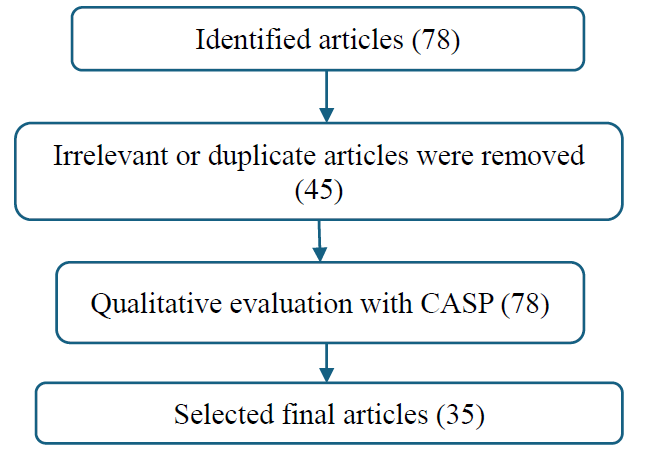
Figure 1 displays the article screening process. Figure 1 would initially include the Initial search to identify 78 articles, followed by the removal of 45 irrelevant or duplicate articles. Were removed. Finally, the articles were qualitatively evaluated using the CASP tool, resulting in the final selection of 35 articles.
Flowchart of Article Screening
To evaluate the research using the CASP[1] With a checklist, the quality of the articles can be systematically examined. This checklist includes criteria that help us assess qualitative and quantitative studies. We also used Cronbach's alpha and Cohen's kappa index to evaluate the reliability of the extracted codes. Cronbach's alpha is a tool for measuring the internal consistency of data. This study calculated Cronbach's alpha for the extracted codes from the articles, which was .89. This value indicates the outstanding reliability of the extracted codes. Values above .7 usually indicate good internal consistency, and .89 indicates strong reliability.
Cohen's kappa index, equal to .85, was also used to examine inter-coder agreement in data analysis. This value indicates very high agreement between coders. Cohen's kappa has values between (-1) and (+1); values above .8 indicate excellent agreement.
Concept Coding
Concept coding in qualitative research, such as meta-synthesis, is a process in which data or textual information (e.g., article findings) are divided into smaller meaningful components, and these components are placed into specific categories based on semantic similarities and differences. This process helps the researcher identify hidden structures and patterns within the data.
The meta-synthesis method begins by extracting initial codes from relevant studies, which are then organized through axial coding. The final codes become the primary output of the research. During the first stage, we conduct open coding; initial codes are drawn directly from the articles' texts. These codes reflect fundamental concepts that are directly taken from the reviewed articles, representing recurring themes and findings in studies on organizational silence and suggestion systems.
Steps for extracting initial codes:
- Careful reading of articles: Each article was read thoroughly, and sections that referred to organizational silence or suggestion systems were identified.
- Identifying key phrases: Phrases such as "fear of criticism," "lack of transparency," and "closed organizational culture" were recorded as initial codes.
- Recording codes: The extracted codes were recorded in a table for each article, and ultimately, 80 initial codes were identified.
For brevity, 20 codes are presented in Table 2.
Initial coding of concepts
|
Code Number |
Initial Code Title |
Description |
Frequency |
|
1 |
Fear of Criticism |
Employees worry about negative feedback from managers. |
15 |
|
2 |
Closed Organizational Climate |
Inability to express opinions freely. |
12 |
|
3 |
Lack of Transparency in Decision-Making |
Absence of clarity in processes and policies. |
18 |
|
4 |
Concern about Negative Consequences |
Fear of the potential consequences of expressing opinions. |
10 |
|
5 |
Lack of Feedback System |
No effective system for providing feedback. |
14 |
|
6 |
Authoritarian Leadership Style |
Managers create silence through dictatorial behavior. |
11 |
|
7 |
Job Insecurity |
Employees fear losing their jobs. |
9 |
|
8 |
Lack of Organizational Trust |
Absence of trust between managers and employees. |
13 |
|
9 |
Lack of Incentive Rewards |
Employees do not receive rewards for their suggestions. |
10 |
|
10 |
Hierarchical Culture |
An organizational culture where ideas do not flow from bottom to top. |
8 |
|
11 |
Lack of Manager-Employee Interaction |
Managers do not provide enough opportunities for interaction. |
12 |
|
12 |
Lack of Proper Training |
Employees are not trained to use the suggestion system. |
7 |
|
13 |
Resource Constraints |
There is a shortage of financial and human resources to implement the suggestion system. |
6 |
|
14 |
Distrust in the System |
Employees do not trust the effectiveness of the suggestion system. |
9 |
|
15 |
Fear of Change |
Fear of changes resulting from the proposed suggestions. |
11 |
|
16 |
Lack of Individual Motivation |
Employees do not feel motivated to participate. |
7 |
|
Code Number |
Initial Code Title |
Description |
Frequency |
|
17 |
Weak Communication |
Lack of effective communication channels in the organization. |
13 |
|
18 |
Weak Leadership |
The inability of management to create transparent communication. |
10 |
|
19 |
Policy Inconsistencies |
The presence of contradictory policies in the organization. |
5 |
|
20 |
Lack of Data Analysis |
The organization does not utilize data analysis for suggestions. |
6 |
In the second stage of the meta-synthesis method, we have axial coding (See Table 3). Axial codes are derived from the combination and grouping of initial codes. These codes represent the main categories of research concepts and help identify relationships between factors. The stages of forming axial codes begin with examining semantic similarities, where similar initial codes are grouped based on common meanings. Then, the main categories are formed. Here, the initial codes were placed into three general categories:
- Managerial factors: Factors related to leadership style and managers' behavior.
- Individual factors are factors related to employees' personality traits and attitudes.
- Cultural factors: Factors related to the overall climate and organizational culture.
Finally, we have category validation, where each category is reviewed and confirmed.
Axial Coding of Concepts
|
Category |
Core Code |
Description |
Frequency |
|
Managerial Factors |
Authoritarian Leadership Style |
Managers who restrict employees and reinforce organizational silence. |
30 |
|
Managerial Factors |
Lack of Transparency |
The inability to provide clear information and explanations reduces employee trust. |
25 |
|
Managerial Factors |
Frequent Negative Feedback |
Managers who constantly criticize employees contribute to their silence. |
28 |
|
Individual Factors |
Fear of Criticism |
Employees avoid expressing their ideas due to concerns about negative consequences. |
20 |
|
Individual Factors |
Concern about Negative Consequences |
Fear of the potential consequences of expressing opinions. |
18 |
|
Individual Factors |
Job Insecurity |
A sense of job insecurity increases silent behavior. |
15 |
|
Cultural Factors |
Closed Organizational Climate |
Organizations with a non-transparent and closed atmosphere encourage employee silence. |
22 |
|
Cultural Factors |
Hierarchical Culture |
A structure where ideas only flow from top to bottom. |
20 |
|
Cultural Factors |
Resistance to Change |
A negative attitude toward organizational changes. |
16 |
In the third stage of concept coding, we have the final codes (See Table 4). The final codes are the result of the coding process and form the conceptual framework of the research. These codes represent the main factors affecting organizational silence and the role of the suggestion system in reducing it.
The final codes result from the coding process and form the research's conceptual framework. These codes represent the main factors affecting organizational silence and the role of the suggestion system in reducing it.
Steps for forming the final codes:
- Aggregation of axial codes: Axial codes were merged based on research objectives and the main effects identified in the managerial, individual, and cultural categories.
- Final review: The final codes were reviewed to ensure that all essential concepts were covered.
- Formation of the conceptual framework: The final codes were placed within the research's final conceptual framework.
In this stage, the axial codes were reduced to 10 principal codes.
Final Coding of Concepts
|
Final Code Number |
Final Code Title |
Description |
Frequency |
|
1 |
Leadership Style |
The impact of leadership on fostering or reducing organizational silence. |
60 |
|
2 |
Decision-Making Transparency |
The importance of clarity in processes and decision-making. |
50 |
|
3 |
Open Culture |
Encouraging interaction and expression of opinions without fear. |
45 |
|
4 |
Suggestion System |
A tool for reducing silence and enhancing participation. |
55 |
|
5 |
Organizational Trust |
The role of trust in reducing communication barriers. |
40 |
|
6 |
Incentive Rewards |
The impact of incentives and rewards on increasing engagement. |
35 |
|
7 |
Employee Training |
The importance of training employees to participate in the system. |
25 |
|
8 |
Human and Financial Resources |
Strengthening resources to support the suggestion system. |
30 |
|
9 |
Data Analysis |
Utilizing suggestion data for decision-making. |
20 |
|
10 |
Effective Communication |
Establishing transparent communication channels between managers and employees. |
30 |
The results of the meta-synthesis method in this article can be examined from several perspectives. First, the factors affecting organizational silence include a managerial aspect, encompassing authoritarian leadership styles, lack of transparency, and absence of positive feedback; an individual aspect, including fear of criticism, concern about job security, and stress—additionally, a cultural aspect, including a closed climate and lack of free space for expressing opinions. Second, the role of the suggestion system is to create a safe space for expressing ideas, strengthen transparency in the organization, and increase employee motivation with appropriate rewards. Finally, the proposed theoretical framework is presented in Figure 2.
Discussion and Conceptual Framework
The findings of this meta-synthesis show that a mix of managerial, individual, and cultural factors influences organizational silence. Authoritarian leadership, a lack of psychological safety, and ineffective communication systems consistently emerge as major contributors to silence across studies. This supports earlier research (e.g., Dedahanov et al., 2016; Edmondson, 1999) while providing new insights into how suggestion systems can act as a corrective mechanism.
Unlike many previous studies, this synthesis allows managers and policymakers to create participatory environments where employees feel safe to speak, examine, and suggest systems separately, and it emphasizes their interactive dynamics. It demonstrates that suggestion systems—when equipped with clear communication channels, constructive feedback, recognition mechanisms, and trust-building efforts—can decrease defensive and acquiescent silence, and even turn silence into constructive voice behavior.
Practically, this framework enables managers and policymakers to create participatory environments where employees feel safe speaking up. Theoretically, it helps develop a more comprehensive understanding of how structural and psychological mechanisms work together to influence employee silence.
Based on these insights, the conceptual framework developed in this study includes three main dimensions: inputs, processes, and outputs. It explains how contextual and organizational factors contribute to a system of suggestion and feedback, ultimately affecting employee participation and reducing silence.
Proposed Framework for Reducing Organizational Silence
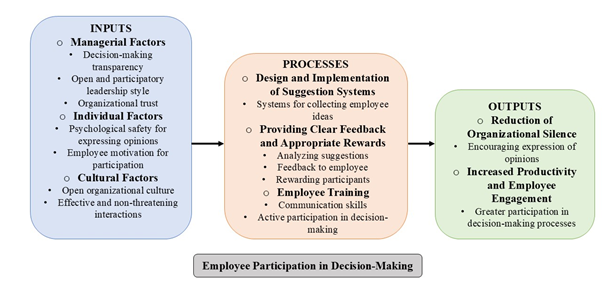
Based on Figure 2, it can be said that the benefits of identifying factors affecting organizational silence are that organizations can modify their management practices and policies to prevent this problem. Also, as a management tool, the suggestion system can help strengthen employee trust and encourage them to provide feedback and participate more in decision-making. The expected outcomes of this framework include reducing employee silence behaviors and improving their interaction and job satisfaction.
In conclusion, the meta-synthesis approach discussed here effectively pinpointed the contributors to organizational silence and highlighted how a suggestion system can mitigate this issue. By synthesizing qualitative data from diverse sources, this method offered a unified theoretical framework to assist managers in fostering employee participation and diminishing silence.
Conclusion
Organizational silence remains a significant challenge that hinders innovation, reduces productivity, and weakens decision-making effectiveness. This research reviews a wide range of studies, emphasizing the complex nature of silence influenced by managerial actions, individual psychological factors, and organizational culture. Fear of punishment, lack of openness, hierarchical obstacles, and emotional disconnect all work together to prevent employees from speaking up or sharing ideas.
Against this context, suggestion systems act as a structured and proactive way to break the cycle of silence. By creating a psychologically safe environment where employees feel free to share input without fear of negative consequences, these systems play a transformative role in encouraging open communication. When supported by mechanisms such as constructive feedback, fair recognition, and transparent processes, suggestion systems not only reduce silence but also foster engagement, trust, and effective group problem-solving.
The conceptual model developed in this study provides an integrated view of how suggestion systems interact with organizational dynamics to promote voice behavior. Instead of treating silence and participation as separate phenomena, the framework places them within a continuous, systemic process. This approach provides both theoretical clarity and practical guidance for organizations seeking to cultivate a participatory culture and enhance their organizational responsiveness. In doing so, it advances the understanding of how voice-enabling structures can reshape the social fabric of the workplace.
Suggestions for Future Research
Considering the limitations of this research, future studies should explore how varying organizational cultures influence employee silence and assess whether certain cultural traits significantly affect organizational silence. Additionally, further investigation into how new technologies impact suggestion systems could provide insights into effective strategies for minimizing organizational silence. Lastly, conducting empirical studies on the effects of these systems in organizations of different sizes can contribute to a broader understanding of how suggestion systems can reduce silence and enhance overall organizational performance.
Suggestions for Managers
Managers play a fundamental role in reducing organizational silence and strengthening a participatory culture. As a serious obstacle to productivity and innovation, organizational silence requires targeted management approaches. Using suggestion systems to create a safe and transparent space can improve intra-organizational communications.
The suggestions presented in this section provide scientific and practical solutions based on research findings to reduce organizational silence and increase employee engagement. These recommendations focus on transparency, constructive feedback, and strengthening employee motivation.
- Creating an open and transparent culture to strengthen trust and transparency.
- Designing effective and fair reward systems to appreciate employee suggestions.
- Enhancing managers' communication skills and providing appropriate positive and constructive feedback opportunities.
References
Afkhami Ardakani, M., Rajabpour, E., & Ali Mohammadi Ardakani, M. (2021). Suggestion system and getting rid of organizational silence. Strategic Studies in the Oil and Energy Industry, 12(47), 170–191. http://iieshrm.ir/article-1-1131-fa.html
Alhojairi, H. M., Elseesy, N. A. M., Mahran, S. M., Banakhar, M. A., & Alsharif, F. (2024). Assessment of nurses’ workplace silence behaviour motives: A cross-sectional study. International Journal of Nursing Sciences. https://doi.org/10.1016/j.ijnss.2024.10.006
Arif, M., Aburas, H., AlKuwaiti, A., & Kulonda, D. (2010). Suggestion systems: A usability-based evaluation model. Salford University Repository. https://salford-repository.worktribe.com/output/1444635
Bandarkhani, M., & Rafiei, M. (2010). The effect of creativity training on promoting participation in the suggestion system: A case study of the Central Province Electricity Distribution Company [Paper presentation]. In 10th National Suggestion System Conference. https://civilica.com/doc/247412
Brinsfield, C. T., & Edwards, M. S. (2020). Employee voice and silence in organizational behavior. In Handbook of Research on Employee Voice (pp. 103–120). Edward Elgar Publishing. https://doi.org/10.4337/9780857939272.00015
Buech, V. I., Michel, A., & Sonntag, K. (2010). Suggestion systems in organizations: What motivates employees to submit suggestions? European Journal of Innovation Management, 13(4), 507–525. https://doi.org/10.1108/14601061011086311
Dedahanov, A. T., Lee, D. H., & Rhee, J. (2016). Silence as a mediator between organizational factors and stress. Journal of Managerial Psychology, 31(8), 1251–1264. https://doi.org/10.1108/JMP-09-2014-0265
Dehkharghani, L. L., Paul, J., Maharati, Y., & Menzies, J. (2022). Employee silence in an organizational context: A review and research agenda. European Management Journal. https://doi.org/10.1016/j.emj.2022.12.004
Dupret, K. (2019). Performative silences: Potentiality of organizational change. Organization Studies, 40(5), 681–703. https://doi.org/10.1177/0170840618759816
Edmondson, A. C. (1999). Psychological safety and learning behavior in work teams. Administrative Science Quarterly, 44(2), 350–383. https://doi.org/10.2307/2666999
Erfanian Khanzadeh, H. (2021). Conceptual exploration of organizational silence components and effective factors (Mixed approach). Transformation Management Journal, 12(Autumn and Winter), 229–262. https://doi.org/10.22067/tmj.2021.30739.0
Fallah, M. A., Kasraei, A., Momeni, M., & Rajabi Taj Amir, A. (2014). Feasibility of implementing participatory management through suggestion systems at Shahid Sattari Aeronautical University. Human Resource Studies, 4(4), 47–66. https://www.jhrs.ir/article_65727.html
Focus HR. (2024). The hidden cost of silence: Why psychological safety is the key to high-performing teams. https://focushr.net/the-hidden-cost-of-silence-why-psychological-safety-is-the-key-to-high-performing-teams/
Ghanbari, S., & Beheshti Rad, R. (2017). The effect of organizational silence on reducing teamwork and organizational performance based on the balanced scorecard (BSC) (Case study of Kermanshah Razi University staff). Applied Sociology, 27(4), 47–60. https://doi.org/10.22108/jas.2017.21160
Hashemi, S. M., Meyghi, A., Nosrati, S., & Kabiri, H. (2012). Everything you need to know to improve the productivity of suggestion systems. (Case study in Tehran Greater Electricity Distribution Company)[[Paper presentation].. In 4th National Festival of Suggestion System. https://sid.ir/paper/820926/fa
Heshmatzadeh, A., & Malekiha, M. (2024). The effect of narcissistic leadership on employee cynicism, with the mediating role of employee silence and workplace gossip among the hospital staff. Journal of Modern Medical Information Sciences, 10(1), 82–97. http://jmis.hums.ac.ir/article-1-486-en.html
Hoon, C. (2013). Meta-synthesis of qualitative case studies: An approach to theory building. Organizational Research Methods, 16(4), 522–556. https://doi.org/10.1177/1094428113484969
Khourakian, A., Maharrati, Y., & Heshmati, M. R. (2014). Investigating the moderating role of employees' mental health and well-being in the occurrence of creative and innovative behavior through the suggestion system. Innovation and Creativity in Human Sciences, 4(1), 1–27. https://sid.ir/paper/223447/fa
Knoll, M., Wegge, J., Unterrainer, C., Silva, S., & Jønsson, T. (2016). Is our knowledge of voice and silence in organizations growing? Building bridges and (re) discovering opportunities. German Journal of Human Resource Management, 30(3–4), 161–194. https://doi.org/10.1177/2397002216649857
Mahar, N. A., Shah, S. M. A., Majid, A., & Pirzada, Z. A. (2024). Transformational leadership in advancing proactive voice behavior and reducing organizational silence: The mediating role of trust in leadership. Qurrah Journal of Social Sciences, 6(2). https://doi.org/10.55737/qjss.vi-ii.25355
Mahmoudi, A., Nikbin, B., Khanjani, A. R., & Ghorbani, M. H. (2022). Role of the suggestion system in the level of transparency and organizational development of the Sports and Youth Department in Alborz Province. Strategic Studies on Youth and Sports, 21(57), 301–320. https://doi.org/10.22034/ssys.2022.778
Mehdizadeh, I., Rajaeipour, S., & Siadat, S. A. (2024). Phenomenology of organizational silence (Case study: Farhangian University). Journal of Public Administration, 16(3). https://doi.org/10.22059/JIPA.2024.378304.3525
Morrison, E. W., & Milliken, F. J. (2000). Organizational silence: A barrier to change and development in a pluralistic world. Academy of Management Review, 25(4), 706–725. https://doi.org/10.5465/amr.2000.3707697
Mottahari, A., & Ghaffari, R. (2015). Investigating the key success factors of the suggestion system in Qom Water and Wastewater Company [Paper presentation]. . In 6th National Festival of Suggestion System. https://sid.ir/paper/877729/fa
Otsupius, A. I. (2019). Employee silence and its effects on organizational effectiveness. International Journal of Indian Economic Light (JIEL), 7, 56–61. https://www.researchgate.net/publication/372101745
Ölçer, F., & Coşkun, Ö. F. (2024). The mediating role of organizational silence in the relationship between organizational justice and organizational creativity. Society and Business Review, 19(1), 23–46. https://doi.org/10.1108/SBR-09-2021-0172
Petrič, G., & Orehek, Š. (2024). Expressing opinions about information security in an organization: The spiral of silence theory perspective. Information & Computer Security. https://doi.org/10.1108/ICS-04-2024-0083
Piran Nejad, A., Davari, E., & Afkhami, M. (2017). Organizational silence: A contemporary challenge of human resource management: Identifying its factors and consequences. Organizational Behavior Studies, 6(1), 147–176. https://obs.sinaweb.net/article_25876.html
Salavati, A., Yarahmadi, Y., & Seyed Hashemi, S. N. (2014). Effective communications and organizational silence in the country's banking network (Case study: Sanandaj city). Governmental Management, 6(3), 523–542. https://doi.org/10.22059/jipa.2014.50762
Salavatian, S., Nemati Anaraki, D., & Neyestani, K. (2017). Factors affecting organizational silence of media personnel based on the experience of staff working at the administration of IRIB's public relation. Journal of Public Administration, 8(4), 665–690. https://sid.ir/paper/139821/en
Sarwono, S. R., & Tao, J. J. (2024). The effect of appraisal and reward on employee motivation in the suggestion system. Istanbul Journal of Social Sciences and Humanities, 2(2), 28–38. https://doi.org/10.62185/issn.3023-5448.2.2.3
Shafiee Sarvestani, M., Mohammadi, M., & Khalili, Z. (2017). Relationship between teachers’ organizational silence and their organizational memory in girls high schools in Shiraz. School Administration, 5(1), 1–21. https://doi.org/doi: JSA-1705-1134 (R1)
Sharma, R. S., Shaikh, A. A., & Li, E. (2021). Designing recommendation or suggestion systems: Looking to the future. Electronic Markets, 31, 243–252. https://doi.org/10.1007/s12525-021-00478-z
Shojaie, S., Matin, H. Z., & Barani, G. (2011). Analyzing the infrastructures of organizational silence and ways to get rid of it. Procedia - Social and Behavioral Sciences, 30, 1731–1735. https://doi.org/10.1016/j.sbspro.2011.10.334
Song, H. J., & Cho, Y. J. (2025). Determinants of Employee Silence: Evidence From Multi-Level Analysis. Public Personnel Management, 0(0). https://doi.org/10.1177/00910260251350403
Takhsha, M., Barahimi, N., Adelpanah, A., & Salehzadeh, R. (2020). The effect of workplace ostracism on knowledge sharing: The mediating role of organization-based self-esteem and organizational silence. Journal of Workplace Learning, 32(6), 417–435. https://doi.org/10.1108/JWL-07-2019-0088
Tanhaei, M. H., Nasr Esfahani, A., Nilipour Tabatabaei, S. A., & Akhavan Sarraf, A. R. (2018). Recreating the pattern of antecedents and consequences of employees' organizational silence: A case study of Isfahan Municipality. Applied Sociology, 29(4), 147–166. https://doi.org/10.22108/jas.2018.107632.1220
Van Dyne, L., Ang, S., & Botero, I. C. (2003). Conceptualizing employee silence and employee voice as multidimensional constructs. Journal of Management Studies, 40(6), 1359–1392. https://doi.org/10.1111/1467-6486.00384
Yu, J., Xie, C., & Huang, S. S. (2022). Effect of perceived job risk on organizational conflict in tourism organizations: Examining the roles of employee responsible behavior and employee silence. Journal of Hospitality and Tourism Management, 53, 21–31. https://doi.org/10.1016/j.jhtm.2022.08.009
Zou, J., Zhu, X., Fu, X., Zong, X., Tang, J., Chi, C., & Jiang, J. (2025). The experiences of organizational silence among nurses: a qualitative meta-synthesis. BMC Nursing, 24(1), 31. https://doi.org/10.1186/s12912-024-02636-y

Page 1 of
Download Count : 43
Visit Count : 110
Keywords
Organizational Silence; Suggestion System; Meta-Synthesis Approach; Organizational Culture; Rewarding Suggestions


Author(s) Information



How to cite this article
Javadi, T., & Ardabili, F. S. (2025). The employee suggestion system with an approach to reduce organizational silence: A meta-synthesis study. International Journal of Behavior Studies in Organizations, 14, 1-16. https://doi.org/10.32038/jbso.2025.14.01
Acknowledgments
The authors wish to thank the Editor, Dr. Ali Intezari from the Department of Management, University of Queensland, for their careful reading of the manuscript and for providing constructive comments and suggestions, which have significantly contributed to improving the clarity and scholarly quality of this work.
Funding
Not applicable.
Conflict of Interests
No, there are no conflicting interests.
Open Access
This article is licensed under a Creative Commons Attribution 4.0 International License, which permits use, sharing, adaptation, distribution and reproduction in any medium or format, as long as you give appropriate credit to the original author(s) and the source, provide a link to the Creative Commons license, and indicate if changes were made. You may view a copy of Creative Commons Attribution 4.0 International License here: http://creativecommons.org/licenses/by/4.0/