






Original Research
Organizational Support for Lecturer Performance with Psychological Well-Being as Mediation


- Abstract
- Full text
- Metrics
This study aims to examine the influence of organizational support on lecturers' performance with psychological well-being as a mediating variable. The quantitative methodology the collected data. The data processing process in this study uses Smart PLS 3 software. Statistical analysis shows that organizational support either directly or indirectly affects performance. Psychological well-being serves as a key link between organizational support and lecturer performance. In higher education, it fosters enthusiasm, dedication, and effective workload management, enabling lecturers to develop professionally and contribute to the Tri Dharma of Higher Education. The findings of the study confirm that organizational support is a key pillar in supporting lecturer performance, which is strengthened by the unique role of psychological well-being as a bridge between the two. This study recommends that universities establish targeted policies to reinforce organizational support and take tangible steps, such as upgrading facilities, expanding access to technology, enhancing the quality of scientific journals, and fostering a supportive work environment. Further actions include acknowledging accomplishments, advancing career development, and providing programs to boost psychological well-being, such as stress management training, mentorship, and counselling. Incorporating these initiatives will foster a productive academic environment, enhance lecturer loyalty, and continually strengthen the institution’s reputation.
Organizational Support for Lecturer Performance with Psychological Well-Being as Mediation
Yuyuk Liana1*, Eko Priyo Purnomo2, Bunyamin Bunyamin1, Endang Suswati3, Ernani Hadiyati3
1Malangkuçeçwara College of Economics, Indonesia
2Muhammadiyah University of Yogyakarta, Indonesia
3Gajayana University, Indonesia
ABSTRACT:
This study aims to examine the influence of organizational support on lecturers' performance with psychological well-being as a mediating variable. The quantitative methodology the collected data. The data processing process in this study uses Smart PLS 3 software. Statistical analysis shows that organizational support either directly or indirectly affects performance. Psychological well-being serves as a key link between organizational support and lecturer performance. In higher education, it fosters enthusiasm, dedication, and effective workload management, enabling lecturers to develop professionally and contribute to the Tri Dharma of Higher Education. The findings of the study confirm that organizational support is a key pillar in supporting lecturer performance, which is strengthened by the unique role of psychological well-being as a bridge between the two. This study recommends that universities establish targeted policies to reinforce organizational support and take tangible steps, such as upgrading facilities, expanding access to technology, enhancing the quality of scientific journals, and fostering a supportive work environment. Further actions include acknowledging accomplishments, advancing career development, and providing programs to boost psychological well-being, such as stress management training, mentorship, and counselling. Incorporating these initiatives will foster a productive academic environment, enhance lecturer loyalty, and continually strengthen the institution’s reputation.
KEYWORDS: Organizational Support, Performance, Psychological Well-Being
Lecturer performance is one of the key indicators of success in ensuring the quality of higher education institutions (Srinadi et al., 2024), measured by specific indicators, namely the fields of Teaching, Research, and Community Service (Sukanti, 2023). Carrying out the Tri Dharma of Higher Education. Moreover, Factors of Professionalism and Competence of Lecturers (Qurtubi, 2023) who actively contribute to improving the performance of lecturers and institutions that provide opportunities for professional development, allowing lecturers to improve their skills and knowledge (Widodo, 2019). Therefore, it is necessary to evaluate the performance of this approach to determine its impact on improving the quality of learning and optimal lecturer performance (Fandir, 2024).
One of the important aspects in assessing lecturer performance is the achievement of academic positions, which reflects competence, scientific productivity, and lecturers' contribution to the Tri Dharma of Higher Education. But. Based on available data, there is still an inequality in the distribution of academic positions among lecturers, especially in LLDIKTI Region VII East Java, where most of them are still at the level of Expert Assistants and Lecturers, while the levels of Head Lecturers and Professors are still few. Lecturer demographics in East Java, particularly within the LLDIKTI Region VII, exhibit a range of functional positions. The East Java LLDIKTI Region VII Performance Report (Lapkin) states that most lecturers are teaching staff or serve as Expert Assistants. Teaching staff make up the largest group, at 34.9%. Those holding Expert Assistant positions follow at 33.2%. Lecturers in Lecturer and Head Lecturer roles make up 24.7% and 5.8%, respectively. Professors, the highest position, are only 1.5%. These numbers show most lecturers in the region are at entry to intermediate levels. This allows for a valuable review of early-career lecturer performance and well-being.
This phenomenon indicates that there are challenges in the development of lecturers' academic careers, which may be influenced by many factors, including support from institutions and psychological well-being. The imbalance in the level of academic positions shows that there are still many lecturers who have not achieved optimal performance, especially in terms of research and scientific publications. For this reason, strong organizational support, such as research facilities, training, and award systems, is needed to encourage lecturers' productivity in conducting scientific research and publications.
There is inconsistency in the findings of some previous studies that show that organizational support does not always have a direct effect on performance (Chiang & Hsieh, 2012; Darman, Hamzah et al., 2017). In addition, the majority of studies tend to focus on the direct relationship between organizational support and performance, but fail to dig deep into the mechanisms of psychological well-being that serve as mediators in these relationships. Related to this, psychological well-being is conceptualized as an intrinsic mechanism that facilitates the relationship between these relationships, because individuals who have a high level of psychological well-being tend to be more motivated, and have the ability to manage work demands better, which has an impact on more optimal performance. Furthermore, this study fills in a gap by developing a model that places psychological well-being as a strategic element in the process of improving lecturer performance, which has been poorly explored in the human resources literature. This approach enriches understanding of how organizational support can translate into optimal performance through improved lecturer psychological well-being (Yang et al., 2024).
Another factor that has a great influence on lecturer performance is Organizational Support, which includes policies that support lecturer career development, the provision of adequate resources, and a conducive work climate, in addition to Training, Performance Evaluation (Hanh, 2023), which is part of institutional policies that support the professional development of lecturers. In this context, lecturers can enhance their abilities and competencies, enabling them to deliver optimal performance in higher education institutions. When lecturers feel supported by the institution, they will feel appreciated and will work with full responsibility, which will have an impact on improving performance (Aziti, 2022; Ma et al., 2023; Wang, 2022).
In an effort to improve the quality of Higher Education, the organization's support for educators cannot be ignored. When an organization provides sufficient support, it leads to a more positive and productive work environment for educators (Hall, 2022), and can improve psychological well-being, which will consequently affect the improvement of educator performance. This phenomenon can be attributed to the fact that institutional support has a direct impact on many psychological and professional dimensions of educators, which, in turn, leads to improved performance. The organization's constant support causes individuals to feel supported by the organization, thus promoting higher psychological well-being and lower emotional levels (Artar & Erdil, 2024; Wang et al., 2022).
Psychological well-being plays an important role in influencing productive work behaviour in an institution. Employees, which directly impacts performance improvement. Therefore, psychological well-being is a strategic element in human resource management in the university environment. Psychologically well-off individuals tend to be more creative, responsible, and able to communicate well with others in the academic environment, which will ultimately improve their overall performance (Moreno-Milan et al., 2021; van der Ross et al., 2022; Wyman et al., 2022). In this study, we will develop a model that explains how organizational support affects performance through psychological well-being mediation. Where this approach enriches the human resource literature by placing psychological well-being as a strategic element in the process of improving performance.
Literature Review
Organizational Support
Organizational Support indicates the extent to which employees are confident that the organization recognizes their contributions and cares about their overall well-being (TUNA). Organizational support is considered an important resource that has the potential to mitigate the negative impact of role conflicts faced by faculty who are expected to balance teaching and research (Rafsanjani et al., 2020). The increase in support for the eating organization can lead to improved performance among lecturers (Ridwan, 2022). According to social exchange theory, when employees feel supported by the organization, they have a moral responsibility to perform their work wholeheartedly, leading to improved performance (Rajâa & Mekkaoui, 2025). The relationship is reciprocal, meaning that positive treatment from institutions, such as lecturers, can lead to opportunities for career development and appreciation for their work, ultimately impacting optimal performance.
Organizational support indicators serve as a concept to determine employee care. This is important because it is a key factor in building positive relationships between individuals and institutions, which in turn creates harmonious working relationships and fosters good performance. Statement from (Ridwan, 2022) These indicators include: (1) Supervisor Support, includes: the interests of employees, providing assistance, concern for welfare, work success, (2) Justice, including: lecturer contributions, recognition of extra work, lecturers' goals and values, responding to complaints, (3) Organizational Awards, and (4) Indicators of Work Conditions, namely: job satisfaction, attention, pride, interesting work. Next statement (Eviana, 2024) consists of: (1) Fair Treatment, (2) Satisfactory Compensation, (3) Involvement in Decision Making, (4) Career Opportunities, (5) Performance Recognition, (6) Peer Support, and (7) Leadership Support. These indicators are expected to help the organization create a good environment and foster mutual cooperation among employees, thereby impacting the institution's goals.
Psychological Well-Being
Psychological well-being is crucial aspect of lecturers' lives, as it directly impacts their motivation to teach and productivity, enabling them to focus on their teaching responsibilities and manage their workload effectively (Krishnan, 2022). In addition, it also leads to mental health and overall individual happiness, which significantly impacts performance (Dhanabhakyam & Sarath, 2023; Muhammad & Martyrs, 2022; Putra et al., 2023). Lecturers who have a high level of psychological well-being tend to have a more positive outlook on life, are able to build good interpersonal relationships, and show resilience in the face of academic pressure, such as the burden of teaching, research, and community service. Related to this, this is a crucial element in supporting the sustainability of optimal lecturer performance in an institution.
To understand more comprehensively the psychological well-being that affects performance, it is critical to identify the dimensions that make up those constructs. Psychological well-being (Ryff & Keyes, 1995) Includes: (1) Self-government (2) Skill milieu (3) Personal growth (4) Meaningful and supportive relationships (5) Objectives in life and (6) a positive attitude Yourself. Meanwhile, according to Henríquez et al. (2021), the indicators include: (1) Alignment Personal life goals with work responsibilities, (2) Positive relationships, (3) Autonomy, (4) Life goals, and (5) Self-development. Psychological well-being is a crucial aspect of an employee's life, directly influencing their ability to cope with work-related pressure. This, in turn, strengthens their capacity to deal with the challenges posed by the increasingly dynamic work environment. Furthermore, the psychological condition of lecturers can be objectively and holistically assessed based on these challenges.
Performance
Performance is the effort of an employee and the results they achieve in the job, which includes the duties and responsibilities in completing the job (Yang et al., 2024). The concept of performance describes the extent to which individuals can meet set goals and carry out their responsibilities effectively, thereby impacting the overall organizational goals. Good performance is essential for companies because it allows employees to carry out their duties effectively (Chalisa & Prawitasari, 2024). Furthermore, the performance of lecturers is the results achieved from the individual's work activities over a period of time (Maghfirah et al., 2023) and Evaluations that consider teaching, research, and community service, and are supported by a systematic assessment process aimed at encouraging continuous and professional improvement (Thalhah et al., 2022). Performance in these areas is very important to assess the quality of higher education institutions (Nurhadi et al., 2024). Therefore, the assessment of lecturers' performance is the main goal for universities to maintain academic quality. Institutional support, continuous training, and a conducive work environment are important factors that can encourage lecturers to further optimize their professional roles. Thus, the performance of educators not only affects individual achievement but also improves the overall quality.
Lecturer performance indicators can help to provide assessments for lecturers to carry out their duties and responsibilities in their work. The lecturer performance indicators include (Sulatini, 2025): (1) Impotencies Tri Dharma, (2) Professional development, (3) Teaching Effectiveness, (4) Research Contributions, (5) Workload Management, (6) Collaboration and Teamwork, (7) Evaluation and Feedback Mechanisms. Next (Sulistiarini, 2024) among others: (1) compensation received by lecturers, (2) responsibilities and duties given to lecturers, (3) Work environment, (4) Teaching experience, (5) Professional Development Opportunities. Consider other factors (Hiswara et al., 2023): (1) Teaching effectiveness, (2) Research productivity, (3) Professional services, (4) Organizational commitment, and (5) Management practices. Statement (Saragih, 2022) such as: (1) Skills, (2) Abilities and motivation, and (3) Feedback and Evaluation. The performance indicator provides an overview of the significant dimensions in the implementation of the Tri Dharma of Higher Education responsibilities, and it is hoped that this indicator can show that lecturer performance assessments can be evaluated systematically, objectively, and measurably, thereby assisting the institution in the process of evaluation and formulation of strategic decisions.
Hypothesis Development
The Direct Influence of Organizational Support on Performance
Organizational support indicates an individual's assessment of the extent to which the organization can value their contributions and prioritize their well-being, which is considered to have an important role in influencing behaviour and performance outcomes. When lecturers feel support from the organization, they tend to show high motivation, be more careful in carrying out their work, have a strong sense of organization, and increase dedication to their responsibilities. The phenomenon has an impact on improving their performance, which includes teaching, research, and community service.
Organisational support is not only limited to formal recognition of lecturers' performance, but also includes more fundamental elements such as a sense of security and comfort at work, opportunities for professional development, opportunities and encouragement in developing careers, rewards, and a sense of community in the work environment. In addition, if lecturers feel supported, they will tend to actively participate in various activities, both academic and non-academic, and be more open to innovations and changes, demonstrating their ability to collaborate with others. In academic institutions, this support can be manifested through the availability of learning facilities, awarding awards for the work that has been done, and developing lecturer competencies through training programs, seminars, and research. This shows that with better organizational support for employees, it will reflect optimal performance improvement. This statement is in line with the research that has been conducted by Chu et al. (2023) and Li et al. (2022). The hypothesis:
H1: The direct influence of organizational support on performance.
The Effect of Organizational Support on Psychological Well-being
Organizational support not only impacts the performance aspect but also has a significant contribution to the psychological well-being of individuals. In the academic context, lecturers who believe their institution supports their attention and well-being are more likely to experience positive psychological conditions. This is very important because it will reflect the condition of the organization that is oriented towards the development of human resources holistically. In addition, it will also create a conducive academic atmosphere that is expected to focus not only on the achievement of the institution's targets, but also on the emotional balance and psychological well-being of the individuals who are part of the organization.
In social support theory, the support of the work environment plays an important role in reducing psychological stress and improving mental balance. Support obtained from superiors, colleagues, and organizational policies can create a sense of security and comfort at work. For the long term, continuous support has an influence on the resilience of each individual in facing work stress, self-development, career development, and improvement of individual competencies. So, with the condition that lecturers feel supported by the organization, it will further increase their motivation in working both in the field of research and community service, career planning with the management of their academic positions, in addition to developing themselves by increasing the professionalism of lecturers which as a whole shows that they will feel more prosperous psychologically. Thus, the organization needs to pay overall attention to employee development, which will have an impact on the overall psychological well-being of employees. In line with the research that has been carried out by (Nong et al., 2022; Wang et al., 2022). The hypothesis:
H2: The direct effect of organizational support on psychological well-being.
Effect of Psychological Well-being on Performance
Psychological well-being is a positive mental condition characterized by strong feelings about work, high motivation, and a sense of living life with meaningful value. This condition also includes the individual's ability to manage stress, foster healthy social relationships, and have the ability to face challenges. In the academic world, the psychological well-being of lecturers greatly determines the quality of their performance, particularly in the context of the Tri Dharma of PT. Lecturers with high psychological well-being tend to exhibit greater work involvement and a stronger sense of organizational belonging, which in turn enhances their performance of professional duties and responsibilities. So psychological well-being has a significant direct influence on various aspects of lecturer performance.
Psychological well-being is the main foundation in shaping the drive in individuals to work optimally. This condition will encourage lecturers to engage in more meaningful work, thereby enabling them to make the best contributions in teaching, research, and community service. A positive mental state contributes to better cognitive abilities, including the ability to solve problems quickly and precisely, think critically, and make effective decisions, all of which impact superior academic performance. Thus, psychological well-being not only strengthens work morale, but also becomes an important element in improving the quality of social interaction, creativity, and productivity. Therefore, efforts to improve lecturer performance should start from creating working conditions that support psychological well-being as a whole and sustainably, where this will have an impact on performance. This is in line with Liu (2024). The hypothesis:
H3: Direct effect of psychological well-being on performance.
Indirect Influence of Organizational Support on Performance through Psychological Well-Being
The support provided by the institution not only has a direct impact on improving individual performance, but can also have an indirect influence through the mediating role of psychological well-being. Employees who receive organizational support will reflect a more consistent psychological state. So they will feel valued for their presence in the organization. Meanwhile, psychological well-being indicates an individual's ability to cope with various work pressures, maintain a stable mentality, and demonstrate a high willingness to perform assigned tasks. So when employees' psychological well-being improves, they are better able to develop positive attitudes, think clearly and rationally in decision-making, and foster good relationships with colleagues. For this reason, psychological well-being serves as an important bridge that connects organizational support with a variety of positive work behaviours in the organizational environment.
The form of appreciation given to lecturers for their contributions to the institution, attention to welfare, will create a positive work environment and lead to an improvement in the psychological well-being of lecturers. Feeling valued and supported will reduce the level of tension at work, as well as foster high confidence and optimism. Lecturers who feel psychologically prosperous, having a more stable mental and emotional condition, will complete assignments of higher quality, leading to optimal improvement in lecturer performance. Thus, it can be stated that with organizational support in improving psychological well-being, which in turn will have a positive impact on professional performance. In line with the research conducted by Kuang et al. (2023) and Moreno-Milan et al. (2021). The hypothesis:
H4: Indirect effect of organizational support on performance through psychological well-being.
Research Model
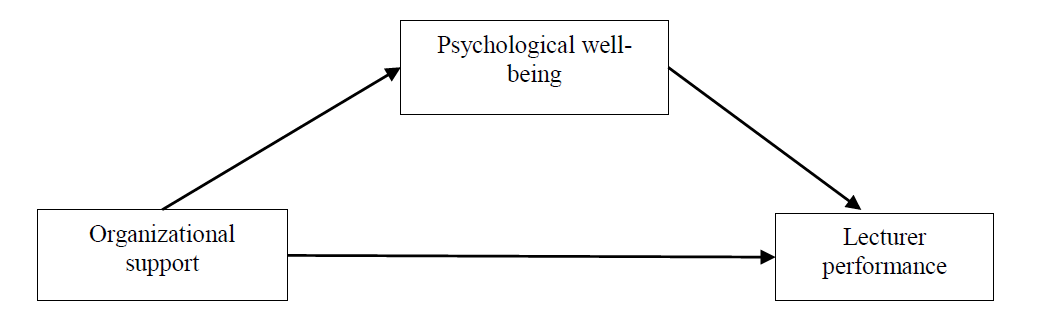
Numerous studies have investigated the relationship between lecturer performance and organizational support; however, the underlying mechanisms remain unclear. This study proposes that psychological health mediates this relationship. Figure 1 presents a research model illustrating how organizational support enhances psychological well-being, which in turn improves lecturer performance.
Research model
Method
This study employs a quantitative, explanatory research design to examine the causal relationship between organizational support, psychological well-being, and lecturer performance. This study focused on permanent lecturers at private universities in the Greater Malang area. Purposive sampling was applied, selecting lecturers with at least two years of experience to ensure respondents had sufficient knowledge of organizational support and performance in their work environment.
Data were collected by distributing online questionnaires to respondents from various private universities. A total of 68 responses were obtained. Stratified sampling ensured proportional representation from each institution, with strata defined by lecturers' institutional affiliation.
This study measured three main variables using a questionnaire with a 5-point Likert scale, where 1 indicated "Strongly Disagree" and 5 indicated "Strongly Agree." The demographic data show that most respondents were female (54.4%), with the largest age group between 36 and 45 years (47.1%). Most held master's degrees and had 6 to 10 years of work experience, indicating the sample primarily consisted of experienced lecturers. The operationalization of variables and indicators is presented in Table 1.
Variable, Indicator, and Items
|
Variable |
Operational Definition |
Indicator |
Items |
|
Organizational Support |
Organizational support is considered an important resource that has the potential to mitigate the negative impact of role conflicts faced by faculty who are expected to balance teaching and research (Rafsanjani et al., 2020). |
1. Justice 2. Appreciation 3. Career Opportunities 4. Involvement in Decision Making |
1. The management at my university treats all lecturers fairly. 2. The university gave me a deserved reward for my work performance. 3. I feel like I have a clear opportunity to improve my career here. 4. My opinion is often considered in important decision-making processes
|
|
Variable |
Operational Definition |
Indicator |
Items |
|
Psychological Well-Being |
Psychological well-being is an important aspect in the life of lecturers, because it has a direct effect on increasing motivation to teach among lecturers and being more productive, thus allowing them to focus on their responsibilities in terms of teaching as well as manage their workload effectively (Krishnan, 2022). |
1. Self-government 2. Life Purpose 3. Positive Attitude 4. Self-Development |
2. I was able to make my own decisions without being influenced by pressure from others. 3. I have a clear purpose and direction in my life. 4. I am optimistic and see the positive side of various situations. 5. I feel like I'm constantly growing and developing as an individual. |
|
Lecturer Performance |
Performance is the effort of an employee and the results they achieve in the job which includes the duties and responsibilities in completing the job (Yang et al., 2024) |
1. Workload Management 2. Feedback and Evaluation 3. Teamwork 4. Professional Development |
1. I managed to complete all the teaching and research assignments according to the given deadline. 2. I regularly receive constructive feedback to improve my performance. 3. I actively participate in team projects in the department. 4. I am proactive in looking for training or workshops to improve my competence. |
Results
Analysis Descriptive
Descriptive analysis was used to provide an overview of the condition of the research variables through the average (mean), correlation results, and standard deviation values. The following is a description of each variable based on data collected from respondents.
Based on Table 2, the overall results of the descriptive analysis indicate that respondents' perceptions of all research variables are in the high to very high category. The highest average was found in the Psychological Well-being variable (4.29), indicating that lecturers have very good psychological conditions. Followed by Lecturer Performance (4.06), which is also in the very high category, reflecting good work performance. Meanwhile, the Organizational Support variable (3.92) has the highest average in the high category. In general, these findings indicate a positive relationship between working conditions and psychology with lecturer performance, where good levels of organizational support and psychological well-being are in line with high performance assessments.
The results on Table 2, indicate that Organizational Support was significantly and positively correlated with Psychological Well-being (r = .68, p < .01) and Lecturer Performance (r = .39, p < .01). Similarly, Psychological Well-Being had a significant positive correlation with Lecturer Performance (r = .46, p < .01). These findings show that the higher the organizational support, the higher the psychological well-being and Performance of lecturers.
Results of Descriptive Analysis
|
Variable |
M |
SD |
1 |
2 |
3 |
|
1- Organizational Support |
3.92 |
.86 |
1 |
|
|
|
2- Psychological Well-Being |
4.29 |
.70 |
.68** |
1 |
|
|
3- Lecturer Performance |
4.06 |
.73 |
.39** |
.46** |
1 |
**p < .01
Validity and Reliability Tests
This analysis uses a validity test with an outer model test tool, one of which is through convergent and discriminant validity measurement which compares the loading factor between the latent variable and the indicator and is declared valid if the loading factor > .7 or the loading factor value .7 or the loading factor value > .6 but the Average Variance Extracted value is 0.5. The results of the outer model to assess the validity and reliability of the test, using Smart PLS are as follows:
The results in Table 3 demonstrate that your research instrument is of high quality. Each indicator is valid, as shown by high factor loadings, and the set of questions for each variable is reliable, indicated by strong Composite Reliability and Cronbach's Alpha values, which means that we can proceed to the evaluation of the structural model.
Validity and Reliability Test
|
Variable |
Constructs |
Loading Factor |
AVE |
CR |
Cronbach's Alpha (α) |
Information |
|
Organizational Support |
Justice |
.74 |
.61 |
.86 |
.79 |
Valid & Reliable |
|
Appreciation |
.80 |
|||||
|
Career opportunities |
.76 |
|||||
|
Involvement in decision-making |
.81 |
|||||
|
Psychological Well-Being |
Self-government |
.79 |
.67 |
.89 |
.83 |
Valid & Reliable |
|
Life purpose |
.83 |
|||||
|
Positive attitude |
.83 |
|||||
|
Self-development |
.83 |
|||||
|
Lecturer Performance |
Workload management |
.83 |
.72 |
.91 |
.87 |
Valid & Reliable |
|
Feedback and evaluation |
.80 |
|||||
|
Teamwork |
.85 |
|||||
|
Job responsibilities and duties |
.91 |
Discriminant Validity
Furthermore, for the discriminant validity test, the AVE value of a construct must be higher than the correlation between the latent variables, or the cross-loading value (Hair et al., 2014) should be examined. The cross-loading values presented in Table 4 indicate that this study possesses valid discriminant validity.
Table 4
Cross Loading
|
|
Organizational Support |
Psychological Well-Being |
Performance |
|
DO1 |
.74 |
.51 |
.54 |
|
DO2 |
.80 |
.59 |
.63 |
|
DO3 |
.76 |
.48 |
.52 |
|
DO4 |
.81 |
.55 |
.54 |
|
KIN1 |
.59 |
.49 |
.83 |
|
KIN2 |
.56 |
.64 |
.80 |
|
KIN3 |
.59 |
.68 |
.85 |
|
KIN4 |
.69 |
.67 |
.91 |
|
KP1 |
.64 |
.79 |
.48 |
|
KP2 |
.41 |
.83 |
.71 |
|
KP3 |
.47 |
.83 |
.69 |
|
KP4 |
.70 |
.80 |
.53 |
Inner Model Evaluation
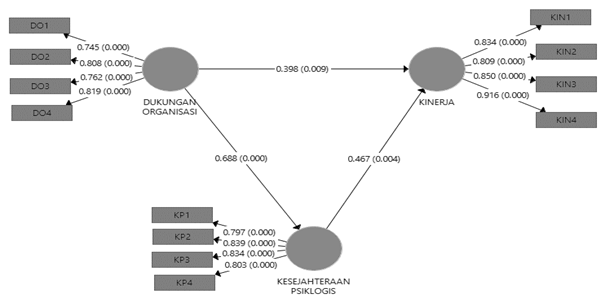
Internal model testing aims to predict the causal relationship between variables, as evidenced by the results of the determination coefficient, predictive relevance, goodness of fit, path coefficient, and parameter coefficient. Hypothesis testing is done by bootstrapping. The results are demonstrated in Figure 2.
PLS Model Inner Path Diagram
Hypothesis Testing
As presented in Table 5, path coefficient has a value of .68 and a p-value of .000, indicating that organizational support has a significant effect on performance, thereby supporting the acceptance of the H1 hypothesis. Organizational support for psychological well-being with a p-value of .009 and a path coefficient of .39, which reflects that H2 is accepted. Along with the hypothesis of psychological well-being on performance, it was received with a p-value of .004 and a coefficient of the path of .46.
Path Coefficient
|
|
Original Sample |
P-Value |
Information |
|
Performance organizational support à Performance |
.39 |
.009 |
Significant |
|
Organizational support à Psychological well-being |
.68 |
.000 |
Significant |
|
Psychological Well-Being à Performance |
.46 |
.004 |
Significant |
Discussion
The correlation results in Table 2 reinforce the theoretical foundation that organizational support is not only closely related to psychological well-being, but also contributes positively to improving lecturer performance. The strength of correlation between organizational support and psychological well-being (r = .68) showed that supportive work environment factors can build healthy and positive psychological conditions for lecturers. In addition, a positive relationship between psychological well-being and performance (r = .46) indicates that lecturers who have a high level of psychological well-being tend to be more productive, motivated, and able to meet the set performance targets. These results are in line with previous studies that confirm the important role of psychological factors as a link between organizational support and performance outcomes.
Organizational Support for Performance
Table 2 shows an average organizational support score of 3.92, indicating that most lecturers feel adequately supported. The average lecturer performance score is 4.06, reflecting strong implementation of the Tri Dharma. Inferential analysis in Table 5 and Figure 1 demonstrates that organizational support has a positive and significant effect on lecturer performance, with a path coefficient of .39 and a p-value of .009. These results suggest that increasing organizational support through facilities, recognition, or career development can directly enhance lecturer performance (Yildiz & Çalışkan, 2024). Organizational support plays a crucial role in lecturer performance, offering an individual evaluation of the extent to which the organization values their contribution and is concerned about their well-being, which will impact lecturer performance (Wang, 2024). When lecturers feel strong support from the organization, it provides a strong foundation for development and achievement. The form of support can be in the form of the availability of adequate facilities and infrastructure, the existence of clear career development regulations in institutions, training, seminars that support lecturer competence, and recognition of academic achievements.
Lecturers who feel a sense of support tend to show motivation in completing their duties and responsibilities effectively, show true loyalty to the institution, and actively participate in the Tri Dharma of Higher Education (Nguyen & Nguyen, 2025). In addition, it will not only increase the productivity of individual lecturers, namely in the fields of teaching, research, and community service, but will further strengthen the quality of the institution as a whole. Previous research has shown that organizational support can reduce work stress, enhance task completion effectiveness, and strengthen work involvement. This is particularly relevant for lecturers in LLDIKTI Region VII East Java, who face high performance challenges and increasing academic targets. The role of organizational support is crucial in creating a safe and comfortable work environment, fostering psychological balance, and bolstering lecturers' motivation to continue developing, ultimately leading to improved performance.
Organizational Support for Psychological Well-Being
Table 2 shows an average organizational support score of 3.92, indicating that most lecturers perceive strong institutional support. The average psychological well-being score is 4.29, also classified as high, suggesting lecturers generally feel positive, appreciated, and capable of managing work demands. Inferential analysis in Table 5 and Figure 1 indicates that organizational support has a significant positive effect on psychological well-being, with a path coefficient of .68 and a p-value of .000. This is the strongest relationship in the research model, highlighting organizational support as the primary factor influencing lecturers' psychological well-being. Organizational support, as an external factor, is directly experienced by lecturers through work facilities, recognition of achievements, and career development opportunities. This support fosters a sense of security and value, which in turn enhances intrinsic motivation and professional commitment. The results of this study consistently indicate that organizational support has a significant influence on psychological well-being, in creating a more productive work environment. Several theories and previous studies emphasize the importance of a comfortable work atmosphere in relation to the individual's emotional state (Bonaiuto et al., 2022; Kirkbesoglu & Ozder, 2015). The support provided is not only physical and financial resources, but also the emotional and social aspects that are crucial for mental well-being. With this support, they experience a comfortable psychological climate, which enables them to become more creative in expressing themselves and face obstacles or challenges at work more effectively.
If lecturers feel they have full support from the institution, it will encourage them to feel recognized for their contributions and actively participate in various academic activities, further motivating them to continue providing the best for the institution. The form starts from the availability of adequate resources for research and teaching activities, career development opportunities, and lecturer competency development (Paudel, 2021; Putri & Sofyandi, 2019). In addition, further study opportunities, training, seminars, and publications can increase the sense of competence and confidence for lecturers. Overall, this will create a better life balance, which ultimately improves psychological well-being for lecturers. The practical implications of these findings are clear: organizations must invest in creating a supportive, safe, and comfortable work culture to enhance their employees' psychological well-being, ultimately leading to improved productivity and overall organizational performance.
Psychological Well-Being to Performance
Table 2 shows an average psychological well-being score of 4.29. This suggests that most lecturers experience positive psychological well-being, feel valued, and adapt effectively to job demands. Table 5 and Figure 2 further demonstrate that psychological well-being has a significant positive effect on lecturer performance. The path coefficient is .46 with a p-value of .004. This suggests that higher psychological well-being among lecturers is associated with improved performance in fulfilling the Tri Dharma of Higher Education. Lecturers who have a high level of psychological well-being tend to show better performance in various aspects of the Tri Dharma of Higher Education. This is reflected in quality teaching, continuity in publishing both national and international journals, periodic service activities that positively impact the community, and the ability to cooperate or collaborate dynamically (Voitenko, 2022). Along with this, lecturers will carry out their duties more effectively, manage their workload well, and demonstrate a dedication to their profession, becoming positive inspirations for students and ultimately improving the quality of graduates (Fernandez, 2020).
Positive psychological well-being will give the impression that lecturers are able to face challenges in work, be more creative in solving problems, and have enough time and energy to carry out academic tasks and responsibilities, be more adaptive to work pressure, encourage more innovation in teaching and research methods, which will contribute to the institution and the development of science. Its influence on lecturer performance is crucial, as it increases productivity (Saleem et al., 2022; Zewude et al., 2022), enhances the quality of academic outputs, and fosters a positive image of the institution as a whole. Thus, psychological well-being is a key factor that affects their overall performance and contributes to the success of higher education institutions.
Organizational Support for Performance Through Psychological Well-Being
Organizational support plays a crucial role in shaping lecturer performance, and this influence is significantly strengthened by the mediation of psychological well-being (Guan et al., 2014; Sulistiyani, 2022). In this case, psychological well-being is a catalyst for improving lecturer performance in various elements. Lecturers who feel psychologically prosperous tend to be actively involved in teaching tasks by producing higher quality learning materials, and creating an inspiring learning environment for students, as well as conducting innovative research, journal publications, and service that have an effect on the progress of society so as to contribute to the development of science and technology.
Organizational support not only provides facilities but also creates a positive climate that will encourage lecturers to develop both professionally and individually. The psychological well-being resulting from the support of this organization then becomes a strong foundation for improving lecturer performance in various fields, ranging from teaching, research, to community service (Vasconcelos et al., 2022). Higher education institutions should prioritize strategic investments in organizational support to improve lecturer performance sustainably. This approach can provide insight into how psychological well-being, as a key factor, mediates the achievement of these goals (Christensen et al., 2021; Gast et al., 2022).
Conclusion and Further Research
Based on the results of an in-depth analysis, this study emphasizes that organizational support is not just a supporting factor, but the main pillar that supports lecturer performance. More so, this study highlights the unique role of psychological well-being as a bridge that strengthens the relationship between organizational support and lecturer performance. When lecturers feel strong, structured support from the institution, this not only improves performance directly, but also triggers a positive circle that improves their psychological well-being. A positive work environment, increased job satisfaction, controlled stress levels, and solid resilience are valuable assets for lecturers to achieve the best performance in teaching, research, and community service. These findings lead higher education institutions to view investment in organizational support as a transformative strategy, not just an administrative action, by placing the psychological well-being of lecturers as a top priority to achieve sustainable and superior academic performance. The practical implications of this research encourage institutional managers to design holistic and integrated programs and policies, that focus not only on improving performance, but also on improving the psychological well-being of lecturers as a key foundation for success.
As for the next research, it can expand the scope of the sample by involving lecturers from various types of higher education institutions, including public universities, private universities, and polytechnics, to improve the generalization of findings. In addition, it can test more complex mediation models by including other variables that may mediate the relationship between organizational support and lecturer performance, such as intrinsic motivation, self-efficacy, and life satisfaction. It is hoped that by conducting more in-depth and comprehensive research, we can gain a better understanding of the factors that affect lecturer performance and develop more effective strategies to improve the quality of higher education.
So the correlation results in Table 2 reinforce the theoretical foundation that organizational support is not only closely related to psychological well-being, but also contributes positively to improving lecturer performance. The strength of the correlation between organizational support and psychological well-being (r = .68) suggests that supportive work environment factors can build healthy and positive psychological conditions for lecturers. In addition, a positive relationship between psychological well-being and performance (r = .46) indicates that lecturers who have a high level of psychological well-being tend to be more productive, motivated, and able to meet set performance targets. These results are in line with previous studies that confirm the important role of psychological factors as a link between organizational support and performance outcomes.
Reference
Artar, M., & Erdil, O. (2024). Navigating the new normal: How workplace isolation impacted teleworkers’ psychological well-being in Covid-19? The roles of perceived organizational support and job insecurity. Work, 79, 1–16. https://doi.org/10.3233/wor-230580
Aziti, T. M. (2022). The ınfluence of learning climate, organizational support, and supervision on lecturer performance. International Journal of Economics (IJEC), 1(2), 368–375. https://doi.org/10.55299/ijec.v1i2.665
Bonaiuto, F., Fantinelli, S., Milani, A., Cortini, M., Vitiello, M. C., & Bonaiuto, M. (2022). Perceived organizational support and work engagement: the role of psychosocial variables. Journal of Workplace Learning, 34(5), 418–436. https://doi.org/10.1108/JWL-11-2021-0140
Chalisa, R. N., & Prawitasari, D. (2024). Analysis of employee performance ındicators using the human resource scorecard approach and analytical hierarchy process. Jurnal Ilmiah Manajemen Kesatuan, 12(1), 75–84. https://doi.org/10.37641/jimkes.v12i1.2391
Chiang, C. F., & Hsieh, T. S. (2012). The impacts of perceived organizational support and psychological empowerment on job performance: The mediating effects of organizational citizenship behavior. International Journal of Hospitality Management, 31(1), 180–190. https://doi.org/10.1016/j.ijhm.2011.04.011
Christensen, M., Dawson, J., & Nielsen, K. (2021). The role of adequate resources, community and supportive leadership in creating engaged academics. International Journal of Environmental Research and Public Health, 18(5), 1–11. https://doi.org/10.3390/ijerph18052776
Chu, X., Yu, J., Litifu, A., Zhao, W., Wei, X., Wang, P., & Wei, J. (2023). Organizational support and task performance: a multiple mediation model. Frontiers in Psychology, 14(January), 1–9. https://doi.org/10.3389/fpsyg.2023.1258177
Darman, Hamzah, D., Taba, M. I., & Mardiana, R. (2017). The effect of personality , ability , organizational support , job satisfaction and organizational commitment towards lecturer performance of private university in Gorontalo. Scientific Research Journal (SCIRJ), V(VI), 61–70.
Dhanabhakyam, & Sarath M. (2023). Psychological wellbeing: Asystematic literature review. International Journal of Advanced Research in Science, Communication and Technology, April, 603–607. https://doi.org/10.48175/ijarsct-8345
Eviana, N. (2024). The role of Perceived Organizational Support (POS) and employee satisfaction to enhance employee engagement: Does gender and tenure matter? Jurnal Manajemen Bisnis, 15(1), 13–31. https://doi.org/10.18196/mb.v15i1.19529
Fandir, A. (2024). The ınfluence of lecturer performance evaluation on ımproving the quality of learning at STKIP Harapan Bima. Jurnal Ilmu Sosial dan Pendidikan (JISIP), 8(3), 1930–1938. https://doi.org/10.58258/jisip.v7i1.7183/http
Fernandez, S. (2020). Faculty work engagement and teaching effectiveness in a state higher education ınstitution Sanny Fernandez. International Journal of Educational Research Review Faculty, 6(1), 1–13. www.ijere.com
Gast, I., Neelen, M., Delnoij, L., Menten, M., Mihai, A., & Grohnert, T. (2022). Supporting the well-being of new university teachers through teacher professional development. Frontiers in Psychology, 13(July), 1–19. https://doi.org/10.3389/fpsyg.2022.866000
Guan, X., Sun, T., Hou, Y., Zhao, L., Luan, Y. Z., & Fan, L. H. (2014). The relationship between job performance and perceived organizational support in faculty members at Chinese universities: A questionnaire survey. BMC Medical Education, 14(1). https://doi.org/10.1186/1472-6920-14-50
Hair, J. F., Black, J. W. C., Babin, B. J., & Anderson, R. E. (2014). Mutivariate data analysis. In Neuromarketing in India: Understanding the Indian Consumer. https://doi.org/10.4324/9781351269360
Hall, P. T. (2022). Teaching Environment, Instructional Coaching, and Perceived Teaching Environment, Instructional Coaching, and Perceived Organizational Support on Educators’ Quality of Work-Life Organizational Support on Educators’ Quality of Work-Life [Doctoral dissertation, Walden University].
Hanh, N. T. T. (2023). Organizational factors affecting lecturer performance in HEIs in the context of blended learning: An empirical study in Vietnam. Journal of Higher Education Policy and Leadership Studies, 4(4), 32–49. https://doi.org/10.61186/johepal.4.4.32
Henríquez, D., Urzúa, A., & López-López, W. (2021). Indicators of ıdentity and psychological well-being in ımmigrant population. Frontiers in Psychology, 12(October). https://doi.org/10.3389/fpsyg.2021.707101
Hiswara, A., Sawitri, N. N., Hapzi, H., & Rony, Z. T. (2023). Lecturer’s performance in Java Island in review of and lecturer performance in review of organizational culture, management effectiveness and organizational commitment. West Science Interdisciplinary Studies, 1(11), 1133–1145. https://doi.org/10.58812/wsis.v1i11.395
Kirkbesoglu, E., & Ozder, E. H. (2015). The effects of organizational performance on the relationship between perceived organizational support and career satisfaction: An Application on ınsurance ındustry. Journal of Management Research, 7(3), 35. https://doi.org/10.5296/jmr.v7i3.7094
Krishnan, J. (2022). Contributor factors to psychological well-being among lecturers in the aspects of teaching motivation and career satisfaction. European Journal of Education Studies, 9(12), 139–152. https://doi.org/10.46827/ejes.v9i12.4570
Kuang, M., Anggraini, Y., Derliwanti, & Rohman, A. (2023). Triad of employee performance: Leadership, organizational support, and well-being. International Journal of Innovation, Creativity and Change, 17(2), 455–475. https://doi.org/10.53333/ijicc2013/17208
Li, M., Jameel, A., Ma, Z., Sun, H., Hussain, A., & Mubeen, S. (2022). Prism of employee performance through the means of ınternal support: A study of perceived organizational support. Psychology Research and Behavior Management, 15(April), 965–976. https://doi.org/10.2147/PRBM.S346697
Liu, Q. (2024). The research on the relationship between employee psychology and work performance. Highlights in Business, Economics and Management, 37, 241–245. https://doi.org/10.54097/mgnbq760
Ma, H., Zhu, X., Huang, J., Zhang, S., Tan, J., & Luo, Y. (2023). Assessing the effects of organizational support, psychological capital, organizational identification on job performance among nurses: a structural equation modeling approach. BMC Health Services Research, 23(1), 1–10. https://doi.org/10.1186/s12913-023-09705-z
Maghfirah, M., Usman, N., & Niswanto, N. (2023). Analysis of lecturer performance ın ıncreasing productivity of Indonesian Polytechnic Venezuela ın Aceh Besar. International Journal of Engineering Business and Social Science, 2(01), 722–741. https://doi.org/10.58451/ijebss.v2i01.89
Moreno-Milan, B., Breitbart, B., Herreros, B., Olaciregui Dague, K., & Coca Pereira, M. C. (2021). Psychological well-being of palliative care professionals: Who cares? Palliative and Supportive Care, 19(2), 257–261. https://doi.org/10.1017/S1478951521000134
Muhammad, M., & Syahid, A. (2022). Work motivation and psychological well-being on teacher performance at Perguruan Alkhairaat, Palu, Indonesia. TAZKIYA Journal of Psychology, 10(2), 97–109. https://doi.org/10.15408/tazkiya.v10i2.26894
Nguyen, T. N., & Nguyen, K. H. (2025). Factors affecting work motivation of lecturers at Ho Chi Minh City University of Technology And Education [Paper presentation]. International Conference on Economics, February.
Nong, L., Ye, J. H., & Hong, J. C. (2022). The ımpact of empowering leadership on preschool teachers’ job well-being in the context of COVID-19: A perspective based on job demands-resources model. Frontiers in Psychology, 13(May). https://doi.org/10.3389/fpsyg.2022.895664
Nurhadi, A., Mufarrikoh, Z., Indahsari, K., Riskiyah, E. M., & Ifadhah, H. (2024). Bridging the Gap : Improving lecturer adherence to the tri dharma of higher education through performance monitoring. Al-Tanzim: Jurnal Manajemen Pendidikan Islam, 08(04), 1097–1109.
Paudel, K. P. (2021). Dimensions of academic performance in the context of Nepali Higher Education Institutions. Journal of Education and Research, 11(1), 29–48. https://doi.org/10.51474/jer.v11i1.497
Putra, A. S. B., Kusumawati, E. D., & Kartikasari, D. (2023). Psychological empowerment and psychological well-being as job performance mediators. Journal of Business Management and Economic Development, 2(01), 127–141. https://doi.org/10.59653/jbmed.v2i01.372
Putri, R. K., & Sofyandi, H. (2019). Research climate and institutional support in improving performance of scientific publications at private university in Indonesia. Universal Journal of Educational Research, 7(4), 67–71. https://doi.org/10.13189/ujer.2019.071410
Qurtubi, A. (2023). The ımpact of professionalism and lecturer competency on lecturer performance In Indonesia. Journal on Education, 05(04), 11485–11497.
Rafsanjani, M. A., Ghofur, M. A., Fitrayati, D., & Dewi, R. M. (2020). Does perceived organizational support mitigate the negative effect of teacher-researcher role conflict among lecturers? (evidence from indonesia). Pedagogika, 138(2), 25–36. https://doi.org/10.15823/p.2020.138.2
Rajâa, O., & Mekkaoui, A. (2025). Revealing the impact of social exchange theory on financial performance: a systematic review of the mediating role of human resource performance. Cogent Business and Management, 12(1). https://doi.org/10.1080/23311975.2025.2475983
Ridwan, M. (2022). Perceived organizational support as key success factor to improve employee performance besides organization commitment and organizational citizenship behavior. Jurnal Manajemen Dan Pemasaran Jasa, 15(2), 275–288.
Ryff, C. D., & Keyes, C. L. M. (1995). The structure of psychological well-being revisited. Journal of Personality and Social Psychology, 69(4), 719–727. https://doi.org/10.1037/0022-3514.69.4.719
Saleem, M. S., Isha, A. S. N., Awan, M. I., Yusop, Y. B., & Naji, G. M. A. (2022). Fostering academic engagement in post-graduate students: assessing the role of positive emotions, positive psychology, and stress. Frontiers in Psychology, 13(August). https://doi.org/10.3389/fpsyg.2022.920395
Saragih. (2022). The effect of learning climate, organizational support, and supervision on the performance of lecturers. International Journal of Economics (IJEC), 1(1), 228–236. https://doi.org/10.55299/ijec.v1i1.132
Srinadi, N. L. P., Widhyastuti, L. P. W., Hostiadi, D. P., & Ahmadi, C. (2024). Lecturer performance measurement based on organizational culture and leadership behavior analysis using Pearson Correlation. Journal of Innovation in Educational and Culutral Research, 5(1), 131–139. https://doi.org/10.46843/jiecr.v5i1.1163
Sukanti, L. (2023). Management of lecturers performance assessment ımproving the quality of higher education academic at Syekh Yusuf Islamic University Tangerang. The International Journal of Education Management and Sociology, 2(3), 123–129. https://doi.org/10.58818/ijems.v2i3.34
Sulatini, R. (2025). Lectura. Jurnal Pendidikan. 16(6), 344–356.
Sulistiarini, E. B. (2024). The relationship between lecturer performance factors and ıncreased ınsight , strategy, and ımpact on higher education students. Jurnal Pedagogi dan Pembelajaran, 7(2), 252–261.
Sulistiyani, E. (2022). Perceived organizational support and performance: The mediating effect of affective values. Jurnal Manajemen Bisnis, 13(1), 61–75. https://doi.org/10.18196/mb.v13i1.13555
Thalhah, S. Z., Tahrim, T., & Sari, R. E. (2022). Development of lecturer performance assessment ınstruments through the Plomp Model in Higher Education. AL-ISHLAH: Jurnal Pendidikan, 14(2), 1527–1540. https://doi.org/10.35445/alishlah.v14i2.1350
van der Ross, M. R., Olckers, C., & Schaap, P. (2022). Engagement of academic staff amidst COVID-19: The role of perceived organisational support, burnout risk, and lack of reciprocity as psychological conditions. Frontiers in Psychology, 13(May), 1–17. https://doi.org/10.3389/fpsyg.2022.874599
Vasconcelos, C. R. M., Costa de, H. C., & El-Aouar, W. A. (2022). Organizational culture, organizational support, and positive psychological capital: Validation of a theoretical model. International Journal of Behavior Studies in Organizations, 7(7), 1–13. https://doi.org/10.32038/jbso.2022.07.01
Voitenko, E. (2022). Occupational well-being: A comparative analysis of the main structural models. International Journal of Behavior Studies in Organizations,(7), 30–39.
Wang, C. J. (2022). Exploring the mechanisms linking transformational leadership, perceived organizational support, creativity, and performance in hospitality: The mediating role of affective organizational commitment. Behavioral Sciences, 12(10). https://doi.org/10.3390/bs12100406
Wang, L. (2024). Impact of organizational support in colleges and universities on teachers’ work performance and job satisfaction: Basis for faculty support program. International Journal of Education and Humanities, 14(1), 56–62. https://doi.org/10.54097/r89ndv24
Wang, L., Peng, F., & Song, N. (2022). Organizational support and job crafting with the new math teachers’ well-being: The mediating effect of basic psychological needs. Frontiers in Psychology, 13(November), 1–11. https://doi.org/10.3389/fpsyg.2022.961702
Widodo, H. (2019). The role of school culture in holistic education development in Muhammadiyah Elementary School Sleman Yogyakarta. Dinamika Ilmu, 19(2), 265–285. https://doi.org/10.21093/di.v19i2.1742
Wyman, M. F., Van Hulle, C. A., Umucu, E., Livingston, S., Lambrou, N. H., Carter, F. P., Johnson, S. C., Asthana, S., Gleason, C. E., & Zuelsdorff, M. (2022). Psychological well-being and cognitive aging in Black, Native American, and White Alzheimer’s Disease Research Center participants. Frontiers in Human Neuroscience, 16(July), 1–12. https://doi.org/10.3389/fnhum.2022.924845
Yang, Y., Obrenovic, B., Kamotho, D. W., Godinic, D., & Ostic, D. (2024). Enhancing job performance: The critical roles of well-being, satisfaction, and trust in supervisor. Behavioral Sciences, 14(8). https://doi.org/10.3390/bs14080688
Yildiz, M. L., & Çalışkan, E. (2024). Perceived overqualification and ınnovative work behavior: The effects of work engagement and organizational support. International Journal of Behavior Studies in Organizations, 12(12), 32–44. https://doi.org/10.32038/jbso.2024.12.03
Zewude, G. T., Hercz, M., Duong, N. T. N., & Pozsonyi, F. (2022). European Journal of Educational Research. European Journal of Educational Research, 11(4), 2243–2263. https://pdf.eu-jer.com/EU-JER_9_1_395.pdf

Page 1 of
Download Count : 41
Visit Count : 171
Keywords
Organizational Support; Performance; Psychological Well-Being

Author(s) Information


How to cite this article
Liana, Y., Purnomo, E. P., Bunyamin, B., Suswati, E., & Hadiyati, E. (2025). Organizational Support for Lecturer Performance with Psychological Well-Being as Mediation. International Journal of Behavior Studies in Organizations, 14, 17-34. https://doi.org/10.32038/jbso.2025.14.02
Acknowledgments
Not applicable.
Funding
Not applicable.
Conflict of Interests
No, there are no conflicting interests.
Open Access
This article is licensed under a Creative Commons Attribution 4.0 International License, which permits use, sharing, adaptation, distribution and reproduction in any medium or format, as long as you give appropriate credit to the original author(s) and the source, provide a link to the Creative Commons license, and indicate if changes were made. You may view a copy of Creative Commons Attribution 4.0 International License here: http://creativecommons.org/licenses/by/4.0/