







Original Research
Brand Communication, Service Quality, and Brand Image: A Mediated Path to Purchase Intention through Customer Loyalty


- Abstract
- Full text
- Metrics
The study asks how brand communication and service quality contribute to brand image, and whether brand image leads to purchase intention on its own or works mainly by strengthening customer loyalty. A cross-sectional survey was completed by 235 university students in Tehran who owned and used Samsung smartphones. The questionnaire employed established multi-item measures, and the five proposed relationships were examined using partial least squares structural equation modeling (PLS-SEM). Both brand communication (β = .15, p < .05) and service quality (β = .68, p < .01) had significant positive effects on brand image. Brand image strongly predicted customer loyalty (β = .81, p < .01), which in turn predicted purchase intention (β = .85, p < .01). By contrast, the direct path from brand image to purchase intention was not significant (β = .02, p = .70). With a VAF of 96.25%, the results indicate full mediation through customer loyalty. A positive image is most likely to influence future purchase when it develops into loyalty. Managers should therefore connect image-building activities with product and service performance, customer retention, and relationship programs rather than relying on favorable perceptions alone. The paper brings the antecedents and outcomes of brand image into one model. It also helps explain the mixed findings in earlier research by showing that loyalty can carry the effect of brand image to purchase intention even when the direct relationship is not significant.
Brand Communication, Service Quality, and Brand Image: A Mediated Path to Purchase Intention through Customer Loyalty
Hossein Norouzi, Kebria Talebi Darestani
Faculty of Management, Kharazmi University, Tehran, Iran
ABSTRACT
The study asks how brand communication and service quality contribute to brand image, and whether brand image leads to purchase intention on its own or works mainly by strengthening customer loyalty. A cross-sectional survey was completed by 235 university students in Tehran who owned and used Samsung smartphones. The questionnaire employed established multi-item measures, and the five proposed relationships were examined using partial least squares structural equation modeling (PLS-SEM). Both brand communication (β = .15, p < .05) and service quality (β = .68, p < .01) had significant positive effects on brand image. Brand image strongly predicted customer loyalty (β = .81, p < .01), which in turn predicted purchase intention (β = .85, p < .01). By contrast, the direct path from brand image to purchase intention was not significant (β = .02, p = .70). With a VAF of 96.25%, the results indicate full mediation through customer loyalty. A positive image is most likely to influence future purchase when it develops into loyalty. Managers should therefore connect image-building activities with product and service performance, customer retention, and relationship programs rather than relying on favorable perceptions alone. The paper brings the antecedents and outcomes of brand image into one model. It also helps explain the mixed findings in earlier research by showing that loyalty can carry the effect of brand image to purchase intention even when the direct relationship is not significant.
KEYWORDS:
Brand Image, Brand Communication, Service Quality, Customer Loyalty, Purchase Intention
Consumers do not experience a brand as a list of product attributes. Over time, they form an overall impression from what the brand says, what it delivers, and what they remember about earlier encounters. This impression, commonly described as brand image, consists of the beliefs, associations, and perceptions attached to the brand (Aaker, 1991). A clear image makes recognition and comparison easier, helps the brand stand apart from competitors, and can encourage recommendation and repeat choice (Park & Park, 2019; Sao & Cuong, 2021). It is therefore understandable that brand-image management remains a central marketing concern (Sokolowska et al., 2022).
What happens after a favorable image has been formed is less settled. Several studies report that brand image directly increases purchase intention (Ghezelbash, 2021; Mousavi et al., 2024; Norvadewi et al., 2023; Praditya & Purwanto, 2024; Sutrisno et al., 2023; Wijaya, 2023). Others, however, find no significant direct effect after related brand mechanisms are included in the model (Azzari & Pelissari, 2020; Bernarto et al., 2020). Similar disagreement exists about the sources of brand image. Service quality is significant in some settings (Lin et al., 2021; Sao & Cuong, 2021; Hosseini et al., 2015), but not in all of them (Hsieh et al., 2018). Brand communication has also been studied more often as a direct predictor of loyalty or purchase intention than as a contributor to image (Zehir et al., 2011; Shahmoradi, 2023).
One reason for these differences may be that brand image does not move consumers straight to purchase. A favorable image can create confidence and preference, but purchase intention may emerge only after those evaluations become loyalty. Loyalty captures the consumer's willingness to stay with a brand and choose it again (Zeithaml et al., 1996), making it a plausible link between image and future behavior. This possibility has not been examined consistently. A number of Iranian studies identify a direct image-intention relationship without testing loyalty as a mediator (Fardi, 2022; Mousavi et al., 2024; Soltani Nejad et al., 2021; Tabatabaei Yeganeh, 2022). Conversely, studies of communication, service quality, loyalty, or image often examine only part of the sequence (Hwang et al., 2021; Sokolowska et al., 2022; Zehir et al., 2011).
The present study examines the full sequence in a single model. It proposes that brand communication and service quality strengthen brand image (H1 and H2), that brand image increases customer loyalty (H3), and that loyalty increases purchase intention (H4). A direct path from brand image to purchase intention is also tested (H5). Survey data from 235 Samsung-smartphone users in Tehran are analyzed using PLS-SEM. Four hypotheses are supported, while the direct image-intention path is not. The findings suggest that a favorable image becomes commercially meaningful when it is converted into loyalty. The sections that follow develop the hypotheses, explain the research design, present the results, and discuss their implications and limitations.
Literature Review and Hypothesis Development
Brand Image
Brand image is the pattern of perceptions and associations that consumers connect with a brand and retain in memory (Aaker, 1991; Khoirunnisa & Albari, 2023). These associations help people recognize the brand, interpret what it represents, and distinguish it from competing offers (Park & Park, 2019). In the present study, brand image is captured through brand awareness and brand associations, following the consumer-based brand-equity measures developed by Yoo and Donthu (2001) and Schivinski and Dabrowski (2014).
Brand Communication and Brand Image
Brand communication includes the messages and interactions through which a firm presents its offer and maintains contact with customers. Advertising, promotions, loyalty incentives, and other customer-facing communication can influence what people associate with the brand (Zehir et al., 2011). When these signals are frequent, relevant, and consistent, they make the intended positioning easier to understand. Communication is therefore closely tied to image formation because it provides much of the material from which consumers construct their view of the brand (Sokolowska et al., 2022).
Evidence from Iran also points in this direction. Fatah Dizji (2021) found that brand communication improved customers' mental image of Huawei, while Eisapour and Vaseghi (2023) reported a similar relationship in the medical-equipment sector. Other studies have linked brand communication to loyalty or purchase intention without examining image as the immediate outcome (Shahmoradi, 2023; Zehir et al., 2011). Testing the communication-image relationship directly therefore adds a useful step to the existing evidence. Related evidence also shows that electronic word-of-mouth is more likely to shape purchase intention when consumers regard the information as credible, useful, and worth adopting (Norouzi & Barzegar, 2025b). Accordingly:
H1. Brand communication has a significant positive effect on brand image.
Service Quality and Brand Image
Service quality reflects the consumer's judgment of how well actual service delivery compares with prior expectations (Lin et al., 2021). Positive service encounters give customers tangible reasons to view the brand as dependable and capable. Several studies have reported significant effects on brand image in retail services, hospitality, mobile handsets, and medical equipment (Eisapour & Vaseghi, 2023; Fatah Dizji, 2021; Hosseini et al., 2015; Sao & Cuong, 2021). In the Iranian banking sector, perceived service quality also helped translate corporate social responsibility into customer citizenship behavior, while corporate image did not show the same mediating effect (Norouzi & Teimourfamian Asl, 2023). The relationship is not universal, however. Hsieh et al. (2018) found no significant effect in a catering context. The balance of the evidence nevertheless supports the following expectation:
H2. Service quality has a significant positive effect on brand image.
Brand Image and Customer Loyalty
A favorable image gives consumers reasons to feel confident about the brand and to remain attached to it. When awareness and associations are positive, satisfaction, recommendation, and repeat preference are more likely to follow (Savitri et al., 2022). Sao and Cuong (2021), Liu et al. (2020), and Fatah Dizji (2021) all report a positive relationship between image and loyalty. Findings are not entirely consistent, as Bernarto et al. (2020) and Ghezelbash (2021) did not observe a significant path in their respective settings. Even so, the prevailing expectation is that a stronger image should support loyalty. Thus:
H3. Brand image has a significant positive effect on customer loyalty.
Customer Loyalty and Purchase Intention
Loyal customers are more inclined to choose the brand again, recommend it to others, and maintain the relationship even when alternatives are available. Loyalty can also increase willingness to pay a premium (Malarvizhi et al., 2022). Cardoso et al. (2022) show that trust and loyalty have a lasting influence on purchase behavior, while Azzari and Pelissari (2020) argue that the affective bond created by familiarity and loyalty precedes purchase intention. Research on Iranian luxury-brand consumers similarly found that purchase intention strengthened purchase commitment, which subsequently increased brand advocacy (Norouzi & Barzegar, 2025a). This leads to the following hypothesis:
H4. Customer loyalty has a significant positive effect on purchase intention.
Brand Image and Purchase Intention
Brand image may also affect purchase intention without passing through loyalty. A recognizable and differentiated image can reduce uncertainty, make the choice feel less risky, and increase willingness to buy or pay more (Dash et al., 2021; Malarvizhi et al., 2022; Sao & Cuong, 2021; Savitri et al., 2022). Significant direct effects have been reported in several international studies (Norvadewi et al., 2023; Praditya & Purwanto, 2024; Sutrisno et al., 2023; Wijaya, 2023) and in Iranian research (Fardi, 2022; Ghezelbash, 2021; Mousavi et al., 2024; Soltani Nejad et al., 2021; Tabatabaei Yeganeh, 2022). Because these studies provide a credible alternative to the mediated explanation, the direct relationship is retained in the model:
H5. Brand image has a significant positive effect on purchase intention.
Conceptual Model
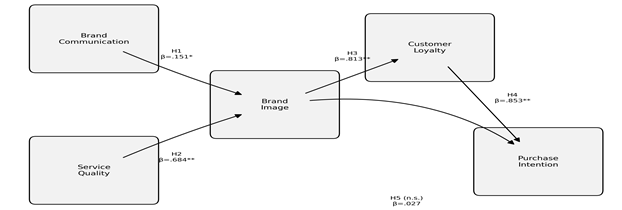
Figure 1 brings the five hypotheses together. Brand communication and service quality appear as parallel antecedents of brand image (H1 and H2). From there, the model follows two possible routes to purchase intention: an indirect route through customer loyalty (H3 and H4) and a direct route from brand image (H5). Estimating the two routes together allows the analysis to show whether image has an independent effect or whether its influence is carried mainly through loyalty. The standardized coefficients shown in Figure 1 are discussed in the results section.
Conceptual Model and Standardized Path Coefficients
Note. *p < .05; **p < .01; n.s. = not significant.
Method
Research Design and Sample
The study used a quantitative, cross-sectional survey design. The target population consisted of university students in Tehran who owned and used a Samsung smartphone. Samsung was selected because it is a widely recognized brand and was familiar to the intended respondents. University students were also accessible through online channels and generally comfortable completing a digital questionnaire. Questions about socioeconomic status and field of study were omitted to keep the survey focused on the five constructs in the model.
Participants were recruited through convenience sampling. The questionnaire link was shared by e-mail and through student groups on social media, allowing respondents to complete it privately and at a convenient time. Data collection remained open for two weeks. At the end of that period, 235 complete and valid questionnaires had been received, with no partial responses in the final dataset. The sample exceeds commonly cited minimum recommendations for survey research and structural equation modeling (cf. Krejcie & Morgan, 1970). Table 1 summarizes the demographic characteristics of the sample.
Sample Demographics (N = 235)
|
Variable |
Category |
n |
% |
|
Gender |
Female |
123 |
52% |
|
Male |
112 |
48% |
|
|
Age |
Under 18 |
10 |
4% |
|
18–25 |
86 |
37% |
|
|
26–35 |
110 |
47% |
|
|
Over 35 |
29 |
12% |
|
|
Education |
Associate degree |
14 |
6% |
|
Bachelor's degree |
80 |
34% |
|
|
Master's degree |
127 |
54% |
|
|
Doctoral degree |
14 |
6% |
Instrument
The questionnaire included demographic questions and 38 construct items adapted to the Samsung-smartphone setting. Each construct item was rated on a 5-point Likert scale ranging from 1 (strongly disagree) to 5 (strongly agree). Brand communication was measured with 4 items from Zehir et al. (2011). The 8 service-quality items covered performance, reliability, durability, and product or service variety (Azzari & Pelissari, 2020). Brand image was assessed with 12 items covering brand awareness and brand associations (Schivinski & Dabrowski, 2014; Yoo & Donthu, 2001). Customer loyalty was measured with 10 behavioral and attitudinal items, including two reverse-coded statements (Zeithaml et al., 1996; Liu et al., 2020). Purchase intention was measured with 4 items from Azzari and Pelissari (2020).
Examples from the questionnaire help clarify how each construct was operationalized. Brand-communication items included "Samsung communicates with customers respectfully" and "Samsung provides customers with timely and accurate services." Service-quality items included "Samsung smartphones are of higher quality than competing products" and "Samsung smartphones have a long useful life." Brand image was represented by items such as "When similar smartphones are discussed, I can quickly recall some features associated with Samsung" and "I can easily recognize Samsung smartphones among competing brands." Loyalty items included "When I need a new smartphone in the future, I will return to Samsung" and "I say positive things about Samsung smartphones to others." Purchase intention included "I intend to buy a Samsung smartphone in the future" and "If possible, I would buy a Samsung smartphone again." The two reverse-coded loyalty statements asked whether Samsung was used only when necessary and whether respondents hesitated to recommend it to people they knew.
The research supervisor and advisor reviewed the instrument before distribution and assessed whether the items adequately represented the intended constructs. After data collection, convergent validity was examined through Average Variance Extracted (AVE), while discriminant validity was assessed with the Heterotrait-Monotrait Ratio (HTMT).
Analytical Strategy
SPSS was used to calculate the Kaiser-Meyer-Olkin (KMO) statistic and Bartlett's test of sphericity. SmartPLS 3 was then used to assess the measurement model through indicator loadings, Cronbach's alpha, composite reliability, AVE, and HTMT, and the structural model through bootstrapped path estimates, R², Q², SRMR, and NFI. Mediation was evaluated with variance accounted for (VAF), the indirect effect divided by the total effect. Values above 80% were interpreted as full mediation, values from 20% to 80% as partial mediation, and values below 20% as no meaningful mediation.
Results
Measurement Model Assessment
The adequacy tests supported further analysis: KMO was .94 and Bartlett's test was significant, χ²(703) = 8504.60, p < .001. All indicator loadings exceeded .40. Table 2 shows that Cronbach's alpha ranged from .83 to .93, composite reliability from .89 to .95, and AVE from .59 to .83, all above the usual .70 reliability and .50 AVE criteria. HTMT was below .85 for every construct pair except customer loyalty and purchase intention (.85). Their closeness is consistent with loyalty's mediating position between brand image and purchase intention.
Reliability and Convergent Validity
|
Construct |
Items |
Cronbach's α |
Composite reliability |
AVE |
|
Brand Communication |
4 |
.83 |
.89 |
.67 |
|
Service Quality |
8 |
.90 |
.92 |
.59 |
|
Brand Image |
12 |
.93 |
.94 |
.60 |
|
Customer Loyalty |
10 |
.92 |
.93 |
.61 |
|
Purchase Intention |
4 |
.93 |
.95 |
.83 |
Structural Model and Hypothesis Tests
The model accounted for substantial variance in its endogenous constructs: R² was .64 for brand image, .66 for customer loyalty, and .76 for purchase intention. Q² exceeded .35 for all three, indicating strong predictive relevance. Model-fit indices were acceptable (SRMR = .07; NFI = .69). Table 3 reports the coefficient, t-value, significance level, and decision for each hypothesis; Figure 1 displays the same standardized estimates.
Structural Path Estimates and Hypothesis Testing
|
Hyp. |
Path |
β |
t |
p |
Decision |
|
H1 |
Brand Communication → Brand Image |
.15 |
2.11 |
.035 |
Supported |
|
H2 |
Service Quality → Brand Image |
.68 |
10.66 |
< .001 |
Supported |
|
H3 |
Brand Image → Customer Loyalty |
.81 |
41.83 |
< .001 |
Supported |
|
H4 |
Customer Loyalty → Purchase Intention |
.85 |
12.85 |
< .001 |
Supported |
|
H5 |
Brand Image → Purchase Intention (direct) |
.02 |
0.38 |
.701 |
Not supported |
Mediation Analysis
The direct effect of brand image on purchase intention was not significant, whereas the two paths that form the indirect route through loyalty were significant. Multiplying those coefficients gives an indirect effect of .69 (.81 × .85). With a total effect of .72, the indirect effect represents approximately 96.25% of the total. This exceeds the 80% VAF criterion and indicates full mediation. In practical terms, brand image influences purchase intention almost entirely by first strengthening customer loyalty rather than through a meaningful direct path.
Discussion
Antecedents of Brand Image: Brand Communication and Service Quality
The results first shed light on how brand image is formed. Brand communication has a positive effect on image (H1), which is consistent with Zehir et al. (2011), Sokolowska et al. (2022), Fatah Dizji (2021), and Eisapour and Vaseghi (2023). Respectful, responsive, and timely communication gives customers repeated signals about the character of the brand. As those signals accumulate, they reduce uncertainty and become part of the associations held in memory. Communication therefore does more than pass along information. It also demonstrates attentiveness and reliability in the relationship with customers.
Service quality is also positively related to brand image (H2), supporting the findings of Lin et al. (2021), Hosseini et al. (2015), Sao and Cuong (2021), and Fatah Dizji (2021). Its coefficient is considerably larger than the communication coefficient (.68 compared with .15). For smartphone users, this difference is understandable. Reliability, durability, performance, and feature variety are experienced repeatedly during ownership, making them concrete evidence against which brand promises can be judged. The result differs from Hsieh et al. (2018), who found no significant service-quality effect in catering. The nature and duration of the customer experience may explain part of that contrast. Communication can set expectations, but sustained product and service performance is what confirms them.
Brand Image, Customer Loyalty, and Purchase Intention
The most important result appears further down the model. Brand image does not have a significant direct effect on purchase intention (H5), yet it has a strong effect on loyalty (H3), and loyalty strongly predicts purchase intention (H4). A favorable image, then, seems to provide an evaluation of the brand without automatically creating an intention to buy. Loyalty adds the commitment needed to turn that evaluation into a continuing preference. This mechanism is particularly plausible among existing Samsung users: prior experience supports confidence, loyalty reduces the appeal of switching, and purchase intention becomes the behavioral expression of that preference. The interpretation is consistent with Azzari and Pelissari (2020) and Cardoso et al. (2022).
This mediated pattern agrees with Azzari and Pelissari (2020), but it differs from studies that report a significant direct image-intention relationship (Fardi, 2022; Ghezelbash, 2021; Mousavi et al., 2024; Norvadewi et al., 2023; Praditya & Purwanto, 2024; Savitri et al., 2022; Soltani Nejad et al., 2021; Sutrisno et al., 2023; Tabatabaei Yeganeh, 2022; Wijaya, 2023). Model specification offers one possible explanation. When loyalty is not included, part of its contribution may appear within the direct association between image and intention. Once loyalty is modeled explicitly, that commitment process becomes visible. The product context may matter as well. Smartphones are relatively durable, high-involvement purchases, so continuity and reduced switching uncertainty can be especially valuable. Brand image remains commercially important, but its influence is realized through the loyalty it creates.
Theoretical Implications
From a theoretical standpoint, the results separate more distant evaluations from the mechanism closest to intended behavior. Brand image summarizes what consumers believe and feel about the brand; loyalty turns those evaluations into commitment, repeat preference, and resistance to alternatives. The model therefore extends studies that treat image only as a direct predictor. It proposes a fuller sequence in which communication and service quality shape image, image builds loyalty, and loyalty leads to purchase intention. This sequence offers a reasonable explanation for inconsistent findings in earlier research and shows why loyalty deserves an explicit place in future brand-image models.
Managerial Implications
For managers, the path to purchase should be managed as a connected sequence rather than as a collection of separate brand metrics. Communication must be consistent across digital, traditional, and interpersonal touchpoints, and it should show that the brand listens and responds to customers. At the same time, the stronger service-quality coefficient makes clear that messages need to be supported by reliable performance, durability, useful features, and responsive service. In the smartphone category, monitoring the ownership experience is therefore just as important as measuring campaign delivery.
A favorable image should then be converted into loyalty through deliberate relationship activity. After-sales contact, effective problem resolution, customer recognition, relevant upgrade offers, and consistent treatment across channels can all help deepen attachment to the brand. Because loyalty is closely related to purchase intention, these programs should focus on customers who already show a positive connection with Samsung. The non-significant direct path also means that image-building activity should not be evaluated through awareness and favorable perceptions alone. Loyalty, recommendation, repeat consideration, and purchase intention should be tracked as successive outcomes.
Limitations and Future Research
First, the sample was limited to university students in Tehran who already owned and used Samsung smartphones. Convenience sampling may have produced a group that was younger, more digitally engaged, and more familiar with the focal brand than the wider population. These characteristics could strengthen the relationship observed between image and loyalty. The findings should therefore not be generalized automatically to other age groups, locations, brands, or product categories. Future studies should use broader or probability-based samples and compare results across demographic groups and markets.
Second, every construct was measured by self-report in the same questionnaire and at the same point in time. Recall, interpretation of the questions, and a tendency to respond consistently may have influenced several measures together. The cross-sectional design also cannot establish the temporal sequence implied by the model. The results show associations that fit the proposed explanation, but they do not prove how loyalty develops over time. Longitudinal or time-lagged research could address this limitation and could combine surveys with observed behaviors such as repeat purchase, recommendation, or switching.
Third, the model was intentionally restricted to five constructs. Other factors that may influence purchase intention, including brand trust, satisfaction, perceived price, perceived risk, and switching costs, were not included. Some of the effect attributed to loyalty may therefore overlap with mechanisms outside the present model. Future work should compare alternative specifications that add these variables as mediators or moderators. It would also be useful to test whether the mediation pattern changes with product involvement, brand familiarity, or market conditions.
Conclusion
The study began with a simple question: does brand image move consumers directly toward purchase, or does it work through loyalty? The results from 235 Samsung-smartphone users in Tehran favor the second explanation. Brand communication and service quality both strengthen brand image; brand image strengthens loyalty; and loyalty predicts purchase intention. Once loyalty is included, the direct path from image to purchase intention is not significant. The implication for managers is clear. A positive image is valuable, but it must be supported by real performance and converted into loyalty before it can be expected to influence future purchase. By examining the antecedents of image and its downstream effects together, the study provides a coherent explanation for some of the disagreement in earlier research.
References
Aaker, D. A. (1991). Managing brand equity: Capitalizing on the value of a brand name. Free Press.
Azzari, V., & Pelissari, A. (2020). Does brand awareness influence purchase intention? The mediation role of brand equity dimensions. Brazilian Business Review, 17(6), 670–685. https://doi.org/10.15728/bbr.2020.17.6.4
Bernarto, I., Berlianto, M. P., Meilani, Y. F. C. P., Masman, R. R., & Suryawan, I. N. (2020). The influence of brand awareness, brand image, and brand trust on brand loyalty. Jurnal Manajemen, 24(3), 412–426. https://doi.org/10.24912/jm.v24i3.676
Cardoso, A., Gabriel, M., Figueiredo, J., Oliveira, I., Rego, R., Silva, R., Oliveira, M., & Meirinhos, G. (2022). Trust and loyalty in building the brand relationship with the customer: Empirical analysis in a retail chain in northern Brazil. Journal of Open Innovation: Technology, Market, and Complexity, 8(2), 109. https://doi.org/10.3390/joitmc8030109
Dash, G., Kiefer, K., & Paul, J. (2021). Marketing-to-Millennials: Marketing 4.0, customer satisfaction and purchase intention. Journal of Business Research, 122, 608–620. https://doi.org/10.1016/j.jbusres.2020.10.016
Eisapour, H., & Vaseghi, F. (2023). Karafarini-ye esteratezhik bar ghasd-e kharid-e mojaddad ba naghsh-e mianji-ye tasvir-e brand va etemad [Strategic entrepreneurship and repurchase intention: The mediating role of brand image and trust at Mantra Media Decamond Medical Equipment Company]. Paper presented at the 6th International Conference on New Approaches in Management, Psychology, and Humanities in the 21st Century, Tehran, Iran. https://civilica.com/doc/1875676/
Fardi, A. (2022). Tabyin-e ghasd-e kharid-e online ba naghsh-e mianji-ye tasirgozaran ba ta'kid bar edrak-e anan az tasvir-e brand [Explaining online purchase intention through the mediating role of influencers, with emphasis on their perception of brand image]. Paper presented at the 3rd National Conference on Organization and Management Research, Tehran, Iran. https://civilica.com/doc/1463182/
Fatah Dizji, E. (2021). Baresi-ye ta'sir-e keyfiyat-e khadamat va ertebatat-e brand bar vafadari-ye moshtari dar Sherkat-e Huawei [The effect of service quality and brand communication on customer loyalty at Huawei]. Paper presented at the 4th National Conference on New Patterns of Business Management, Tehran, Iran. https://www.symposia.ir/MBAC04
Ghezelbash, A. (2021). Baresi-ye ta'sir-e fa'aliyat-haye bazaryabi-ye paydar va tasvir-e brand bar vafadari-ye moshtari ba naghsh-e mianji-ye rezayat va etemad-e moshtari [The effect of sustainable marketing activities and brand image on customer loyalty, mediated by customer satisfaction and trust: The case of Central Insurance]. https://civilica.com/doc/1376949
Hosseini, R. S., Zainal, A., & Sumarjan, N. (2015). The effects of service performance of hotel customers on quality of experience and brand loyalty in Iran. Procedia – Social and Behavioral Sciences, 201, 156–164. https://doi.org/10.1016/j.sbspro.2015.08.163
Hsieh, S. W., Lu, C., & Lu, Y. (2018). A study on the relationship among brand image, service quality, customer satisfaction, and customer loyalty – Taking ‘the Bao Wei Zhen Catering Team’ as an empirical study. KnE Social Sciences, 1768–1781. https://kneopen.com/Kne-Social/article/view/3512/3288/
Hwang, S., Lee, M., Park, E., & del Pobil, A. P. (2021). Determinants of customer brand loyalty in the retail industry: A comparison between national and private brands in South Korea. Journal of Retailing and Consumer Services, 63, 102684. https://doi.org/10.1016/j.jretconser.2021.102684
Khoirunnisa, D., & Albari, A. (2023). The effect of brand image and product knowledge on purchase intentions with e-WOM as a mediator variable. International Journal of Research in Business and Social Science, 12(1), 80–89. https://doi.org/10.20525/ijrbs.v12i1.2256
Krejcie, R. V., & Morgan, D. W. (1970). Determining sample size for research activities. Educational and Psychological Measurement, 30, 607–610. https://doi.org/10.1177/001316447003000308
Lin, Y. H., Lin, F. J., & Wang, K. H. (2021). The effect of social mission on service quality and brand image. Journal of Business Research, 132, 744–752. https://doi.org/10.1016/j.jbusres.2020.10.054
Liu, M. T., Liu, Y., Mo, Z., Zhao, Z., & Zhu, Z. (2020). How CSR influences customer behavioural loyalty in the Chinese hotel industry. Asia Pacific Journal of Marketing and Logistics, 32(1), 1–22. https://doi.org/10.1108/APJML-04-2018-0160
Malarvizhi, C. A., Mamun, A. A., Jayashree, S., Naznen, F., & Abir, T. (2022). Modelling the significance of social media marketing activities, brand equity and loyalty to predict consumers' willingness to pay premium price for portable tech gadgets. Heliyon, 8(11). https://doi.org/10.1016/j.heliyon.2022.e10145
Mousavi, S. J., Sahraei, S., & Fathi, H. (2024). Baresi-ye asar-e keyfiyat-e khadamat va tablighat-e kalami bar ghasd-e kharid-e moshtarian az forushgah-e Digikala ba mianjigari-ye tasvir-e brand va rezayat [The effect of service quality and word-of-mouth advertising on customers' purchase intention from Digikala, mediated by brand image and satisfaction]. Paper presented at the 1st International Conference on Information Technology, Management, and Computer, Sari, Iran. https://civilica.com/doc/2084428/
Norouzi, H., & Barzegar, S. (2025a). Investigating the intention of Iranian consumers to advocate luxury brands: Considering the role of purchase intention and purchase commitment. European Journal of Studies in Management and Business, 36, 16–31. https://doi.org/10.32038/mbrq.2025.36.02
Norouzi, H., & Barzegar, S. (2025b). Naghsh-e keyfiyat va etebar-e ettela'at-e dahan-be-dahan-e elektroniki dar shekl-giri-ye tamayol be kharid: Asarat-e mianji-ye mofid boodan va paziresh-e ettela'at [The role of electronic word-of-mouth information quality and credibility in shaping purchase intention: The mediating effects of information usefulness and adoption]. Iranian Journal of Information Processing and Management, 41(2), 515–547. https://doi.org/10.22034/jipm.2025.2061213.2023
Norouzi, H., & Teimourfamian Asl, R. (2023). Investigating the effects of corporate social responsibility on customer citizenship behavior with the mediating roles of corporate image and perceived service quality. Social Responsibility Journal, 19(10), 1885–1899. https://doi.org/10.1108/SRJ-10-2022-0461
Norvadewi, N., Sampe, F., Ardianto, R., & Yusuf, M. (2023). The impact of brand image and price on online product purchase decisions at Shopee. Asian Journal of Management, Entrepreneurship and Social Science, 3(01), 336–351. https://doi.org/10.63922/ajmesc.v3i01.130
Park, H., & Park, S. (2019). The effect of emotional image on customer attitude. Journal of Asian Finance, Economics and Business, 6(3), 259–268. https://doi.org/10.13106/jafeb.2019.vol6.no3.259
Praditya, R. A., & Purwanto, A. (2024). The role of viral marketing, brand image and brand awareness on purchasing decisions. PROFESOR: Professional Education Studies and Operations Research, 1(01), 11–15. https://journal-profesor.org/index.php/profesor/article/view/3
Sao, M., & Cuong, T. (2021). Relationships between service quality, brand image, customer satisfaction, and customer loyalty. Journal of Asian Finance, Economics and Business, 8(3), 585–593. https://doi.org/10.13106/jafeb.2021.vol8.no3.0585
Savitri, C., Hurriyati, R., Wibowo, L. A., & Hendrayati, H. (2022). The role of social media marketing and brand image on smartphone purchase intention. International Journal of Data and Network Science, 6, 185–192. https://doi.org/10.5267/j.ijdns.2021.9.009
Schivinski, B., & Dabrowski, D. (2014). The consumer-based brand equity inventory: Scale construct and validation (No. 4/2014 (22)). GUT FME Working Paper Series A. https://ideas.repec.org/p/gdk/wpaper/22.html
Shahmoradi, S. M. M. (2023). Ta'sir-e fa'aliyat-haye bazaryabi-ye resaneh-ye ejtemaei va tajrobeh-ye moshtari bar vafadari va tamayol be kharid ba dar nazar gereftan-e naghsh-e mianji-ye keyfiyat-e rabeteh: Motale'eh-ye moredi-ye Department-e Amoozeshi-ye Raya [The effect of social media marketing activities and customer experience on loyalty and purchase intention, considering the mediating role of relationship quality: The case of Raya educational department]. Paper presented at the 5th International Conference on New Ideas in Management, Economics, and Banking, Berlin, Germany. https://civilica.com/doc/1722706/
Sokolowska, E., Pawlak, K., Hajduk, G., & Dziadkiewicz, A. (2022). City brand equity, a marketing perspective. Procedia Computer Science, 192, 1–10. https://doi.org/10.1016/j.cities.2022.103936
Soltani Nejad, N., Soltani, N., Esfidani, M. R., & Jandaghi, G. (2021). Ta'sir-e tasvir-e forushgah va keyfiyat-e khadamat bar tasvir-e brand-e khosusi va ghasd-e kharid [The effect of store image and service quality on private brand image and purchase intention]. Business Management Explorations, 14(27), 1–26. https://doi.org/10.22034/jbar.2022.3495.1421
Sutrisno, S., Jodi, I. W. G. A. S., Putra, S. A., Bakhar, M., & Hanafiah, A. (2023). Analisis pengaruh brand image dan brand awareness terhadap keputusan pembelian produk minuman street boba [Analysis of the effect of brand image and brand awareness on purchase decisions for Street Boba beverage products]. Management Studies and Entrepreneurship Journal, 4(1), 571–578. https://garuda.kemdiktisaintek.go.id/documents/detail/3991269
Tabatabaei Yeganeh, Z. S. (2022). Baresi-ye ta'sirat-e tajrobeh-ye brand, tasvir-e brand va etemad be brand bar delbastegi-ye brand va ghasd-e kharid: Masraf-konandegan-e gooshi-haye iPhone dar Iran [The effects of brand experience, brand image, and brand trust on brand attachment and purchase intention: A study of iPhone consumers in Iran]. Interdisciplinary Studies in Marketing Management Quarterly, 1(1), 135–153. https://journals.iau.ir/article_694617.html?lang=en
Wijaya, K. S. (2023). The influence of brand image and trust on purchase decisions in TikTok Shop. Journal Research of Social Science, Economics, and Management, 3(1), 1–13. https://doi.org/10.59141/jrssem.v3i01.516
Yoo, B., & Donthu, N. (2001). Developing and validating a multidimensional consumer-based brand equity scale. Journal of Business Research, 52(1), 1–14. https://doi.org/10.1016/S0148-2963(99)00098-3
Zehir, C., Sahin, A., Kitapci, H., & Ozsahin, M. (2011). The effects of brand communication and service quality in building brand loyalty through brand trust: The empirical research on global brands. Procedia – Social and Behavioral Sciences, 24, 1218–1231. https://doi.org/10.1016/j.sbspro.2011.09.142
Zeithaml, V. A., Berry, L. L., & Parasuraman, A. (1996). The behavioral consequences of service quality. Journal of Marketing, 60(2), 31–46. https://doi.org/10.1177/002224299606000203

Page 1 of
Download Count : 3
Visit Count : 7
Keywords
Brand Image; Brand Communication; Service Quality; Customer Loyalty; Purchase Intention

Author(s) Information



How to cite this article
Norouzi, H., & Talebi Darestani, K. (2026). Brand communication, service quality, and brand image: A mediated path to purchase. Marketing and Branding Research, 13(1), 1-13. https://doi.org/10.32038/mbr.2026.13.01.01
Acknowledgments
Not applicable.
Funding
Not applicable.
Conflict of Interests
No, there are no conflicting interests.
Open Access
This article is licensed under a Creative Commons Attribution 4.0 International License, which permits use, sharing, adaptation, distribution and reproduction in any medium or format, as long as you give appropriate credit to the original author(s) and the source, provide a link to the Creative Commons license, and indicate if changes were made. You may view a copy of Creative Commons Attribution 4.0 International License here: http://creativecommons.org/licenses/by/4.0/