






Perspective Article
Beyond Reputation: Ethical Employer Branding and the Future of Human-Centred Organisations


- Abstract
- Full text
- Metrics
Organisations increasingly realise that employer branding is not only about talent attraction but also includes ethical governance, organisational culture, and long-term stakeholder relations. This work presents a narrative synthesis of evidence integrating contemporary literatures in employer branding with stakeholder theory, signalling theory, Corporate Social Responsibility (CSR), Environmental, Social and Governance (ESG), Diversity, Equity and Inclusion (DEI) as well as human-oriented organisational design to create an integrated conceptual framework. The synthesis explores the role of ethical employer branding as a strategic tool for talent attraction, engagement and retention to combine organisational resilience and sustainability. It also explores the interaction of employee value proposition, governance and leadership, stakeholder engagement, authentic organisational practices and digital communication to create credible employer brands. It concluded that ethical employer branding has the greatest potential as an organisational capability conceptualised not necessarily as a recruitment or communications tool, but primarily in terms of developing a governance driven authentic human resource practice aligned with the employee value proposition, stakeholder engagement and ESG commitments. This holistic perspective provides practical insights for implementing robust, human-centred corporate forms that can sustain work and trust, organisational legitimacy and long-term competitiveness in an increasingly transparent socio-technical context.
Beyond Reputation: Ethical Employer Branding and the Future of Human-Centred Organisations
Michael Oyedele Oyenuga
School of Business, Woxsen University, Telangana, India
ABSTRACT
Organisations increasingly realise that employer branding is not only about talent attraction but also includes ethical governance, organisational culture, and long-term stakeholder relations. This work presents a narrative synthesis of evidence integrating contemporary literatures in employer branding with stakeholder theory, signalling theory, Corporate Social Responsibility (CSR), Environmental, Social and Governance (ESG), Diversity, Equity and Inclusion (DEI) as well as human-oriented organisational design to create an integrated conceptual framework. The synthesis explores the role of ethical employer branding as a strategic tool for talent attraction, engagement and retention to combine organisational resilience and sustainability. It also explores the interaction of employee value proposition, governance and leadership, stakeholder engagement, authentic organisational practices and digital communication to create credible employer brands. It concluded that ethical employer branding has the greatest potential as an organisational capability conceptualised not necessarily as a recruitment or communications tool, but primarily in terms of developing a governance driven authentic human resource practice aligned with the employee value proposition, stakeholder engagement and ESG commitments. This holistic perspective provides practical insights for implementing robust, human-centred corporate forms that can sustain work and trust, organisational legitimacy and long-term competitiveness in an increasingly transparent socio-technical context.
KEYWORDS:
ESG, Ethics Washing, Employer Branding, Human-Centred Organisations, Signalling, Stakeholder Theory, Sustainability
The future of work centres on organisations that combine a solid ethical base with human-centred approaches, where employer branding goes beyond reputational signalling to become embedded, practised, and edge organisational identity. In such a context, employer branding is more than just a communication around talent acquisition; it is a transformative approach to enact corporate culture change, governance, and employee experiences that deliver value creation for people, markets, and society over the long run. From the perspective of potential (and existing) employees, ethical considerations such as fairness and transparency in hiring, environmental stewardship, and social responsibility are all foundational to how they perceive an employer and desire to invest their career there. This change is seen in research connecting ethics and sustainability with employer branding: ethical labour practices and ecological commitment can become the core of an organisation's value proposition that shapes its attractiveness, drives its employee engagement and retention (Kurniawan et al., 2020; Szegedi et al., 2023).
A core theoretical underpinning is the belief that employer branding operates within a social contract between organisations and their people. Employees read these signals as commitment, representation and trust when organisations decide in line with their own value statements and decision-makers behave ethically. That level of ethics and other signals from the organisation set the terms of engaging with potential as well as current employees, and is consistent with broader literature showing ethical leadership and authentic CSR positions constitute a credible employer brand (Jain & Bhatt, 2015; Strobel et al., 2010). Consequently, employer branding needs to weave together CSR and ethics with people-oriented HR practices into integrated genuine branding that employees can see, touch and feel as part of the everyday rhythm of work (Khdour, 2021; Panaccio et al., 2023; Raj et al., 2022).
In practice, ethical employer branding concerns and connects human resource management, corporate communication and strategy. It needs internal alignment so that recruitment messaging, career development, reward structures and work-life balance align with lived experience and external signalling through transparent reporting, responsible governance now in place and clear investments in employee well-being. Several strands of empirical work identify important levers: compensation and benefits; development opportunities; CSR engagement; organisational culture; and reputation as both attractors and retainers, with significant migration differences by sector, region, and demographics. Additionally, the evidence base highlights potential mediating and moderating factors that may amplify or dampen the effects of branding on retention and performance (Graham & Cascio, 2018; Huseynova et al., 2022; Maheshwari et al., 2017; Panaccio et al., 2023; Raj et al., 2022; Yameen et al., 2020).
An increasing amount of work asks for a new view toward employer branding as not a static image, but rather an evolving and co-built experience. From here, employer branding unfolds in daily conversations, behaviours and habits that indicate an organisation’s approach to people and society (Raju, 2023; Srimulyani & Hermanto, 2022). In this sense, ethical employer branding is a boundary-spanning endeavour that draws a connection between different human resource systems within the organisation and external communications, stakeholder engagement, and policy contexts to facilitate workplaces which are not only attractive but truly humane and responsible.
The research uses a narrative evidence-synthesis approach, integrating contemporary literature in the fields of employer branding, stakeholder theory, signalling theory, corporate social responsibility (CSR), environmental, social and governance (ESG), diversity, equity and inclusion (DEI) and human-centred organisational design formulate a conceptual perspective.
The sections that follow will explore how ethical employer branding translates into human-centred organisational design, governance, and leadership in a circular and sustainable economy. They will examine how employer branding interacts with CSR, diversity and inclusion, health and well-being, and workforce development to produce a brand that is credible in the eyes of employees and resilient in the face of evolving societal expectations.
Conceptual Foundations of Employer Branding
Defining Employer Branding
Employer Branding (EB) is a strategic practice of influencing how an organisation is viewed as an employer by current employees, prospective recruits, or other stakeholders. It combines branding ideas with human resource management to describe and promote a unique Employee Value Proposition (EVP) articulating why good people should work for, stay with, and contribute to the organisation. EB has two sides: internal and external (Figure 1). The internal dimension relates to culture, leadership, company perks, working conditions and the everyday experience of live employees, while the external element deals with communications, recruitment messages and perceived signals that shape a wider labour market. This definitional core positions EB at the crossroads of HRM, marketing, and CSR, and embraces its potential as a strategic asset instead of purely a communications device (Baum, 2019; Ning et al., 2023; Sharma et al., 2024).
A germinal distinction in the literature involves that between employer branding and similar constructs such as internal branding and HR marketing. EB relates to the focused effort of marketing the organisation as an employer, which shapes perceptions about the organisation's culture and values, along with perceived employment experience among job seekers and employees in general (Saleem & Iglesias, 2016). Internal branding, by contrast, focuses on aligning and engaging employees with the brand from within through culture and HR practices; a related but distinct idea, and many authors treat EB as the outward-facing counterpart to internal branding (Kravariti et al., 2021). Typically, the theories upon which EB is based are branding theory, signalling theory, social exchange and human resource management to explain how these reputational signals translate into attraction, engagement and retention in the labour market (Chaudhary & Khanal, 2023; Voronkova et al., 2024).
One established perspective on EB is the employee value proposition (EVP), which describes the set of tangible and intangible benefits that an organisation offers to employees in return for their skills and contributions (Vieira et al., 2024). The EVP includes things like compensation and benefits, career development, work-life balance, organisational culture, meaning and purpose and social and environmental values. When EVP is credible, differentiated and consistently delivered, EB reinforces talent attraction and retention and contributes to wider organisational performance (Voronkova et al., 2024). EB is established through a combination of recruitment communications, HR practices and real workplace experiences; this coherence between the external messaging, internal policies and lived experience of employees is critical for strong EB (Ning, 2023).
EB has evolved from systematic literature reviews and frameworks to empirical analyses across sectors and regions. Sarabdeen et al. (2022) and Strobel et al. (2010) consider EB to be an interdisciplinary artifact incorporating marketing and HRM dimensions, whereas Tulbure and Popescu (2023) focused on measures, outcomes and contextual characteristics like generation, culture and industrial sector. EB’s success hinges on credible signalling, alignment between espoused and lived values, as well as leadership and governance that embody the brand promise within the organisation (Graham & Cascio, 2018; Maheshwari et al., 2017; Raj et al., 2022; Yameen et al., 2020).
In practice, EB is increasingly described and defined as an experience that evolves over time rather than a static one. This reframing acknowledges that potential employees now consider EB on the basis of true employee stories, peer reviews, and visible commitment to diversity, equity, inclusion and sustainability as well as well-being (Srimulyani & Hermanto, 2022) instead of curated narratives. Consequently, EB design integrates HR processes, corporate communications, and governance mechanisms to produce a credible and sustainable employee experience that can adapt to shifting labour-market expectations and societal norms (Raju, 2023; Sandeepanie et al., 2022; Vieira et al., 2024).
The Two Sides of Employer Branding
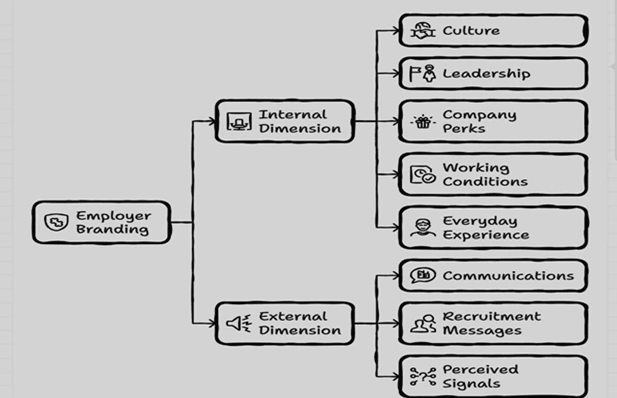
Note: Image generated using AI
Theoretical Perspectives
Stakeholder Theory and Employer Branding
Employer branding is transactional in two senses: firstly, relational and in terms of what goes on outside a firm to which they are selling employment (outside firms' internal human resource practices); secondly, in terms of the range of stakeholders that make up an interaction, they not only define but are defined by an organisation’s employee value proposition. Stakeholder theory will help frame the employer brand as a normative and descriptive approach, exploring how it is constructed, communicated, and interpreted by employees, job seekers, customers, suppliers, regulators, communities, and investors. So, instead of seeing an employer brand as a one-way message from the firm to the market, in this perspective, it becomes an ongoing negotiation among multiple actors with divergent interests, values and power (Wickham et al., 2025). The more firms identify relevant stakeholders, recognise their claims, and weave their concerns into strategy making and day-to-day practice, the more legitimacy, coherence, and credibility an employer brand would have. The opportunity is to learn from stakeholders how well CSR signals, ethical leadership, workplace culture and labour practices resonate with those who care most about the organisation’s ability to attract and retain talent (Sharma et al., 2024).
A core implication of applying stakeholder theory to employer branding is that the EVP must resonate with the values and expectations of multiple groups, not only prospective employees. Through these interactions, as well as with its communications and observable practices, stakeholders negotiate the meaning of the brand (Ali & Vargas‐Hernández, 2024). Signalling theory explains that credible signals, such as transparent CSR reporting, fair labour practices and inclusive policies go a long way in reducing information asymmetries, restoring trust and strengthening employer branding. Where stakeholders see congruence between the communicated and actual actions of organisations they help legitimatise brands through advocacy, referral of talent, social endorsement; in turn helping underpin attractiveness to and retention within diverse pools (Thomas, 2024; Trkulja et al., 2024; Westerbeek, 2025).
Employees are not simply passive recipients of the EVP but active co-creators of brand meanings through daily behaviour, word-of-mouth and social media presence. Their voice signals to multi-stakeholders that a company can be trusted. As employees assimilate and act on brand values, their lived experiences and behaviours reinforce external branding communications toward the overall collective result of increased EBBE (employer-based brand equity) and enhanced future organisational appeal to potential talent (Jacobson et al., 2022). This paired relationship signals a mutually influential interaction where internal stakeholder experiences flow outward to shape their external reputational impact, an effect well documented within studies of internal branding, CSR signalling and employee-led branding activities (Santos et al., 2023; Su, 2025).
Employer branding is also shaped by other stakeholders, including customers, suppliers, regulators and the community who have increasing expectations for corporate citizenship, ethical governance and social impact (Kashive et al., 2020; Wickham et al., 2025). Companies that work with those external stakeholders openly and constructively can leverage broader CSR ambitions into meaningful employer value propositions. When credible, consistent with the organisation's past behaviour, and enacted through other practices, these external CSR signals increase organisational attractiveness to job applicants who are concerned about social purpose, ethical conduct and long-term sustainability. Such a cross-stakeholder perspective relates to research suggesting that CSR motives can be linked to employer branding as well as perceived organisational legitimacy, which all support the notion of viewing employer branding as a stakeholder-centric strategic instrument rather than a unilateral communications activity (Kim et al., 2025).
In stakeholder-centred employer branding, one important fact is to avoid stakeholder symbolism without effective action (Chaudhary & Khanal, 2023). Ethically, brands should avoid “ethics washing”, where superficial or performative CSR signals are issued to cover up poor governance practices or bad labour behaviours. Credibility results from congruent alignment of leadership behaviour, governance mechanisms, internal HR processes and external communications, where signals do not align with practice, credibility is eroded (Saleem & Iglesias, 2016), which negatively impacts the trust of all stakeholders and reduces the capacity of an employer brand to attract and retain talent. This drives home the importance of continued stakeholder engagement, accountable promises and transparent reporting as core principles of credible EB approaches (Ali & Vargas‐Hernández, 2024; Pich et al., 2025).
Diversity and inclusion figure prominently within stakeholder-informed EB. A stakeholder approach recognises that diverse groups, including different generations, genders, cultures, and career stages, have distinct expectations from an employer brand (Kim et al., 2025). Integrating DEI into the EVP and legitimizing (through hiring, development, evaluation and workplace practices) all stakeholder coalitions is necessary to attract/retain talent pool in a global labour market. CSR and EB initiatives are fallouts observed in empirical work across the sectors that drive the institutionalised logic of stakeholders (Abratt & Kleyn, 2023; Тягунова, 2023).
In short, from a stakeholder theory perspective, ethical employer branding must be seen as actor-oriented and governance-driven multi-actor business management in which the EVP, CSR signals and organisational practices need to coherently integrate what is important for employees and a broad range of external stakeholders. The trustworthiness and longevity of an employer brand is built on genuine involvement, open accountability, and a clear connection between what the organisation says it does, and how it shows up at every stage of the employment experience. This perspective helps to build the integration of inclusive stakeholder dialogue, credible governance and measurable social impact as policy to help employer branding designers prepare a truly responsible institution that is human-centred.
Human-Centred Organisations: A New Paradigm
This radical re-orientation is evident in contemporary debates about organisational design that are so human-centred as to promote organisations designed around people and work harmonisation, with governance and strategy designed with dignity, belonging and purpose (Fasanmi et al., 2025). This framework views employees, not as a cog in a wheel of the machine, but rather as equal co-creator of value, where employees’ well-being development and voice can dictate the trajectory of organisational outcomes. Simmons (2009) and Oyedele et al. (2023) maintain that ethics, stakeholder participation and human-centric design take precedence over performance in terms of resilience and sustainable success.
As Pandey (2023) contends, human-centred organisations weave practices of trust, inclusion and meaning into everyday structures, strategies and systems to cultivate these attributes as prime movers of attraction, engagement and retention where organisational adaptability is a key consideration in times of fast-paced change and complex value networks. As such, future-oriented organisations will need to bring together governance, culture and strategy in ways that uplift people whilst providing sustained value for customers, partners and society (Pitt et al., 2019; Raj et al., 2022).
One of the key tenets of this paradigm is that organisations attain sustainable performance when individuals are empowered to engage in decision-making, design and governance processes (Omale et al., 2021). This participatory orientation aligns with stakeholder theory and co-creation literature that highlight the need for strategy and practice to be influenced by diverse voices: employees, customers, suppliers, communities and regulators (Itam et al., 2020). Organisations showcase legitimacy and authenticity when employees participate in branding. CSR signalling and internal governance facilitate trust and commitment across workforce groups as well as a broader stakeholder base (Boukis & Christodoulides, 2018; Мокіна, 2014). In human-centred organisations, leadership embodies ethical practices, nurtures a psychologically safe environment and exemplifies a sincere investment in well-being and development, thus influencing not only the internal culture but also external views of the organisation as an ethical employer and good corporate citizen (Xiao et al., 2023; Elbendary et al., 2023).
A second dimension concerns the integration of ethics, transparency, and accountability into everyday organisational life. Ethical employer branding, an extension of the broader ESG discourse, requires credible signalling, transparent reporting, and demonstrable impact in labour practices, diversity and inclusion, sustainability, and governance (Hoppe, 2018; Manoharan et al., 2023). Credibility requires that promises made by a brand find expression in lived practices, where challenges demand accountability and are most effectively resolved through clearly defined behaviours of leadership backed by appropriate governance structures (Gawande & Kumar, 2022). To avoid ethics washing, organisations must translate their ethical commitments into policy, practice, and performance measurement (Puncheva‐Michelotti et al., 2018; Raj & Manjusha, 2022), engaging stakeholders in dialogue on a continuous basis and through independent verification of claims
More so, leading human-centred organisations must consider Diversity, Equity and Inclusion (DEI) core to strategy and culture (Apata & Oyenuga, 2025). Linking DEI with innovation, resilience and talent attraction redefined employer branding as osmosis of inclusive values through recruitment, development and reward systems. Extending DEI into EVP design, governance and reporting in order to bolster legitimacy across diverse stakeholder groups as well as equitable access to opportunity whether by virtue of a title or group membership, which supplements career path-based advancement. DEI can raise the attractiveness and performance of an organisation, when integrated into strategy and everyday practice, not weak and implausible slogans but signals of true moral prioritisation (Sheikh & Lim, 2015; Yasin et al., 2022).
On the other hand, employee voice and participatory branding also arise as a clear sign of human-centred organisations. But employees are more than just beneficiaries; they are co-designers of branding, CSR and workplace practices. From this perspective, trust is reinforced and brand legitimacy is boosted, with positive advocacy facilitated through both internal mechanisms and social media. Therefore, a more credible and attractive employer brand is one that features employees in all branding processes, particularly when their insights shape HR policies and CSR initiatives (Younis & Hammad, 2020) which subsequently drive higher retention rates and employee dedication (Deepa & Baral, 2021; Gupta, 2015).
In effect, this is a far-reaching paradigm shift demanding a new organisational architecture built upon distributed leadership, co-operative governance and open accountability. It consists of aligning talent management and CSR signalling and external communications with internal cultures and processes resulting in the employer brand being a true reflection of lived values. Therefore, the design of human-centred organisations includes governance mechanisms that welcome stakeholder engagement, HR practices emphasising well-being and development, and branding strategies expressing ethical commitments throughout the employment lifecycle. As the literature suggests, sustainable leadership and boundary-spanning collaborations are crucial and will help maintain this alignment under conditions of internal turbulence, reactive market volatility, and societal expectations.
ESG, Sustainability, and Employer Branding
The domain of employer branding has transitioned from recruitment storytelling to an all-message signalling system that conveys an organisation’s dedication towards Environmental, Social and Governance (ESG) values (Saini et al., 2021). Sustainability signals including environmental stewardship, ethical labour practices, transparent and accountable corporate governance and social responsibility are increasingly the lens through which potential employees assess current employers in the contemporary labour market (Raju, 2023). The increasing convergence of the literatures on CSR, ESG, and branding demonstrates this shift where strong sustainability commitments become part of Employer Value Propositions (EVPs) in competitive talent markets that attract, engage, and retain talent (Andruszkiewicz et al., 2024; Hu et al., 2025; Poturak & Mulaahmetović, 2022; Saini et al., 2022; Simmons, 2009). If sustainability signals are authentic and embedded at the core of how the organization operates, they help promote organizational ethics and strengthen a more cohesive and intergenerational employer brand that resonates with talent across generations; in particular, Gen Z candidates fortified by environmental credentials represent one-third of potential recruits globally (Camilleri et al., 2024; Hu et al., 2025).
One of the core premises is that firms can build an ESG-driven employer brand on the foundations of signalling theory: signals about companies' ESG posture allow prospective workers to close the information asymmetries and align with long-term value, which baselines alignment with their values. The ease of acquiring Corporate Social Responsibility disclosures, sustainability reports, ESG ratings, third-party verifications, and indirect signals is a day-to-day practice that affects workplace climate and whether employees (and applicants) see these values put into practice. In other words, it is proven that ESG signalling a large growth in credibility gives a significant contribution to perceived legitimacy and attractiveness for employment as well as moderation between recruitment and retention outcomes, especially when enhanced by employees' own governance experiences (Hu et al., 2025; Kim et al., 2025; Luo et al., 2023). In digital settings, employer branding relates to online reviews, social media and employer branding platforms with ESG narratives being explored more thoroughly as well as magnified; these are trends driven by the increasing demand for authenticity and accountability (Luo et al., 2023; Simmons, 2009).
ESG aligned EB needs both internal and external integration. It aims to map a more integrated structure of employer branding concepts with CSR, ESG, and HRM, attaching ethical and sustainable values that, through people-management processes, are evidenced in EVP elements framed by governance and transparency. The confluence of original internal branding, CSR signalling and ESG disclosures substantiates the claim that the alignment of internal HR practices with external messaging enhances employee brand equity as well as organisational attractiveness. This integrated lens reinforces that ESG commitments should be embedded in policy, practice and performance measurement of organizations rather than being limited to communications on the periphery or philanthropic endeavour (Luo et al., 2023; Simmons, 2009).
Digital platforms and ESG signaling are redefining employer branding by mediating corporate narratives through the aggregation of ESG data, employee feedback, and stakeholder commentary. The credibility of EB in this context depends on consistent, transparent, and verifiable ESG practices that users can observe across channels. Digital channels amplify both the reach and the scrutiny of ESG signals, making authenticity and governance more consequential for attraction and retention in a diverse workforce (Hu et al., 2025; Itam et al., 2020; Michelotti et al., 2018; Pandey, 2023; Puncheva‐Luo et al., 2023).
Designing Ethical Employer Brand Experiences
Designing ethical employer brand experiences in the digital era requires an integrated approach across five interlocking levers (Figure 2): (1) mapping the employee journey to surface ethical signals and experience gaps; (2) embedding ethical touchpoints across the entire employment lifecycle; (3) enabling genuine employee involvement in co-creating the employer brand and CSR agenda; (4) balancing internal branding with externally credible signaling; and (5)the measurement of authenticity and trust.
Employee Journey Mapping: Employee journey mapping considers the employee experience as a continuous multi-channel journey from pre-employment to post-retirement, pinpointing touchpoints where perceptions of ethics, fairness, and organisational values are established (Santos et al., 2023). Using this map, recruitment, onboarding, development, performance management, rewards, and well-being practices are integrated with an alumni mapping process at the organisational level to identify where signals of ESG commitments align or not. The best journey maps highlight disconnects between stated values and lived experiences, allowing organisations to close the value gap, even at the policy, governance and practice stages of lifecycle alignment with the employer value proposition (EVP) (Andruszkiewicz et al., 2024). In digitally mediated settings, journey map elements are composed of online reviews, social media discussions, and platform engagement, as genuine reflections of an employer's authenticity and ethical alignment (Luo et al., 2023; Yasin et al., 2022).
Ethical Touchpoints Across the Employee Lifecycle: Ethical touchpoints are moments of interaction where employees assess the truth of an employer’s claims about fairness, safety, inclusion, and social purpose (Strobel et al., 2010). These include recruitment messaging, interview experiences, onboarding rituals, performance feedback, promotion decisions, disciplinary actions, health and safety commitments, and offboarding. convey consistent and ethical ESG signals to avoid suspected ethics washing. Transparency regarding policies, the establishment of clear mechanisms for handling complaints, and the fulfillment of promises regarding employee well-being represent significant steps towards building trust and minimizing the cognitive dissonance created by brand narratives versus workplace realities. For instance, touchpoints of undertakings that are consistent with CSR signalling activities, DEI initiatives, and employee wellness can enhance evaluations of authenticity and commitment to the organisation (Raj & Manjusha, 2022; Sarabdeen et al., 2022).
Co-creation of Employer Brand with Employees: This enables employees to be co-creators of the employer brand and thus partners in EVPs, governance, and communications (Hesse et al., 2022). This includes participatory branding practices, employee-generated narratives, crowdsourced feedback and participation in CSR and inclusion initiatives. Co-creation leads to authentic branding because what employees actually feel and experience is embedded in its interpretation (Kristia, 2023). Employer branding is backed by research indicating that the authenticity and resilience of an employer brand, and its appeal to multiple talent segments, are enhanced when employees are involved in branding processes (Simmons, 2009). Such a practice will also bring to the fore the mismatch between corporate rhetoric and working reality and allows for real time course corrections to policies and programs that support the EVP (Younis & Hammad, 2020).
Internal Branding and External Signalling: Ethical EB consists of interdependent activities such as internal branding, and external signalling. Internal branding directly aligns culture, HR practices, and everyday activities with the brand promise to ensure employees are not merely receivers of messages but co-architects of relevance within a statement (Westerbeek, 2025). External signalling describes organisational internalities in communications that effectively attract new talent and communicate to stakeholders the sustainability of their actions (Pich et al., 2025). Integration is smooth when internal experiences and external communications operate the same values with similar actions, which builds trust and reduces reputational risk. Dissonance between internal narratives and external cues not only creates the risk of ethics washing (Raja & Manjusha, 2022) but also adversely impacts brand credibility (Santos et al., 2023).
Measuring Authenticity and Trust: Measuring ethical employer brand and trust must necessarily capture perceptions and experiences across the employee lifecycle across platforms in a multi-dimensional manner. It contains dimensions like perceived fit between EVP and day-to-day behaviour; degree of trust in ESG disclosures; employee voice/participation, leveraging influence on DEI outcomes; power to make or break trust through platform mediated signals (platforms); employee reviews/social posts. It comprises all relevant data from surveys, sentiment analyses, validated measures of organisational trust and brand equity in the employer space, governance audits, as well as examinations of employee development and people management processes. Good EB can best be demonstrated by ongoing, measurable behaviours and visible accountability systems using a common measurement in the area of branding that indicate continuous improvement (Kim et al., 2025; Pitt et al., 2019; Raj et al., 2022).
Designing Ethical Employer Brand Experiences in the Digital Era: An Integrated Framework
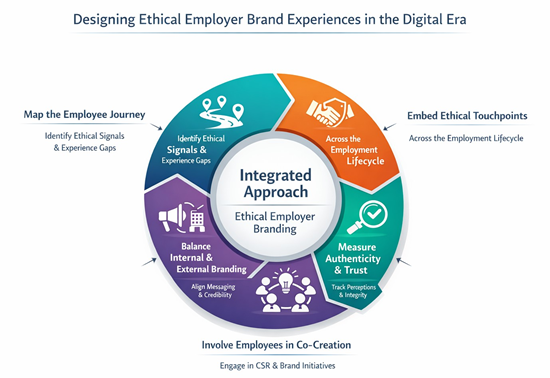
Note: Image generated using AI
Challenges of Ethical Employer Branding
The search for responsible Employer Branding (EB) happens against a backdrop of competing impulses, expanding regulatory scrutiny and technological change. However, organisations are facing the opposing pressures of authentically demonstrating leadership and navigating a tough talent market with millennials and Gen Z professionals. Signals related to CSR, labour practices and governance need to be systematized into actions that can be verified on a daily basis; otherwise, stakeholders dismiss the brand as fake or ethics-washing. This risk is amplified in the digital age, where online reviews, social media discourse, and platform narratives can amplify genuine commitments as well as perceived failures, which means credibility is both more precious and fragile (Saini et al., 2022; Simmons, 2009). Internally, alignment is also a moving target. When the promises represented by employer value propositions (EVPs), such as fair pay, development opportunities, and healthy work environments, do not integrate coherently with HR practices, performance management, and daily routine, employer branding loses its essence (Luo et al., 2023).
The second category of barriers is related to governance, measurement and accountability. The governance architectures that yield the best ethical EB results integrate ESG signals seamlessly into talent management, governance reporting and stakeholder engagement. If not rigorously audited, independently verified and transparently remedied, signalling could simply be virtue-signalling. This creates a dissonance between what was promised (not converting complaints into tangible improvements, when this happens are aired in public forums like social media or review sites increases the chances of reputation damage when dealing with internal issues) and practice which restricts trust (Li, 2022; Raj & Manjusha, 2022). In addition, measuring authenticity and trust beyond a single channel or lifecycle stage is methodologically difficult. This requires multi-dimensional metrics that not only track EVP alignment, EVG disclosures' credibility, employee voice, DEI results and the resonance of platform-mediated signals (Kim et al., 2025; Raj et al., 2022; Тягунова, 2023).
Perspective-taking is another important barrier. Employee have different views of what it means to act ethically and be a credible corporate citizen: customers, suppliers, regulators, communities. Performing to all of these standards absent a singular EVP is inherently complex; divergence will only serve to undermine authenticity and the trust of key constituencies. The literature particularly highlights the need for stakeholder mapping and governance mechanisms that facilitate coordination in cross-actor signalling, transparency, and accountancy to enable credible EB within multi-stakeholder ecosystems (Aggerholm et al., 2011; Boukis & Christodoulides, 2018).
While, this expansion presents a spectrum of new strategic opportunities, the dynamics of the digital age challenges in return. Digital platforms create a larger audience for ESG stories but they also heightening the risk of scrutiny and reputational fallout associated with signals that do not match lived experiences. Another challenge for EB is how AI works in recruitment as well as issues of algorithmic fairness and data privacy (Oyenuga, 2025). If digital processes are opaque and unjust, it will not only do reputational harm to the employer brand but also cause loss of talent. Rather, they need organisations to intentionally transform their digital EB practices in a way that we can responsibly audit and explain them as inclusive; technology should be used to strengthen, not weaken the ethical signalling (Hu et al., 2025; Luo et al., 2023).
DEI commitments introduce additional tensions. While it is true that DEI signals can strengthen employer attractiveness and innovation, disingenuous or opportunistic DEI initiatives will invite skepticism and reputational backlash if not embedded in governance, opportunities, and outcomes. Commitment to DEI principles grounded in values and leveraged throughout EVP design, recruitment, development pathways, and advancement pathways is fostered by governance processes that help monitor progress with transparency regarding outcomes (Kim et al., 2025).
Finally, the external environment; policy, regulation, and expectations of society affects to what extent EB can be ethical. How organisations signal intentions and how employees receive them is shaped by regulatory requirements, disclosure standards, and sustainability norms. Firms are also confronted with the need to convert high-level regulatory expectations into commensurate and credible operational practices that fit naturally within everyday work life but remain nimble to cope with changes in norms and standards. Alignment between ESG strategy and branding, HRM, and CSR is needed to minimize misalignment and leverage sustainability attributes to build a sustainable competitive advantage in talent markets (Hu et al., 2025; Kim et al., 2025; Simmons, 2009).
Strategic Implications of Employer Branding for Organisations
In knowledge-intensive and service-oriented contexts, Employer Branding (EB) increasingly functions as a strategic governance tool that shapes talent pipelines, organisational culture, and ultimately long-term value creation. At the more advanced end of maturity, EB claims are strategic in nature in that they align the Employer Value Proposition (EVP) with higher-order corporate strategy and social legitimacy, such that signals communicated through recruitment or development as well as through everyday practice reinforce a competitive advantage over the longer term by virtue not merely of communicating desirability. EB operates in the nexus of branding, human resource management and CSR with consistent alignment between internal practices, external communication and realised behaviour ultimately leading to authenticity, trust and commitment for current and potential employees (Raj et al., 2022).
An essential strategy implication is the need for coherence of governance between internal and external signalling. To translate EB into a sustainable organisational advantage, firms must ensure that EVP elements are embedded in HR policies, performance management and governance reporting such that what is said on the outside matches what is done on the inside. The idea behind EB is that when both internal and external signals align, EB strengthens organisation legitimacy, recruitment efficiency as well as engagement and retention leading to performance outcomes across different contexts (Ning, 2023; Raj & Manjusha, 2022; Vieira et al., 2024). On the other hand, misalignment of brand promises with bad practices we can think of would damage reputations and increase turnover, especially in high-scrutiny contexts where digital transparency exposes mismatches between ESG commitments and labour practices (Li, 2022; Raj & Manjusha, 2022).
The second strategic implication relates to how DEI and ESG are integrated into the employer branding framework. DEI signals create an authentic EB that resonates with diverse talent pools and aligns them with sustainable development goals, as part of a broader EVP complemented by an equitable approach to recruitment, developmental and progression pathways. There is authentic DEI signalling which needs to be regulated from the top down by governance structures with clear accountability layers but there should also be transparency across all levels for the organisations benefit as a stronger organisation will attract better talent through retention and resilience This integration is also associated with ESG signalling as environmental stewardship and social responsibility thread the EE in changing labour markets (Kim et al., 2025).
Interplay of employer branding with employee voice and co-creation is strategic. When employees are involved in EVP design, CSR program development, and internal branding activities, these can become real-life brand narratives that build credibility with external stakeholders. Employees genuinely represent the ambassadors, and management receives in-the-field signals as to how their values manifest within the life of their organisation. Research finds that this enriches EB leading to deeper brand equity and hence adaptability to market and societal changes, more so in conjunction with transparent governance and inclusive signalling (Kristia, 2023; Simmons, 2009).
The digital era intensifies both opportunities and risks. Social media, employer review platforms, and AI-enabled recruitment practices enable rapid dissemination of EB signals but also magnify scrutiny. Ethical signalling requires auditable recruitment processes, fair algorithmic practice, and transparent ES&G disclosures; it also necessitates robust mechanisms to counter misinformation and perceived manipulation. The primacy of credible, verifiable signals and ongoing governance is needed to mitigate greenwashing and ethics washing while leveraging digital channels to communicate authentic progress and outcomes (Hu et al., 2025; Luo et al., 2023; Simmons, 2009).
Conclusion
Ethical Employer Branding (EB) practice in the modern world is a strategic, governance-driven approach rather than just communication. Organisations that combine a credible Employee Value Proposition (EVP) with genuine practices on an everyday basis and those that are aligned in their internal human resources processes, CSR signals and external communications will have a competitive edge over others in attracting talent, retaining employees and sustaining branding across a multitude of stakeholders. The literature is unanimous in the essential premise that signals about CSR, ESG, pay equity, and workplace well-being only gain credibility when they are consistently executed across governance, management and culture and when employee experiences materialise the brand promise. This is further challenged in the digital era across online reviews and social platforms, creating a situation where both authenticity and accountability are more relevant than ever as they become visible through platform-mediated interactions. This is why strategic EB calls for integrative action: not only ethical behaviours from leaders, governance with ESG dimensions integrated into talent management and reporting structures, but HR practices making EVP commitments tangible in ways employees experience (and influence) every day.
Where these elements align, EB becomes a magnet for talent, but also the engine of trust which lowers turnover and helps organisations perform durably while balancing their social responsibilities. EB must be crafted as a continuous participatory process, weaving together stakeholder input, governance and real-world practice across the employment life continuum that fortifies human-centred organizations to thrive amidst hyper-change and amplifying expectations.
References
Abratt, R. & Kleyn, N. (2023). The conscientious corporate brand: definition, operationalization and application in a B2B context. Journal of Business and Industrial Marketing, 38(10), 2122–2133. https://doi.org/10.1108/jbim-10-2021-0468
Aggerholm, H., Andersen, S., & Thomsen, C. (2011). Conceptualising employer branding in sustainable organisations. Corporate Communications an International Journal, 16(2), 105–123. https://doi.org/10.1108/13563281111141642
Ali, M., & Vargas‐Hernández, J. (2024). Circular economic system under political economy through institutional participation and good governance: In search of attainment of dynamics of macroeconomic stability. Abhigyan, 42(2), 150–171. https://doi.org/10.1177/09702385241239476
Andruszkiewicz, K., Wierzejski, T., & Siemiński, M. (2024). The effect of corporate social responsibility and sustainable development practices on employer branding—A case study of an international corporation operating in Poland. Sustainability, 16(7), 2654. https://doi.org/10.3390/su16072654
Apata, S. B. & Oyenuga, M. O. (2025). Revolutionizing employability: The intersection of digital literacy, inclusive education, and Gen Z's skill set in the 21st Century. In O. Ajani (Ed.), Empowering pre-service teachers to enhance inclusive education through technology (pp. 155-182). IGI Global Scientific Publishing. https://doi.org/10.4018/979-8-3693-8759-7.ch006
Baum, T. (2019). Does the hospitality industry need or deserve talent? International Journal of Contemporary Hospitality Management, 31(10), 3823–3837. https://doi.org/10.1108/ijchm-10-2018-0805
Boukis, A., & Christodoulides, G. (2018). Investigating key antecedents and outcomes of employee‐based brand equity. European Management Review, 17(1), 41–55. https://doi.org/10.1111/emre.12327
Camilleri, M., Zhong, L., Rosenbaum, M., & Wirtz, J. (2024). Ethical considerations of service organizations in the information age. SSRN Electronic Journal. https://doi.org/10.2139/ssrn.4869548
Chaudhary, B. & Khanal, M. (2023). Looking employee retention through the lens of employer branding. The Lumbini Journal of Business and Economics, 11(1), 1–18. https://doi.org/10.3126/ljbe.v11i1.54313
Deepa, R., & Baral, R. (2021). Relationship between integrated communication effectiveness and employee-based brand equity – mediating role of psychological contract fulfillment. Journal of Product & Brand Management, 30(6), 883–897. https://doi.org/10.1108/jpbm-01-2019-2212
Elbendary, I., Elsetouhi, A., Marie, M., & Aljafari, A. (2023). A mixed-methods approach for the relationship between organizational attributes, reputation, employer brand and intention to apply for a job vacancy. Personnel Review, 53(5), 1244–1268. https://doi.org/10.1108/pr-03-2021-0188
Fasanmi O. O, Adeniyi, B. C, & Oyenuga M. O. (2025). Exploring the role of innovation on economic performance of manufacturing firms in Nigeria. Journal of Economics, Finance and Management Studies, 8(1), 694–706 https://doi.org/10.47191/jefms/v8-i1-67
Gawande, A., & Kumar, A. (2022). Fostering resilient business ecosystems and economic growth: Towards the next normal. Research and Publication Cell, Dr. D. Y. Patil B-School, Pune, India. DOI: https://doi.org/10.5281/zenodo.6773034
Graham, B., & Cascio, W. (2018). The employer-branding journey. Management Research: The Journal of the Iberoamerican Academy of Management, 16(4), 363–379. https://doi.org/10.1108/mrjiam-09-2017-0779
Gupta, S. (2015). A conceptual framework that identifies antecedents and consequences of building socially responsible international brands. Thunderbird International Business Review, 58(3), 225–237. https://doi.org/10.1002/tie.21732
Hesse, A., Schmidt, H., Bosslet, R., Häusler, M., & Schneider, A. (2022). How posting in social networks affects employee-based brand equity. European Journal of Marketing, 56(7), 1907–1925. https://doi.org/10.1108/ejm-06-2021-0396
Hoppe, D. (2018). Linking employer branding and internal branding: establishing perceived employer brand image as an antecedent of favourable employee brand attitudes and behaviours. Journal of Product & Brand Management, 27(4), 452–467. https://doi.org/10.1108/jpbm-12-2016-1374
Hu, B., Zheng, T., Huang, S., & Zhang, K. (2025). Leveraging ESG investment to enhance labor employment in hospitality and tourism firms: An signaling theory perspective. Tourism Economics, 32(1), 191–212. https://doi.org/10.1177/13548166251349331
Huseynova, A., Matošková, J., & Gregar, A. (2022). Linking employer branding and firm-level performance: The case of Azerbaijani firms registered on Glassdoor. Problems and Perspectives in Management, 20(1), 128–142. https://doi.org/10.21511/ppm.20(1).2022.12
Itam, U., Misra, S., & Anjum, H. (2020). HRD indicators and branding practices: a viewpoint on the employer brand building process. European Journal of Training and Development, 44(6/7), 675–694. https://doi.org/10.1108/ejtd-05-2019-0072
Jacobson, J., Rinaldi, A., & Rudkowski, J. (2022). Decoding the employee influencer on social media: applying Taylor’s six segment message strategy wheel. European Journal of Marketing, 57(1), 29–59. https://doi.org/10.1108/ejm-06-2021-0418
Jain, N., & Bhatt, P. (2015). Employment preferences of job applicants: unfolding employer branding determinants. Journal of Management Development, 34(6), 634–652. https://doi.org/10.1108/jmd-09-2013-0106
Kashive, N., Khanna, V., & Bharthi, M. (2020). Employer branding through crowdsourcing: understanding the sentiments of employees. Journal of Indian Business Research, 12(1), 93–111. https://doi.org/10.1108/jibr-09-2019-0276
Khdour, N. (2021). The role of human resource managers in the promotion of hotel sector as a brand in Jordanian hotel industry - a cross-sectional study. Cogent Business & Management, 8(1). https://doi.org/10.1080/23311975.2021.1875535
Kim, M., Lee, S., & Chang, H. (2025). Signaling environmental, social, and governance values: ESG practices and moral identity in attracting generation Z prospective employees. Business Strategy & Development, 8(3). https://doi.org/10.1002/bsd2.70184
Kravariti, F., Voutsina, K., Tasoulis, K., Dibia, C., & Johnston, K. (2021). Talent management in hospitality and tourism: a systematic literature review and research agenda. International Journal of Contemporary Hospitality Management, 34(1), 321–360. https://doi.org/10.1108/ijchm-03-2021-0365
Kristia, K. (2023). Connecting with future talent: A review of employer value propositions and digital media channels for sustainable companies targeting generations Y and Z. Jurnal Manajemen Teori Dan Terapan | Journal of Theory and Applied Management, 16(2), 293–308. https://doi.org/10.20473/jmtt.v16i2.45126
Kurniawan, D., Sopiah, S., Juariyah, L., Prohimi, A., & Kusnayain, Y. (2020). How COVID-19 pandemic changes job seeker perceptions about an Indonesian giant startup as top employers. https://doi.org/10.2991/aebmr.k.201222.042
Li, L. (2022). Fast fashion: business models and strategies for adapting to the COVID-19 crisis. Journal of Fashion Marketing and Management, 27(3), 452–469. https://doi.org/10.1108/jfmm-04-2022-0077
Luo, Y., Jiang, H., & Zeng, L. (2023). Linking informative and factual CSR communication to reputation: Understanding CSR motives and organizational identification. Sustainability, 15(6), 5136. https://doi.org/10.3390/su15065136
Maheshwari, V., Gunesh, P., Lodorfos, G., & Konstantopoulou, A. (2017). Exploring HR practitioners’ perspective on employer branding and its role in organisational attractiveness and talent management. International Journal of Organizational Analysis, 25(5), 742–761. https://doi.org/10.1108/ijoa-03-2017-1136
Manoharan, A., Scott-Young, C., & McDonnell, A. (2023). Industry talent branding: a collaborative and strategic approach to reducing hospitality’s talent challenge. International Journal of Contemporary Hospitality Management, 35(8), 2793–2815. https://doi.org/10.1108/ijchm-07-2022-0882
Мокіна, С. (2014). Place and role of employer brand in the structure of corporate brand. Economics & Sociology, 7(2), 136–148. https://doi.org/10.14254/2071-789x.2014/7-2/11
Ning, J. (2023). Study on attracting and recruiting talents based on employer branding - A case study of Volkswagen. The Euraseans Journal on Global Socio-Economic Dynamics, 2(39), 59–69. https://doi.org/10.35678/2539-5645.2(39).2023.59-69
Omale, S. A., Oyenuga, M. O., & Oriaku, C. (2021). Effect of organizational culture on the performance of hospitality industry in Covid-19 Era. Abhigyan Management Journal, 39(3), 24–32. https://doi.org/10.56401/abhigyan/39.3.2021.24-32
Oyedele, M. O., Andah, R. A., & Nduji, R. (2023). Employee participation and organisational performance in an emerging economy. Konfrontasi Journal: Culture, Economy and Social Changes, 10(2), 91–105 https://doi.org/10.33258/konfrontasi2.v10i3.281
Oyenuga, M. O. (2025), Artificial intelligence for social good. African Journal of Economics and Sustainable Development 8(5), 1–17. https://doi.org/10.52589/AJESD-0J428JII
Panaccio, A., Tang, W., & Vandenberghe, C. (2023). Agreeable supervisors promoting the organization – implications for employee commitment and retention. Journal of Personnel Psychology, 22(3), 146–157. https://doi.org/10.1027/1866-5888/a000318
Pandey, N. (2023). Future of employer branding in the era of bard, ChatGPT, metaverse and artificial intelligence. NHRD Network Journal, 16(3), 258–268. https://doi.org/10.1177/26314541231170434
Pitt, C., Plangger, K., Botha, E., Kietzmann, J., & Pitt, L. (2019). How employees engage with B2B brands on social media: Word choice and verbal tone. Industrial Marketing Management, 81, 130–137. https://doi.org/10.1016/j.indmarman.2017.09.012
Pich, C., Harrison, K., & Armannsdottir, G. (2025). Votes at 16 in the UK: Opportunities and ethical challenges for the hard-to-reach and seldom-heard youth segment. International Journal of Market Research, 67(6), 679–695. https://doi.org/10.1177/14707853251381416
Poturak, M., & Mulaahmetović, I. (2022). The impact of corporate social responsibility on customer loyalty and employee satisfaction in Bosnia and Herzegovina. Journal of Global Social Sciences, 3(10), 29–45. https://doi.org/10.31039/jgss.v3i10.15
Puncheva‐Michelotti, P., Vocino, A., Michelotti, M., & Gahan, P. (2018). Employees or consumers? The role of competing identities in individuals’ evaluations of corporate reputation. Personnel Review, 47(6), 1261–1284. https://doi.org/10.1108/pr-04-2017-0116
Raj, A., N., A., & Subramani, A. (2022). Building corporate reputation through corporate social responsibility: the mediation role of employer branding. International Journal of Social Economics, 49(12), 1770–1786. https://doi.org/10.1108/ijse-09-2021-0541
Raj, S., & Manjusha, M. (2022). Family business and creation of brand communities. Journal of Technology Management for Growing Economies, 13(1), 1–7. https://doi.org/10.15415/jtmge.2022.131001
Raju, S. (2023). Role of human resource professionals in implementation of CSR projects: Some observations. NHRD Network Journal, 16(2), 172–178. https://doi.org/10.1177/26314541231159734
Saini, A., Saini, G., & Kumar, S. (2021). Role of corporate social marketing campaigns in employer branding: A study of campus engagement initiatives. Social Marketing Quarterly, 27(4), 324–346. https://doi.org/10.1177/15245004211053858
Saini, G., Lievens, F., & Srivastava, M. (2022). Employer and internal branding research: a bibliometric analysis of 25 years. Journal of Product & Brand Management, 31(8), 1196–1221. https://doi.org/10.1108/jpbm-06-2021-3526
Saleem, F. & Iglesias, O. (2016). Mapping the domain of the fragmented field of internal branding. Journal of Product & Brand Management, 25(1), 43–57. https://doi.org/10.1108/jpbm-11-2014-0751
Sandeepanie, M., Gamage, P., Perera, G., & Sajeewani, T. (2022). The role of talent management and employee psychological contract on employer branding: a pragmatic conceptual model. Management Research Review, 46(2), 196–222. https://doi.org/10.1108/mrr-02-2021-0136
Santos, V., Simão, P., Reis, I., Sampaio, M., Martinho, F., & Sousa, B. (2023). Ethics and sustainability in hospitality employer branding. Administrative Sciences, 13(9), 202. https://doi.org/10.3390/admsci13090202
Sarabdeen, J., Balasubramanian, S., Lindsay, V., Chanchaichujit, J., & Sreejith, S. (2022). Employer branding: Confirmation of a measurement model and its implication for managing the workforce. Journal of General Management, 48(2), 153–170. https://doi.org/10.1177/03063070221079574
Sharma, A., Raj, R., Gupta, A., Johri, A., & Asif, M. (2024). HR practices and employee engagement: The mediating role of employer branding. Sage Open, 14(4). https://doi.org/10.1177/21582440241303625
Sheikh, A. & Lim, M. (2015). The making of brand attachment and brand meanings: the case of a UK engineering services firm. Marketing Intelligence & Planning, 33(6), 887–907. https://doi.org/10.1108/mip-06-2014-0106
Simmons, J. (2009). “Both sides now”: aligning external and internal branding for a socially responsible era. Marketing Intelligence & Planning, 27(5), 681–697. https://doi.org/10.1108/02634500910977890
Srimulyani, V., & Hermanto, Y. (2022). Employer branding and employee performance at KAI: employee retention' role as mediator. Jurnal Studi Komunikasi (Indonesian Journal of Communications Studies), 6(3), 921–940. https://doi.org/10.25139/jsk.v6i3.5381
Strobel, M., Tumasjan, A., & Welpe, I. (2010). Do business ethics pay off?. Zeitschrift Für Psychologie / Journal of Psychology, 218(4), 213–224. https://doi.org/10.1027/0044-3409/a000031
Su, B. (2025). Miss AI beauty pageant: A milestone in the convergence of technology, beauty, and social norms. Journal of Consumer Culture. https://doi.org/10.1177/14695405251356544
Szegedi, K., Németh, T., & Körtvési, D. (2023). Employer branding in the fashion industry: CSR actions by fashion SMEs. Sustainability, 15(3), 1827. https://doi.org/10.3390/su15031827
Тягунова, З. (2023). Features of de&i: unbiased strategies in the new world of work. Підприємництво Та Інновації, (27), 68–72. https://doi.org/10.32782/2415-3583/27.12
Thomas, S. (2024). AI and actors: Ethical challenges, cultural narratives and industry pathways in synthetic media performance. Emerging Media, 2(3), 523–546. https://doi.org/10.1177/27523543241289108
Trkulja, Ž., Primorac, D., & Bilić, I. (2024). Exploring the role of socially responsible marketing in promoting diversity, equity, and inclusion in organizational settings. Administrative Sciences, 14(4), 66. https://doi.org/10.3390/admsci14040066
Tulbure, A. & Popescu, A. (2023). Maximizing the value of Linkedln for employer branding and reputation management of small businesses. Series v - Economic Sciences, 47–56. https://doi.org/10.31926/but.es.2023.16.65.1.6
Vieira, J., Costa, C., & Santos, V. (2024). Talent management and generation Z: A systematic literature review through the lens of employer branding. Administrative Sciences, 14(3), 49. https://doi.org/10.3390/admsci14030049
Voronkova, V., Череп, О., & Bexhter, L. (2024). Conceptual foundations for the formation of personnel strategy at industrial enterprises in the context of digitalisation. Baltic Journal of Economic Studies, 10(2), 60–67. https://doi.org/10.30525/2256-0742/2024-10-2-60-67
Westerbeek, H. (2025). Platform power, athlete branding, generative AI, and the future of sport governance—a systematic review. Frontiers in Sports and Active Living, 7. https://doi.org/10.3389/fspor.2025.1642180
Wickham, M., Fiedler, T., & Donnelly, T. (2025). Addressing the diversity paradox: A resource‐based view of DEI best practices. Sustainable Development, 33(4), 6260–6275. https://doi.org/10.1002/sd.3467
Xiao, Y., Hương, N., Nam, N., Quyet, P., Khanh, C., & Anh, D. (2023). University brand: A systematic literature review. Heliyon, 9(6), e16825. https://doi.org/10.1016/j.heliyon.2023.e16825
Yameen, M., Bharadwaj, S., & Ahmad, I. (2020). University brand as an employer: demystifying employee attraction and retention. Vilakshan – Ximb Journal of Management, 18(1), 26–41. https://doi.org/10.1108/xjm-08-2020-0061
Yasin, R., Huseynova, A., & Atif, M. (2022). Green human resource management, a gateway to employer branding: Mediating role of corporate environmental sustainability and corporate social sustainability. Corporate Social Responsibility and Environmental Management, 30(1), 369–383. https://doi.org/10.1002/csr.2360
Younis, R., & Hammad, R. (2020). Employer image, corporate image and organizational attractiveness: the moderating role of social identity consciousness. Personnel Review, 50(1), 244–263. https://doi.org/10.1108/pr-02-2019-0058

Page 1 of
Download Count : -
Visit Count : 7
Keywords
ESG; Ethics Washing; Employer Branding; Human-Centred Organisations; Signalling; Stakeholder Theory; Sustainability

Author(s) Information


How to cite this article
Oyenuga, M. O. (2026). Beyond reputation: Ethical employer branding and the future of human-centred organisations. Marketing and Branding Research, 13(1), 14-32. https://doi.org/10.32038/mbr.2026.13.01.02
Acknowledgments
Not applicable.
Funding
Not applicable.
Conflict of Interests
No, there are no conflicting interests.
Open Access
This article is licensed under a Creative Commons Attribution 4.0 International License, which permits use, sharing, adaptation, distribution and reproduction in any medium or format, as long as you give appropriate credit to the original author(s) and the source, provide a link to the Creative Commons license, and indicate if changes were made. You may view a copy of Creative Commons Attribution 4.0 International License here: http://creativecommons.org/licenses/by/4.0/