







Original Research
Outsourced Accounting as a Business Function: Concept, Role and Boundaries


- Abstract
- Full text
- Metrics
This study conceptualises outsourced accounting as a distinct business function and asks when transferring accounting work outside the firm adds value and when it erodes control. It combines a PRISMA-guided systematic literature review of 58 studies with a deductive–inductive qualitative content analysis grounded in transaction cost economics, the resource-based view and relational governance. The resulting framework positions accounting activities by process standardisation and strategic importance and links each position to a governance mode: outsourcing, hybrid or co-sourcing arrangements, or internalisation. The selected implications of the framework are then explored with an original survey of the Latvian accounting-services market (N = 773; 382 providers and 391 clients), using chi-square tests, ordinal association measures, logistic regression, reliability analysis, and principal-component analysis. Routine, standardised and low-strategic work travels well to external providers, whereas judgement-intensive and strategically central activities are better retained or shared. The survey provides preliminary evidence consistent with parts of this logic: the preference for a bundled full-cycle contract rises sharply with client size (Cramér’s V = .37), and the service attributes clients value most are relational and assurance-based rather than tangible. These associations do not establish the validity of the full framework. For practice, the framework offers managers a provisional decision aid for what to outsource, retain or co-source and reframes the outsourcing decision as a question of internal control and assurance. The study’s originality lies in treating outsourced accounting as a business function and turning a fragmented literature into a single accounting-specific boundary map that integrates task characteristics, strategic importance, governance quality and capability dynamics.
Outsourced Accounting as a Business Function: Concept, Role and Boundaries
Dace Snikere-Klitko*, Iluta Arbidane, Inga Lapina
Faculty of Engineering Economics and Management, Riga Technical University Rēzekne Academy, Rēzekne, Latvia
ABSTRACT:
This study conceptualises outsourced accounting as a distinct business function and asks when transferring accounting work outside the firm adds value and when it erodes control. It combines a PRISMA-guided systematic literature review of 58 studies with a deductive–inductive qualitative content analysis grounded in transaction cost economics, the resource-based view and relational governance. The resulting framework positions accounting activities by process standardisation and strategic importance and links each position to a governance mode: outsourcing, hybrid or co-sourcing arrangements, or internalisation. The selected implications of the framework are then explored with an original survey of the Latvian accounting-services market (N = 773; 382 providers and 391 clients), using chi-square tests, ordinal association measures, logistic regression, reliability analysis, and principal-component analysis. Routine, standardised and low-strategic work travels well to external providers, whereas judgement-intensive and strategically central activities are better retained or shared. The survey provides preliminary evidence consistent with parts of this logic: the preference for a bundled full-cycle contract rises sharply with client size (Cramér’s V = .37), and the service attributes clients value most are relational and assurance-based rather than tangible. These associations do not establish the validity of the full framework. For practice, the framework offers managers a provisional decision aid for what to outsource, retain or co-source and reframes the outsourcing decision as a question of internal control and assurance. The study’s originality lies in treating outsourced accounting as a business function and turning a fragmented literature into a single accounting-specific boundary map that integrates task characteristics, strategic importance, governance quality and capability dynamics.
KEYWORDS: Outsourced Accounting, Strategic Outsourcing, Organisational Boundaries, Transaction Cost Economics, Relational Governance
Over roughly two decades, outsourcing has shifted from a narrow cost-reduction tactic to a strategic instrument that enables firms to draw on external partners, concentrate on core competencies, and stay operationally flexible (Lacity et al., 2016; Quélin & Duhamel, 2003). Accounting has been drawn into the same current. Firms turn to external providers not only for efficiency but for compliance assurance, specialist knowledge and the kind of expert input that improves financial reporting and supports decision-making (Dekker, 2016; Everaert et al., 2010). Functions once treated as indispensable in-house work, such as IT, logistics, human resources and accounting, are now routinely handed to third parties (Kakabadse & Kakabadse, 2005; Lacity et al., 2011). The benefits depend on organisational and contractual conditions. Where organisational goals, governance and the management of the external relationship fall out of alignment, the anticipated benefits may not materialise (Dekker, 2016; Ellram et al., 2008).
The Central and Eastern European experience illustrates how uneven this picture can be. Shared service centres and business service hubs in the region have pulled accounting and finance into larger service ecosystems, where support functions are bundled and optimised rather than managed as isolated bilateral contracts (Ferreira & Janssen, 2023; Ślusarczyk, 2017). Business Process Outsourcing (BPO) and Shared Service Centres (SSCs) have expanded quickly across the wider economy, driven by economies of scale, process standardisation and the movement of processes to lower-cost locations (Lacity et al., 2011; Wüllenweber et al., 2008). Accounting sits near the centre of this shift, because it mediates both routine information outputs and the higher-order products that feed managerial and strategic decisions (Burko, 2022; Chen et al., 2024).
Advocates point to savings, access to specialist expertise, scalability and better reporting quality, especially for Small and Medium-Sized Enterprises (SMEs) (Adekoya & Ojediran, 2024; Burko, 2022; Everaert et al., 2010). Other studies identify several risks: dependency, the slow loss of tacit knowledge, weakened internal control and the difficulty of keeping a provider’s goals aligned with the firm’s when tasks turn complex or strategically sensitive (Dekker, 2016; Malkus, 2012; Nicholson et al., 2006). Much of the empirical work has mapped the drivers and outputs of outsourcing without answering the practical question managers actually face: where does effective outsourcing stop, and at what point does external delivery become less attractive than keeping the work inside (Lacity et al., 2016; McIvor, 2000)? Studies that examine success factors or individual cases rarely fold boundary conditions into a single theoretical model for accounting (Adekoya & Ojediran, 2024). The literature on drivers, cost savings and risk remains fragmented, and it seldom pins down where the effective boundary lies for accounting activities. It rarely integrates task characteristics, strategic importance, governance quality and learning effects into one account of when full outsourcing fits, when hybrid or co-sourcing models are preferable and when work should stay in-house or be brought back.
The study offers three contributions specific to accounting and auditing rather than outsourcing in general. It treats outsourced accounting as a business function and develops a boundary map for accounting itself, so that concrete activities such as bookkeeping, payroll, statutory reporting, management accounting and strategic forecasting can be positioned according to how standardised the process is and how strategically important it is. It also brings together three theoretical perspectives that the accounting-outsourcing literature has usually applied separately, namely transaction cost economics, the resource-based view and relational governance, and it uses them to set out the conditions under which the effective boundary moves toward hybrid, co-sourcing or backsourcing arrangements. Finally, selected implications of the framework are examined empirically on an original survey that covers both sides of a national accounting-services market (773 providers and clients) and examines associations between contracting preferences and firm size and turnover, alongside an exploratory assessment of an adapted service-quality instrument. The result is a proposed decision tool for the accounting function rather than a general outsourcing model, and it turns a scattered body of findings into a governance map that can be applied and audited in practice.
This paper sets out to conceptualise outsourced accounting as a business function and define the nature and limits of its role in organisational value creation and governance. The paper first reviews the literature and describes the review and survey methods; it then presents the review findings and the boundary framework, reports the exploratory empirical assessment, and closes with a discussion and conclusions.
Review of Literature
Outsourcing as a Strategic Decision
Research has approached outsourcing from several theoretical angles: transaction cost economics (Williamson, 1985), the resource-based view of the firm (Barney, 1991) and relational governance or contracting perspectives (Poppo & Zenger, 2002). Two streams run through the accounting work in particular. One reads outsourcing mainly as an efficiency gain (Everaert et al., 2010; Juma’h & Wood, 2000); the other foregrounds the risk of dependency and knowledge erosion (Dekker, 2016; Ellram et al., 2008). Across both, service standardisation, information asymmetry, trust and control mechanisms and task specificity recur as determinants of outsourcing success (Jensen & Meckling, 1976; Lacity et al., 2011). What is missing is an integrative account of how outsourcing tips from a net positive into a net negative, and this is the gap the study addresses.
At its simplest, outsourcing means transferring activities the firm once performed to external parties under contract, for a defined purpose (Lacity et al., 2011; Quélin & Duhamel, 2003). The decision belongs to the make-or-buy tradition and is usually read through TCE, the RBV or relational governance (Barney, 1991; Poppo & Zenger, 2002; Williamson, 1985). Under conditions of asset specificity, uncertainty and opportunism, TCE favours cost minimisation and holds that highly specific, uncertain transactions are handled more efficiently inside the firm (Ellram et al., 2008; Williamson, 1985). The RBV draws a different line: activities tied to core competencies and distinctive capabilities should be retained, while non-core, standardised tasks can be pushed outside to capture external economies of scale and expertise (Barney, 1991; Lacity et al., 2011). Later work refines this by considering the specific assets a firm holds; make-or-buy decisions turn not only on transaction costs but also on the strategic intangible assets that would be jeopardised by externalisation (Battagello et al., 2019).
Evidence from business process outsourcing shows firms reorganising whole functions, not isolated tasks, to reach cost efficiencies and structural flexibility, though the decision still rests on a systematic reading of core versus non-core activities and process characteristics (Lacity et al., 2011; Wüllenweber et al., 2008). A sizeable literature builds stage-oriented decision frameworks around analysis, choice, contracting, delivery and follow-up management (Lacity et al., 2011; McIvor, 2000). Its lesson is consistent: outsourcing effectiveness is a matter of governance, relationship management and continuous performance monitoring, not a one-off choice (Lacity et al., 2016). The same literature records reversals. Backsourcing occurs when anticipated gains fail to materialise or when cost, coordination and quality problems outweigh the benefits (Berlin et al., 2023; Jansson et al., 2021). Read together, these dynamics support a view of boundaries that move as technologies, markets and internal capabilities change.
Accounting Outsourcing: Benefits and Risks
Accounting outsourcing delegates accounting and related financial processes to external providers, domestic or offshore (Adekoya & Ojediran, 2024; Burko, 2022). Bookkeeping, payroll, tax preparation and accounts payable and receivable are the usual candidates, with management accounting and reporting appearing less often (Everaert et al., 2010). Documented benefits include lower labour costs and economies of scale, current knowledge of accounting standards, more timely and accurate reporting and managerial time freed for core operations (Adekoya & Ojediran, 2024; Burko, 2022; Everaert et al., 2010). These matter most for SMEs, which rarely have the funds to sustain a full in-house function (Burko, 2022; Everaert et al., 2010). Empirical work in emerging markets supports this pattern, as outsourcing is positively associated with owner-manager knowledge and technical competence, as well as improved firm performance (Kamyabi & Devi, 2011). Where the provider relationship is stable and built on trust, outsourcing can lift reporting quality and improve decision-making (Adekoya & Ojediran, 2024). The benefit is not automatic, however. Studies of small-business sourcing find that firms gain far more from frequent advisory contact than from once-a-year compliance work, which suggests the value lies in the ongoing relationship rather than the transaction itself (Oosthuizen et al., 2020).
The literature also documents risks. Research identifies contractual incompleteness, thin performance specifications, and weak client-side expertise as the principal hazards (Malkus, 2012): undefined expectations and weak governance erode the benefits of accounting outsourcing almost immediately. Firms lose visibility into their own processes and systems, grow reliant on the provider and face data-security exposure (Adekoya & Ojediran, 2024; Dekker, 2016; Ellram et al., 2008; Nicholson et al., 2006). Interactive, complex or customised accounting tasks, those that need constant contact with managers and a working knowledge of the business model, resist effective external delivery, and misalignment, delay and miscommunication follow (Dekker, 2016; Nicholson et al., 2006). In the worst cases, weak oversight of outsourced accounting has produced financial misstatements and control failures (Dekker, 2016). Conference research on outsourcing cooperation identifies contractual incompleteness, absent performance specification, limited client knowledge of the outsourced area, and cultural distance as recurring causes of failure, all of which are central to accounting relationships (Malkus, 2012). Public-sector evidence adds a useful qualification: the services that outsource well are precisely those whose quality is contractible, while poorly contractible quality dimensions expose the buyer to cost-cutting on unobservable margins (Andersson et al., 2019).
Gaps in Existing Frameworks
Frameworks for analysing outsourcing choices exist, but most are generic and take little account of what makes accounting services distinctive (Lacity et al., 2011). They dwell on cost comparisons or contract design and stop short of specifying the boundaries of outsourcing use in terms of strategic significance, process complexity, governance requirements and learning effects (Dekker, 2016; Ellram et al., 2008; McIvor, 2000). The accounting literature itself tends to argue one side, benefits or risks, without reconciling them inside a coherent boundary model (Adekoya & Ojediran, 2024; Burko, 2022).
Some work emphasises efficiency and reporting quality; other work turns to control and relational problems in management accounting (Dekker, 2016; Nicholson et al., 2006). Studies of controlling outsourced management accounting show that formal controls have to do double duty, steering the provider’s work while remaining legitimate to the people who perform it, and this complicates any simple efficiency reading (Lepistö et al., 2020). Process-oriented evidence reinforces the point that the outsourced accounting boundary is not only a matter of what is transferred but of how the transition and the subsequent relationship are managed over time; management interventions that pace and sequence a financial accounting outsourcing transition shape whether external delivery ultimately succeeds or has to be reconfigured (Flinkman et al., 2024). Evidence on shared service and outsourcing agreements in Europe suggests that firms increasingly treat support activities as part of a value-creation system, combining accounting, finance and administration for scale rather than handling them in isolation (Ferreira & Janssen, 2023; Ślusarczyk, 2017). These partial views need to be combined to assess when outsourcing is likely to succeed, when hybrid arrangements such as co-sourcing are appropriate and when internalisation is preferable. This paper closes that gap by assembling a more cohesive framework for outsourcing boundaries in accounting.
Method
Research Design
The study uses a systematic literature review to locate, analyse and synthesise research on outsourcing and accounting outsourcing, with the boundary and effectiveness questions in view (Moher et al., 2009; Page et al., 2021). A theory-building, qualitative orientation follows, drawing on content analysis to surface recurrent themes, mechanisms and contextual influences (Mayring, 2014). The design suits a project whose aim is to pull results from diverse studies into a conceptual framework anchored in established theory. A basic quality appraisal accompanied the review, checking each study for clarity of design, transparency of data collection and coherence between research questions and findings.
The work proceeded in four steps: (1) systematic identification of relevant literature against predefined inclusion and exclusion criteria; (2) PRISMA-guided screening and eligibility assessment; (3) structured data extraction covering context, type of accounting activity, theoretical lens and main findings; and (4) qualitative content analysis that paired deductive coding, grounded in transaction cost, resource-based and relational governance constructs, with inductive coding to capture emerging boundary conditions and moderating factors.
Search Strategy and Selection Criteria
The search targeted peer-reviewed journal articles and academic theses in business, management, accounting and related disciplines published between 2000 and 2026. Scopus, Web of Science, and selected publisher platforms such as Emerald and ScienceDirect provided coverage, all of which are strong in outsourcing and accounting research (Dekker, 2016; Lacity et al., 2011; McIvor, 2000). The core search string combined outsourcing and accounting terms such as “outsourced services”, “accounting outsourcing”, “outsourcing accounting functions”, “management accounting outsourcing” and “outsourced finance and accounting” (Adekoya & Ojediran, 2024).
Studies qualified if they examined outsourcing or backsourcing decisions with some bearing on accounting or financial processes, offered theoretical, conceptual or empirical insight into outsourcing success, risk, control or organisational boundaries and appeared in English in peer-reviewed outlets or as academic theses (Adekoya & Ojediran, 2024; Dekker, 2016; Everaert et al., 2010). Excluded were studies confined to IT or manufacturing outsourcing without an accounting component, descriptive practitioner papers with no analytical or theoretical contribution and purely legal or tax outsourcing work that proposed no accounting process (Ellram et al., 2008).
Selection followed the PRISMA 2020 guidelines for documenting identification, screening, eligibility and inclusion (Page et al., 2021). Searches of Scopus, Web of Science and Emerald Insight returned 326 records, with a further 18 identified from other sources. Removing duplicates left 244 records for title and abstract screening. Of these, 166 were excluded as clearly off-topic or outside the inclusion criteria. Full texts of 78 articles were then assessed for eligibility, and 20 were excluded after full-text review for insufficient focus on accounting outsourcing, lack of empirical or theoretical relevance, or inadequate methodological transparency. The remaining 58 studies met all criteria and entered the qualitative synthesis. Figure 1 records the flow.
PRISMA 2020 Flow of Study Selection in the Accounting-Outsourcing Review (Source: authors’ compilation following Page et al., 2021)
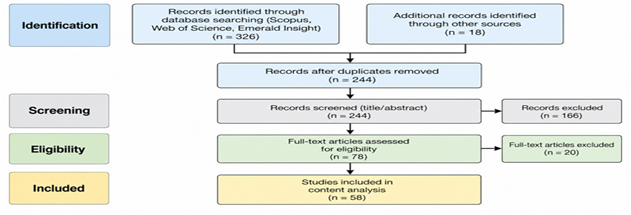
As the diagram shows, the funnel narrows sharply at two points: title-and-abstract screening, which removed most off-topic records, and full-text review, which filtered out studies with weak accounting relevance or thin methodology. The final set of 58 studies reflects a deliberate trade-off between breadth and analytical fit, retaining only work that bears directly on accounting outsourcing and its boundary conditions.
Data Extraction and Analysis
Data were analysed through qualitative content analysis in the tradition of Mayring (2014), combining deductive category application with inductive category development. For each included study, the extraction captured the context and type of accounting activity, theoretical and methodological perspective, and main insights on benefits, risks, control mechanisms, and boundary-related conclusions (Dekker, 2016; Everaert et al., 2010). Deductive codes were anchored in theoretical constructs: asset specificity, uncertainty, core versus non-core activities, relational governance and learning and capability development (Barney, 1991; Poppo & Zenger, 2002; Williamson, 1985). Inductive coding revealed new themes, especially the limits of outsourcing, the triggers for back-sourcing, and the shape of hybrid arrangements (Berlin et al., 2023; McIvor, 2000). Across the coded material, four themes carried the analysis: transaction efficiency, relational governance, learning transfer and control loss. These informed the development of a framework that maps the boundaries of outsourcing feasibility. Methodologically, the study rests on three pillars: systematic review, PRISMA-based screening, and qualitative content analysis, applied to theory building on outsourcing boundaries in accounting.
Results
Task Characteristics and Process Standardisation
Task characteristics run through the literature as the first determinant of outsourcing feasibility. Highly standardised, routine, transactional work, such as bookkeeping, payroll and basic accounts payable and receivable, is repeatedly identified as suitable for outsourcing (Adekoya & Ojediran, 2024; Burko, 2022; Everaert et al., 2010). Such tasks are easy to specify in a contract, run well on standard software and reward the scale a specialist vendor can offer.
The situation is different for tasks built on judgement, tacit knowledge and frequent contact with management, such as strategic management accounting, performance measurement and complex financial analysis (Dekker, 2016; Nicholson et al., 2006). Here the risk that a provider’s output drifts from the firm’s strategic needs rises, and internal coordination costs may offset the anticipated savings (Dekker, 2016). Recent work reinforces this point: outsourcing performance depends on matching task complexity to the way suppliers are managed and developed, so complex work externalised without corresponding governance investment tends to underperform (Lee, 2022). The literature thus marks a boundary along the axis of process standardisation and complexity.
Strategic Importance and Core Capabilities
A second theme links strategic importance to the desirability of outsourcing. Activities that feed competitive advantage or sit close to core competencies are generally poor candidates, even when they are fairly standardised (Barney, 1991; Dekker, 2016; Lacity et al., 2011). When management accounting drives strategic innovation and performance management, moving it outside the firm can hollow out internal analytical capacity and slow the firm’s response to change (Dekker, 2016; Nicholson et al., 2006).
This is consistent with evidence that top managers rely on both formal and informal control practices to steer strategically important, judgement-intensive processes such as product innovation, and that these practices are difficult to delegate to an external provider without losing strategic steering (Pan Fagerlin & Lövstål, 2020). Functions that are necessary but not differentiating, such as compliance-oriented bookkeeping for an SME, are plausible candidates for outsourcing (Burko, 2022; Everaert et al., 2010). Handing these to a provider lets the firm concentrate internal resources on core operational or customer-facing work while the vendor secures compliance and routine reporting (Adekoya & Ojediran, 2024; Burko, 2022). This logic ties RBV reasoning to practical decisions and marks out the second boundary dimension: strategic importance.
Governance, Control and Relational Factors
Effective accounting outsourcing depends heavily on governance and on the quality of the client–provider relationship. Studies of outsourced management accounting and offshore services show that robust controls, clear performance metrics and well-designed contracts blunt opportunism and coordination problems (Dekker, 2016; Ellram et al., 2008; Nicholson et al., 2006). The risk factors are consistent: opportunism, information asymmetry, thin client knowledge of the outsourced field, limited cooperation experience, cultural distance and the absence of agreed measurement principles (Malkus, 2012). Relational governance, meaning trust, communication quality and shared norms, supplements formal contracts and enables joint problem-solving when the unexpected arrives (Lacity et al., 2016; Poppo & Zenger, 2002). The point is not that formal and relational controls compete; controls in an outsourced accounting relationship must steer the provider’s work while remaining legitimate to the boundary-spanning staff who carry them out, which is what makes such arrangements durable and transferable (Lepistö et al., 2020).
Where governance is weak, or where formal controls and actual practice diverge, outsourcing reduces transparency, increases information asymmetry, and creates friction between partners (Dekker, 2016; Nicholson et al., 2006). Cross-border arrangements magnify the problem through cultural and institutional distance (Berlin et al., 2023; Ellram et al., 2008). In these conditions, the scope of feasible outsourcing may be reduced, and firms respond by backsourcing or reconfiguring the relationship (Berlin et al., 2023; McIvor, 2000).
Learning, Capability Dynamics and Backsourcing
The literature also stresses the dynamic side of capabilities and learning. Long, heavy reliance on external providers may constrain internal learning about accounting systems and processes (Adekoya & Ojediran, 2024; Dekker, 2016). Dependency then entrenches itself and makes any later transition to a new system or provider harder. The flow can run the other way too: firms sometimes absorb new practices and technologies that vendors introduce (Burko, 2022; Everaert et al., 2010). From an enablement perspective, outsourcing under financial and competence constraints can even become a route to process improvement, provided the firm retains enough absorptive capacity to learn from the provider (Dekker et al., 2020).
Backsourcing research documents the reversal. Firms bring previously outsourced accounting or finance activities back in-house when costs climb, service quality slips or strategic requirements shift (Berlin et al., 2023; Wüllenweber et al., 2008). These cases suggest that outsourcing boundaries are not fixed. They move with internal capability development, technological change and shifts in strategic priority (Lacity et al., 2011; McIvor, 2000).
A Theoretical Framework for Outsourcing Boundaries in Accounting
Building on these findings, the framework positions accounting activities along two dimensions, process standardisation and complexity and strategic importance, moderated by governance quality and capability relationships (Barney, 1991; Dekker, 2016; Lacity et al., 2011). Together these dimensions place each accounting activity within the firm’s governance frame.
Core Dimensions
The first dimension separates high-standardisation, low-complexity tasks from low-standardisation, high-complexity tasks (Everaert et al., 2010). The second distinguishes high from low strategic importance, that is, how far an activity contributes to competitive advantage and distinctive capability (Barney, 1991; Dekker, 2016). Read together, the two axes produce a conceptual map on which an activity’s position signals whether outsourcing is likely to work.
Strategic importance. High: the activity is a direct source of competitive advantage, strategic decision-making or core capability, such as management accounting, performance measurement and strategic forecasting. Low: the activity supports operations but does not set the firm apart, such as routine bookkeeping or payroll for a small firm.
Process standardisation. High: the process is mechanical, repetitive and rule-based, with clear inputs, outputs, procedures and service-level agreements, for example invoice processing and rule-based bank reconciliation. Low: the process is judgement-driven, rests on case-specific and tacit knowledge and depends on daily interaction with managers, for example scenario analysis, KPI design and complex tax planning.
Figure 2 places accounting activities according to strategic importance and process standardisation, and indicates the governance mode each position suggests.
Matrix of Outsourcing Boundaries in Accounting by Strategic Importance and Process Standardisation. (Source: authors’ synthesis of the literature reviewed in this study)
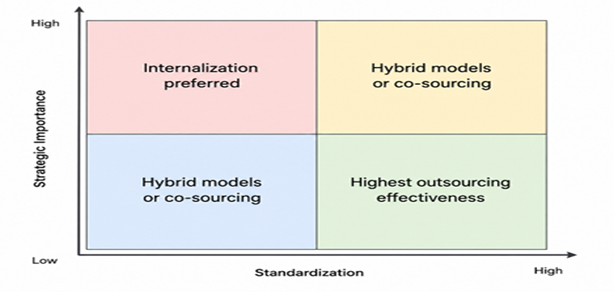
The matrix, read clockwise from the top-left, links the two axes to proposed governance arrangements; each quadrant reflects a proposed governance logic, described below, and the conditions under which an activity moves between quadrants are examined in the subsection on boundary conditions. The quadrants suggest the following governance arrangements:
High strategic importance + low standardisation → internalisation. The activities here are critical and hard to codify, including management accounting and performance-measurement design, strategic budgeting and forecasting and the complex analysis behind large investment or restructuring decisions. Intensive control needs, heavy tacit-knowledge demands and organisational-learning stakes all favour keeping the work inside (Dekker, 2016; Nicholson et al., 2006). The outsourcing boundary is narrow: a firm might hand off data collection or technical sub-tasks but keep the core responsibility.
Low strategic importance + high standardisation → outsourcing. Potential candidates include routine bookkeeping and ledger maintenance, payroll under stable rules and accounts payable and receivable through well-defined workflows. Providers exploit scale and automation, the work is easy to specify contractually and the firm surrenders no core capability by externalising it (Burko, 2022; Everaert et al., 2010). Full outsourcing may be appropriate where governance and data-protection requirements are adequately addressed.
Intermediate zones → hybrid models or co-sourcing. Much real-world work sits in the middle: standardised reporting that informs strategic decisions, project-based accounting that is fairly routine yet demands operational understanding, management reporting where the data is processed often but the interpretation is strategic. Firms tend to outsource the data-rich, homogeneous elements, such as extraction, reconciliation and report generation, for cost and efficiency, while retaining interpretation, judgement and decision support in-house to protect strategic insight and learning (Lacity et al., 2016). Hybrid designs run from co-sourcing (provider and internal teams working side by side) through multi-sourcing (different vendors for different components) to in-house “centres of expertise” paired with outsourced routine processing.
Boundary Conditions for Shifting from Full Outsourcing to Hybrid Models
The framework suggests four conditions under which a firm should step back from full outsourcing toward hybrid or co-sourcing arrangements. The first is rising strategic importance. When management leans more heavily on accounting information for strategic decisions or innovation, the interpretive, judgement-intensive elements need to move back in-house while providers keep the data-intensive, standardised components.
The second is governance strain. Climbing coordination costs, recurring quality problems, or repeated mismatches between provider output and managerial information needs all signal that existing governance cannot support full outsourcing, pushing the firm toward closer internal involvement in design, control, and interpretation.
The third is capability dynamics. As a firm builds internal financial literacy, analytical skill or digital capability, it becomes better placed to internalise the higher value-adding parts of the process and reserve providers for scale-driven transaction work. The reverse also holds: where internal capability is weak but governance quality is high, full outsourcing can remain viable for longer.
The fourth is external change. Shifts in regulation, data-security constraints or technology, for instance the adoption of integrated ERP or platform-based accounting, can move activities across quadrants over time and create conditions where only a hybrid model preserves compliance, risk management and learning. Here co-sourcing lets a firm combine external efficiency with internal control and knowledge retention rather than relying on a fully externalised solution.
Moderating Factors and Dynamic Considerations
Governance and relational factors can move the effective boundary within any quadrant. Sound contracts, clear service-level agreements and trust widen the set of activities that can be safely outsourced, particularly in the standardised-but-strategically-important cells (Lacity et al., 2016; Poppo & Zenger, 2002). Weak governance does the opposite, undermining even outsourcing-friendly tasks (Dekker, 2016; Malkus, 2012).
Dynamic forces such as digitalisation, regulatory change and internal capability development shift activities across quadrants over time and oblige managers to reassess where each process sits (Lacity et al., 2011; McIvor, 2000). Mapping activities on the two axes lets a firm see where outsourcing carries the greatest risk (loss of control, dependency, error in strategic areas) and where it does not, and to calibrate controls and contracts accordingly. The rule that emerges is direct: the more strategic and less standardised the task, the more robust and nuanced the governance a firm needs if it outsources any part of it (Malkus, 2012).
Exploratory Empirical Assessment of the Framework
The review and boundary matrix provide a conceptual framework that requires empirical assessment across firm sizes and service settings (Lacity et al., 2016). The survey examines selected implications in the Latvian accounting-services market. It investigates whether clients’ preferred service-delivery and pricing model is associated with firm size and turnover, and reports reliability coefficients and dimension-level PCA for an adapted service-quality instrument. Pricing preferences provide an indirect indicator of contracting arrangements, while the quality dimensions describe aspects of service provision relevant to governance (Parasuraman et al., 1988; Poppo & Zenger, 2002). These analyses do not directly test the framework’s quadrants, transitions between governance modes or the proposed moderating effects.
Data and Measures
Primary data were collected through two fully anonymous online questionnaires between 18 December 2025 and 31 March 2026. The target groups were outsourced-accounting providers operating in Latvia and entrepreneurs whose businesses use outsourced accounting. Providers were identified through Lursoft.lv, and those with available contact information received an email invitation. An invitation was also circulated among members of the Latvian Association of Outsourced Accountants (LRĀGA). Providers and association members were asked to distribute the client questionnaire to their clients. Both questionnaires were additionally shared in a professional-interest group on social media. Recruitment therefore combined contact-based invitations, voluntary participation and provider-mediated referral; it was not a probability sample. The realised sample comprises N = 773 responses (382 providers, 49.4%; 391 clients, 50.6%), with respondents from all five planning regions of Latvia. The analysis of pricing preferences uses the client subsample (N = 391), because clients select their preferred contracting arrangement.
For population context, the authors report a 2025 benchmark of 4,117 outsourced-accounting providers and a total of 183,991 enterprises in Latvia. The State Revenue Service estimated that approximately one third of enterprises use outsourced accounting (written response to an information request received by one of the authors, personal communication, 2025). Applying this approximate share to the enterprise total gives an indicative client population of approximately 61,330. The realised samples correspond numerically to 9.28% of the provider benchmark and approximately .64% of the estimated client population. These ratios describe sample size relative to population benchmarks; they are neither response rates nor evidence of representativeness. The estimated client population is not an enumerated sampling frame.
Selection probabilities were unknown, and the combined use of email, referrals and public invitations prevents calculation of an overall response rate from the information available (American Association for Public Opinion Research [AAPOR], 2023). The design may underrepresent firms without accessible contact details and overrepresent association-connected, professionally active or digitally engaged respondents. Client recruitment through providers may also favour clients whom providers chose to contact and clients willing to respond. Regional coverage and a substantial sample size do not eliminate these sources of selection bias. Full anonymity limits verification of unique organisational participation and identification of provider–client links. Accordingly, the results describe the participating organisations and should be generalised to the Latvian market with caution.
Three structural variables were measured as ordered categories: firm size (number of employees, six bands from 0–1 to 250+), annual turnover (nine bands from ≤ EUR 10,000 to > EUR 50 million) and the preferred size of the provider. The dependent variable is the preferred service-delivery and pricing model, recorded as a binary choice between a fixed monthly fee for a full bookkeeping-to-annual-report cycle (“full-cycle model”) and a per-transaction fee for each processed document or entry (“transactional model”). A bundled fixed-fee contract may support an ongoing relationship, whereas per-transaction pricing specifies payment by unit of work. However, neither pricing form directly measures trust, control, contract duration or the allocation of activities between internal and external teams. Both are forms of external provision. This variable therefore captures a contracting preference rather than the make-or-buy decision or a direct choice between outsourcing, co-sourcing and internalisation (Poppo & Zenger, 2002; Williamson, 1985).
Service quality was measured with an instrument adapted from SERVQUAL (Parasuraman et al., 1988). Respondents rated 37 attributes for importance and 28 for satisfaction on five-point Likert scales (1 = not important/not satisfied; 5 = very important/very satisfied), grouped into seven dimensions: financial-and-legal security, service organisation, tangibles, reliability, responsiveness, assurance and empathy. In SERVQUAL, responsiveness concerns readiness to assist customers and the timeliness of service (Parasuraman et al., 1988). Its application to accounting outsourcing is conceptual; no separate effect of responsiveness on governance choice is estimated here. Because the adaptation uses seven dimensions and unequal numbers of importance and satisfaction items, the validity of the original instrument cannot be assumed to transfer unchanged to this study.
Analytical Strategy
Associations between the categorical structural variables and the binary pricing preference were tested with Pearson’s χ² test of independence, with Cramér’s V as the effect size; where expected cell counts were small, Fisher’s exact test and a collapsed 2 × 2 table served as robustness checks. Because firm size and turnover are ordinal, monotonic association with the pricing preference was also quantified with Spearman’s ρ and Kendall’s τ-b. A binary logistic regression modelled the probability of selecting the full-cycle model as a function of firm size and turnover, reporting odds ratios and McFadden’s pseudo-R². Scale reliability was assessed with Cronbach’s α; the suitability of the data for dimension reduction was checked with the Kaiser–Meyer–Olkin (KMO) measure and Bartlett’s test of sphericity, followed by principal-component analysis (PCA). The significance threshold is α = .05. Given non-probability recruitment, p-values are exploratory and do not correct for selection bias or establish national representativeness. Provider-mediated recruitment may also introduce dependence among clients referred by the same provider; the reported analyses do not account for this potential clustering. Computations were run in Python (SciPy and statsmodels) and were cross-checked in SPSS.
Firm Size, Turnover and the Pricing Preference
Among the 391 responding clients, 331 (84.7%) preferred a fixed monthly fee and 60 (15.3%) preferred per-transaction pricing. A goodness-of-fit test against an equal split gives χ²(1) = 187.83, p < .001 (exact binomial p < .001), Cohen’s w = .69. Thus, the bundled full-cycle model predominates within the realised sample; this proportion should not be interpreted as an unbiased estimate of preference in the national market.
Pricing preference differs across firm-size categories. As Table 1 and Figure 3 show, the preference for the full-cycle model is generally higher above the smallest size category: among the smallest firms (0–1 employee) only 61.9% choose it and 38.1% prefer per-transaction pricing, whereas firms with 2–10, 11–19, 20–49 and 50–249 employees reach full-cycle shares of 91.7%, 90.5%, 94.5% and 100%. The association is significant and moderate, χ²(5) = 53.11, p < .001, Cramér’s V = .37. Collapsing size into micro/small (0–10 employees) versus larger (11+ employees) firms yields a 2 × 2 table in which larger firms have 3.4 times higher odds of preferring the full-cycle model (odds ratio = 3.42, χ²Yates(1) = 13.89, p < .001; Fisher’s exact p < .001). The positive ordinal association holds under Spearman’s ρ = .30 (p < .001) and Kendall’s τ-b = .27 (p < .001).
Preferred Service-Delivery and Pricing Model by Client Firm Size (N = 391). (Source: authors’ calculations from the client survey, 18 December 2025–31 March 2026; N = 391)
|
Firm size (employees) |
n |
Full-cycle fixed fee |
Per-transaction fee |
|
0–1 |
97 |
61.9% |
38.1% |
|
2–10 |
120 |
91.7% |
8.3% |
|
11–19 |
95 |
90.5% |
9.5% |
|
20–49 |
55 |
94.5% |
5.5% |
|
50–249 |
17 |
100.0% |
0.0% |
|
250+ |
7 |
85.7% |
14.3% |
|
Total |
391 |
84.7% |
15.3% |
Note. Row percentages. χ²(5) = 53.11, p < .001, Cramér’s V = .37. Spearman’s ρ = .30, Kendall’s τ-b = .27 (both p < .001).
Table 1 shows that the main difference occurs between firms with 0–1 employee, of which 61.9% prefer the full-cycle model, and firms with 2–10 employees, of which 91.7% prefer it. The difference is approximately 30 percentage points. The full-cycle shares in the 11–19, 20–49 and 50–249 employee categories are 90.5%, 94.5% and 100%, respectively. The 85.7% share among firms with 250 or more employees is based on only seven responses and should be interpreted cautiously. The moderate association (Cramér’s V = .37; Spearman’s ρ = .30; Kendall’s τ-b = .27) is compatible with the transaction-cost argument that recurring work may favour bundled contracting (Tomašević et al., 2023; Williamson, 1985). However, transaction volume, asset specificity and coordination costs are not directly tested in this comparison; the observed association cannot establish that these mechanisms caused the preference.
Figure 3 presents the same distribution by firm size. Per-transaction pricing is most frequent in the 0–1 employee category, but remains a minority preference even within that group (38.1%). A full-cycle external contract should not be interpreted as internalisation of the accounting function.
Share of Clients Choosing the Full-Cycle (Fixed-Fee) Versus Per-Transaction Model, by Firm Size. (Source: authors’ calculations from the client survey, 18 December 2025–31 March 2026; N = 391)
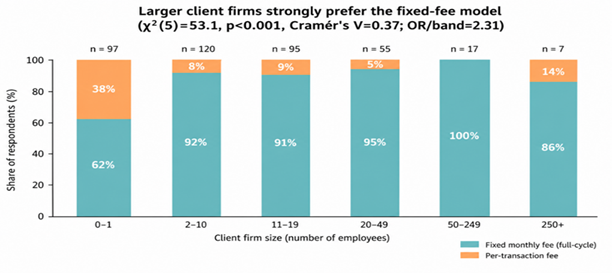
The sharpest difference in Figure 3 occurs between the first two employee bands. This suggests that the smallest responding firms may have different contracting preferences from other respondents. It does not establish distinct national market segments or show that these firms are more price-sensitive, because price sensitivity was not measured in this comparison. The result concerns stated pricing preferences rather than observed changes in governance or the allocation of individual accounting activities.
Annual turnover, an alternative size proxy, traces the same gradient (Figure 4). The full-cycle share rises from roughly 71–72% among firms turning over up to EUR 100,000 to 92–93% in the EUR 100,000–2 million range, reaches 100% in the EUR 2–10 million band and stands at 91% in the EUR 10–50 million band (χ²(8) = 32.96, p < .001, Cramér’s V = .29; Spearman’s ρ = .26, p < .001). Because employee count and turnover are strongly correlated (Spearman’s ρ = .83, p < .001), they provide overlapping indicators of organisational scale.
Percentage of Clients Choosing the Full-Cycle Fixed-Fee Model as a Function of Annual Turnover. (Source: authors’ calculations from the client survey, 18 December 2025–31 March 2026; N = 391)
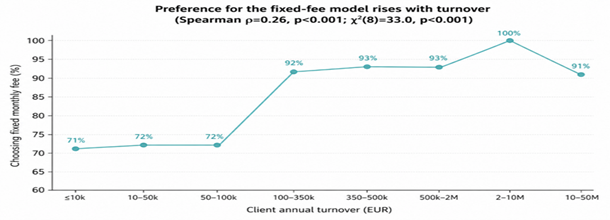
Figure 4 indicates an association between turnover and pricing preference that is broadly consistent with the employee-based comparison. Because employee count and turnover are strongly correlated (Spearman’s ρ = .83), the two indicators provide overlapping information about organisational scale. Their agreement does not establish construct validity of the boundary framework or rule out other explanations for pricing preferences. The joint regression should therefore be interpreted with attention to collinearity, rather than as evidence that turnover has no substantive relevance. The observed percentages describe the responding firms and do not identify a population-level threshold for a change in governance.
A binary logistic regression further describes the association between firm size and pricing preference. Modelling the probability of choosing the full-cycle model on firm size alone yields a significant positive coefficient (b = .84, SE = .17, z = 5.07, p < .001): each one-band increase in firm size multiplies the odds of preferring the full-cycle contract by 2.31 (McFadden pseudo-R² = .10). Entering firm size and turnover jointly, firm size stays significant (b = .73, p = .005) while the turnover coefficient is not statistically significant (b = .08, p = .58), consistent with overlapping information in the two size indicators. Coding size bands as a single ordered predictor assumes a constant change in log-odds between successive bands, although the employee intervals are unequal. The per-band odds ratio should be interpreted under that modelling assumption. Table 2 summarises the association statistics.
Summary of Association Tests Between Structural Firm Characteristics and the Pricing Preference (Client Sub-Sample, N = 391). (Source: authors’ calculations from the client survey, 18 December 2025–31 March 2026; N = 391)
|
Relationship tested |
Test statistic |
Effect size |
p |
|
Firm size × pricing model |
χ²(5) = 53.11 |
Cramér’s V = .37 |
< .001 |
|
Firm size × pricing (2×2 collapsed) |
χ²Yates(1) = 13.89; OR = 3.42 |
φ = .20 |
< .001 |
|
Firm size × pricing (ordinal) |
Spearman ρ = .30; Kendall τ-b = .27 |
— |
< .001 |
|
Turnover × pricing model |
χ²(8) = 32.96 |
Cramér’s V = .29 |
< .001 |
|
Turnover × pricing (ordinal) |
Spearman ρ = .26; τ-b = .23 |
— |
< .001 |
|
Logistic: full-cycle ~ firm size |
b = 0.84 (z = 5.07) |
OR = 2.31 / band |
< .001 |
|
Firm size × preferred provider size |
χ²(15) = 182.38 |
Cramér’s V = .39 |
< .001 |
|
Employees × turnover (size construct) |
Spearman ρ = .83 |
— |
< .001 |
Note. OR = odds ratio; φ = phi coefficient. All tests two-tailed.
Table 2 summarises associations obtained using categorical tests, ordinal coefficients and logistic regression. Their consistency supports the presence of a size–pricing association within the realised sample, but these procedures use the same observations and do not provide independent validation. The odds ratio of 3.42 compares firms with 11 or more employees with those with 0–10 employees; the per-band odds ratio of 2.31 depends on the ordinal coding used in the regression. Firm size is also associated with preferred provider size (χ²(15) = 182.38, p < .001, Cramér’s V = .39; Spearman’s ρ = .27, p < .001). The preference for providers of broadly similar scale may be consistent with relational-governance considerations (Poppo & Zenger, 2002), but the analysis does not directly measure coordination costs or establish why respondents prefer a particular provider size.
Reliability Coefficients and Exploratory Dimensional Evidence
Cronbach’s α is .93 for the 37-item importance scale and .976for the 28-item satisfaction scale (Figure 5). These coefficients describe score reliability under the assumptions of the coefficient; they do not establish unidimensionality or construct validity (Sijtsma, 2009). Reported KMO values range from .73 to .91 across the seven dimensions (financial-and-legal security KMO = .87; assurance KMO = .90), and Bartlett’s test is significant for every block (financial-and-legal security χ²(28) = 1652.91, p < .001). These diagnostics support dimension reduction within the analysed item blocks. PCA of financial-and-legal security retained two components with eigenvalues above 1, jointly explaining 70.7% of the variance; the first component accounts for 58.1%. All reported communalities in this block exceed .50, and no items were removed. This is exploratory evidence for the analysed block, rather than confirmation of a single financial-and-legal security factor or of the complete seven-dimension instrument.
Figure 5 sets both coefficients against the .70 benchmark and shows how far clear of it they sit. The satisfaction scale is the more reliable of the two, but neither leaves room for concern about internal consistency, so the seven dimensions can be treated as sound measures of the governance and relational quality the framework relies on.
Internal Consistency (Cronbach’s α) of the Importance and Satisfaction Scales Relative to the Conventional .70 Acceptability Threshold. (Source: authors’ calculations from the survey data, 18 December 2025–31 March 2026)
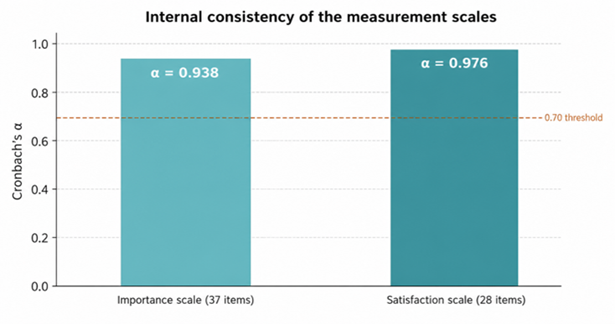
The two reliability coefficients are worth noting for both their difference and their magnitude. The satisfaction scale (α = .97) is more reliable than the importance scale (α = .93), which suggests that clients hold a clear and settled view of the service they actually receive, while their importance ratings vary more because different client types weight the seven dimensions differently, as the framework expects across firm sizes and governance modes. Coefficients close to .98 can sometimes signal redundant items, but the principal-component analysis, which produces coherent components with all communalities above .50 and no items dropped, argues against simple redundancy. The instrument is therefore reliable enough to serve as the measurement basis for the governance-quality moderator in the framework.
Summary of the Empirical Findings
The survey provides preliminary evidence relevant to selected elements of the framework. Client size and turnover are associated with preferred pricing arrangements, with larger responding firms generally favouring a bundled full-cycle contract (χ²(5) = 53.11, p < .001, Cramér’s V = .37; OR = 2.31 per coded size band). This pattern is compatible with transaction-cost and relational-governance arguments, but it does not directly establish the underlying mechanisms (Poppo & Zenger, 2002; Tomašević et al., 2023; Williamson, 1985). The reported alpha coefficients and block-level PCA provide an initial measurement assessment, with important limits concerning the structure of the full instrument. Neither these diagnostics nor associations with pricing preference confirm the complete boundary framework. Its quadrants, governance transitions and proposed moderating relationships remain propositions for direct empirical testing.
Discussion
Theoretical Implications
The study consolidates transaction cost economics, the resource-based view and relational governance into a single boundary framework fitted to accounting outsourcing (Barney, 1991; Dekker, 2016; Poppo & Zenger, 2002; Williamson, 1985). It advances prior work by proposing conditions under which outsourcing may be sustainable, hybrid arrangements may be preferable and internalisation may be appropriate. By treating outsourced accounting as a business function and splitting it along process standardisation and strategic importance, the study fills a gap in a literature that has tended to argue benefits or risks without integration (Adekoya & Ojediran, 2024; Burko, 2022).
The literature synthesis suggests that outsourcing effectiveness depends on task characteristics, strategic importance, governance quality and the interaction of dynamic capabilities (Adekoya & Ojediran, 2024; Everaert et al., 2010). Its quadrants and boundary conditions invite empirical testing through surveys and case studies across industries and firm sizes (Lacity et al., 2016). Longitudinal work on backsourcing and hybrid models would deepen the account of how boundaries move over time (Berlin et al., 2023; Jansson et al., 2021). So would attention to how digital technologies and platform-based services reshape those boundaries, which remains a live question given evidence that shared service centres are being reengineered by automation, analytics and cloud technologies toward 2030 (Ferreira & Janssen, 2023) and that finance shared services can lift profitability through firm-level cost savings and process-level working-capital gains (Chen et al., 2024).
The framework also extends a line of research that has framed outsourcing mainly as a cost- and risk-benefit problem. Quélin and Duhamel (2003) link outsourcing motives to corporate strategy and to the risks that accompany them; Malkus (2012) catalogues the contractual and relational risks of outsourcing cooperation. The present model integrates both and argues that the tension between advantage and risk is largely shaped by where an activity sits in terms of strategic role and process standardisation. In Central and Eastern Europe, where BPO and shared service centres are expanding (Ślusarczyk, 2017), this boundary view is especially useful for deciding which parts of the accounting function can be safely externalised and which should stay in-house. The theoretical contribution is to translate general outsourcing theory into an accounting-specific boundary framework that shows how task characteristics, strategic relevance and governance interact to determine feasible governance modes over time.
Locating the contribution within accounting and auditing, rather than within the broader outsourcing literature, clarifies both what is new and how the study relates to recent work. Earlier accounting-outsourcing studies tend to examine one aspect of the relationship, whereas the present framework connects several of them. Poulaki et al. (2024), studying tourism SMEs, find that firms outsource accounting mainly to reduce operating costs, draw on a partner’s information systems and accounting knowledge, and speed up the processing of accounting tasks, which the authors present as a means of mitigating financial risk. The boundary framework suggests that judgement- and interpretation-intensive work may require greater internal involvement, and it places the risk-reduction motive in the region of low strategic importance and high standardisation, where full outsourcing is most appropriate. Our finding that clients value relational and assurance-related dimensions (financial and legal security, reliability and assurance) more than tangible ones is relevant to the audit-quality concern raised by Cullinan and Zheng (2017), who link outsourced accounting to longer audit lags. These attributes are conceptually relevant to internal control and auditability; the present survey does not test whether they reduce misstatement risk or audit delay. The framework also complements recent work on the digitalisation of accounting. Fragidis et al. (2025) show that digitised accounting brings obstacles as well as advantages for administrative and strategic decision-making; in the terms used here, those obstacles are the moderators, such as governance strain and capability limits, that push standardised, digitised processing toward hybrid or co-sourced arrangements as strategic importance rises. Finally, by treating governance quality as the factor that widens or narrows the feasible boundary, the framework connects to the governance and risk-management themes that feature in recent studies in the field, including enterprise risk-management adoption (Klumpes, 2025) and the credibility of corporate disclosures and investor trust (Passas & Garefalakis, 2025). The practical implication for accounting and governance is straightforward: the decision to outsource part of the accounting function is essentially a decision about internal control and assurance, and it deserves the same care in contract design, performance measurement, data-security safeguards and provider selection that a firm applies to the reliability of its financial reporting.
Managerial Implications
The framework asks managers to appraise accounting activities before they plan any outsourcing, judging processes rather than costs alone (Ellram et al., 2008; Lacity et al., 2011; McIvor, 2000). Making process standardisation and strategic importance explicit guards against outsourcing differentiation-relevant functions that would generate hidden coordination costs (Dekker, 2016).
Governance emerges as a factor that influences the feasible scope of outsourcing. Even where outsourcing looks promising, managers must design contracts, performance measures, and monitoring systems well and deliberately build relational trust (Lacity et al., 2016; Malkus, 2012; Poppo & Zenger, 2002). Data security, confidentiality and compliance deserve particular attention wherever financial information moves outside the firm (Dekker, 2016; Nicholson et al., 2006).
The framework has clear implications for SMEs. Smaller firms gain substantially from outsourcing routine accounting, but they should resist fully externalising strategically sensitive work, especially where internal financial literacy and oversight are thin (Burko, 2022; Everaert et al., 2010). Here, the value lies less in the transaction than in sustained advisory contact, where small businesses draw the greatest benefit from an external accountant (Oosthuizen et al., 2020). The framework proposes a principle for allocating accounting activities: the more strategic and less standardised a function, the closer it should sit to the firm; the more routine and less strategic, the further it can travel across the outsourcing boundary.
Conclusion
This article conceptualises outsourced accounting as a business function and proposes a framework for its role and boundaries in organisational value creation and governance. The literature synthesis identifies task characteristics, strategic importance, governance quality and capability dynamics as relevant boundary conditions. A survey of 773 providers and clients in Latvia provides exploratory evidence on contracting preferences and service-quality measurement. The non-probability recruitment design and the indirect measurement of governance limit the conclusions that can be drawn about the national market and the framework as a whole.
The literature-based framework proposes that standardised activities of low strategic importance are suitable for outsourcing, that hybrid arrangements may suit standardised processes supporting strategic decisions, and that complex, strategically central activities may require stronger internal involvement. The survey shows an association between client size and preferred pricing arrangements, but both pricing options involve external provision. It therefore does not directly confirm the proposed conditions for internalisation or co-sourcing. Similarly, high reliability coefficients and PCA within selected service-quality dimensions do not establish the validity of the complete instrument or the theoretical framework.
The study’s contribution is a framework that aligns accounting activities to two dimensions, process standardisation and strategic importance, with recommended governance modes of outsourcing, hybrid arrangement or internalisation. By treating outsourced accounting as a separate function and reading it through benefits, risks, governance and learning, the framework converts piecemeal conclusions into structured boundary maps useful to both scholars and managers. This boundary perspective helps explain why the same outsourcing decision creates value in one setting and erodes capability and control in another, and it offers a more nuanced account than cost-based reasoning alone.
Future research should test the full measurement structure and directly examine the proposed quadrants, governance transitions, and moderating effects through surveys, case studies, and longitudinal designs across industries, firm sizes, and institutional settings. Probability-based recruitment or comparison with population benchmarks would improve assessment of generalisability. It should also examine whether digitalisation, platform-based accounting and changing regulation make it easier or harder over time to place particular activities within the framework, and whether the model extends to other business functions and the wider service ecosystems in which accounting outsourcing is embedded. For practitioners, the framework offers a provisional principle: the more strategic and less standardised a function, the closer it should remain to the firm; the more routine and less strategic, the further it can move across the outsourcing boundary under appropriate governance.
Funding
Not applicable.
Author Contributions
Dace Snikere-Klitko – Conceptualization, Methodology, Formal Analysis, Investigation, writing - Original Draft
Iluta Arbidane – Supervision, Writing - Review & Editing
Inga Lapina – Supervision, Writing - Review & Editing.
Conflict of Interest
The authors declare that they have no known competing financial interests or personal relationships that could have appeared to influence the work reported in this paper.
Generative AI Use Disclosure Statement
During the preparation of this work, the authors used Perplexity (Perplexity AI) and ChatGPT (OpenAI) in order to translate and edit the English text, including the wording of the methods description, and to improve the visual clarity of the figures. After using this tool/service, the authors reviewed and edited the content as needed and take full responsibility for the content of the publication.
Data Availability Statement
The data supporting the findings of this study are available from the corresponding author upon reasonable request, subject to ethical clearance limitations.
Acknowledgments
The authors thank the respondents from the Latvian accounting-services market who took part in the survey.
References
Adekoya, O., & Ojediran, S. (2024). Outsourcing accounting functions and the quality of financial reporting for SMEs in Lagos State. European Journal of Accounting, Auditing and Finance Research, 12(5), 82–100. https://doi.org/10.37745/ejaafr.2013/vol12n582100
American Association for Public Opinion Research [AAPOR]. (2023). Standard definitions: Final dispositions of case codes and outcome rates for surveys (10th ed.). https://aapor.org/wp-content/uploads/2024/03/Standards-Definitions-10th-edition.pdf
Andersson, F., Jordahl, H., & Josephson, J. (2019). Outsourcing public services: Contractibility, cost, and quality. CESifo Economic Studies, 65(4), 349–372. https://doi.org/10.1093/cesifo/ifz009
Barney, J. (1991). Firm resources and sustained competitive advantage. Journal of Management, 17(1), 99–120. https://doi.org/10.1177/014920639101700108
Battagello, F. M., Cricelli, L., & Grimaldi, M. (2019). Prioritization of strategic intangible assets in make/buy decisions. Sustainability, 11(5), Article 1267. https://doi.org/10.3390/su11051267
Berlin, J., Carlström, E., & Karlsson, D. (2023). Backsourcing in the private and public sectors—A systematic review. Financial Accountability & Management, 39(3), 636–687. https://doi.org/10.1111/faam.12361
Burko, K. (2022). Advantages and risks of accounting outsourcing. Three Seas Economic Journal, 3(2), 44–51. https://doi.org/10.30525/2661-5150/2022-2-6
Chen, X., Dai, Q., & Na, C. (2024). How finance shared services affect profitability: An IT business value perspective. Information Technology and Management, 25(4), 367–382. https://doi.org/10.1007/s10799-023-00391-1
Cullinan, C. P., & Zheng, X. (2017). Accounting outsourcing and audit lag. Managerial Auditing Journal, 32(3), 276–294. https://doi.org/10.1108/MAJ-03-2016-1349
Dekker, H. C. (2016). On the boundaries between intrafirm and interfirm management accounting research. Management Accounting Research, 31, 86–99. https://doi.org/10.1016/j.mar.2016.01.001
Dekker, H. C., Mooi, E., & Visser, A. (2020). Firm enablement through outsourcing: A longitudinal analysis of how outsourcing enables process improvement under financial and competence constraints. Industrial Marketing Management, 90, 124–132. https://doi.org/10.1016/j.indmarman.2020.07.006
Ellram, L. M., Tate, W. L., & Billington, C. (2008). Offshore outsourcing of professional services: A transaction cost economics perspective. Journal of Operations Management, 26(2), 148–163. https://doi.org/10.1016/j.jom.2007.02.008
Everaert, P., Sarens, G., & Rommel, J. (2010). Using transaction cost economics to explain outsourcing of accounting. Small Business Economics, 35(1), 93–112. https://doi.org/10.1007/s11187-008-9149-3
Ferreira, C., & Janssen, M. (2023). Shaping the future of shared services centers: Insights from a Delphi study about SSC transformation towards 2030. Journal of the Knowledge Economy, 14(4), 4828–4847. https://doi.org/10.1007/s13132-022-01072-0
Flinkman, A., Gullkvist, B., & Teittinen, H. (2024). Management interventions in pacing a planned financial accounting outsourcing transition. Qualitative Research in Accounting & Management, 21(4), 342–368. https://doi.org/10.1108/QRAM-06-2023-0104
Fragidis, G., Karagiorgos, A., Lazos, G., & Tsanidis, G. (2025). Digitized accounting and obstacles to optimized strategic decisions. Accounting and Auditing, 1(2), Article 7. https://doi.org/10.3390/accountaudit1020007
Jansson, M., Carlström, E., Karlsson, D., & Berlin, J. (2021). Drivers of outsourcing and backsourcing in the public sector—From idealism to pragmatism. Financial Accountability & Management, 37(3), 262–278. https://doi.org/10.1111/faam.12273
Jensen, M. C., & Meckling, W. H. (1976). Theory of the firm: Managerial behavior, agency costs and ownership structure. Journal of Financial Economics, 3(4), 305–360. https://doi.org/10.1016/0304-405X(76)90026-X
Juma’h, A. H., & Wood, D. (2000). Outsourcing implications on companies’ profitability and liquidity: A sample of UK companies. Work Study, 49(7), 265–275. https://doi.org/10.1108/00438020010350220
Kakabadse, A., & Kakabadse, N. (2005). Outsourcing: Current and future trends. Thunderbird International Business Review, 47(2), 183–204. https://doi.org/10.1002/tie.20048
Kamyabi, Y., & Devi, S. (2011). Accounting outsourcing and firm performance in Iranian SMEs. International Journal of Economics and Finance, 3(4), 181–192. https://doi.org/10.5539/ijef.v3n4p181
Klumpes, P. (2025). Enterprise risk management adoption practices by US and European multinationals. Accounting and Auditing, 1(1), Article 5. https://doi.org/10.3390/accountaudit1010005
Lacity, M. C., Khan, S. A., & Yan, A. (2016). Review of the empirical business services sourcing literature: An update and future directions. Journal of Information Technology, 31(3), 269–328. https://doi.org/10.1057/jit.2016.2
Lacity, M. C., Solomon, S., Yan, A., & Willcocks, L. P. (2011). Business process outsourcing studies: A critical review and research directions. Journal of Information Technology, 26(4), 221–258. https://doi.org/10.1057/jit.2011.25
Lee, G. (2022). Matching task complexity with supplier management to enhance outsourcing performance. SAGE Open, 12(3). https://doi.org/10.1177/21582440221123460
Lepistö, S., Dobroszek, J., Lepistö, L., & Zarzycka, E. (2020). Controlling outsourced management accounting to build legitimacy. Qualitative Research in Accounting & Management, 17(3), 435–463. https://doi.org/10.1108/QRAM-05-2019-0062
Malkus, T. (2012). Risk factors in outsourcing cooperation. In The 7th International Scientific Conference “Business and Management 2012”: Selected papers (pp. 128–134). Vilnius Gediminas Technical University. https://doi.org/10.3846/bm.2012.018
Mayring, P. (2014). Qualitative content analysis: Theoretical foundation, basic procedures and software solution. SSOAR. https://nbn-resolving.org/urn:nbn:de:0168-ssoar-395173
McIvor, R. (2000). A practical framework for understanding the outsourcing process. Supply Chain Management: An International Journal, 5(1), 22–36. https://doi.org/10.1108/13598540010312945
Moher, D., Liberati, A., Tetzlaff, J., Altman, D. G., & The PRISMA Group. (2009). Preferred reporting items for systematic reviews and meta-analyses: The PRISMA statement. PLoS Medicine, 6(7), Article e1000097. https://doi.org/10.1371/journal.pmed.1000097
Nicholson, B., Jones, J., & Espenlaub, S. (2006). Transaction costs and control of outsourced accounting: Case evidence from India. Management Accounting Research, 17(3), 238–258. https://doi.org/10.1016/j.mar.2006.05.002
Oosthuizen, A., van Vuuren, J., & Botha, M. (2020). Compliance or management: The benefits that small business owners gain from frequently sourcing accounting services. The Southern African Journal of Entrepreneurship and Small Business Management, 12(1), Article a330. https://doi.org/10.4102/sajesbm.v12i1.330
Page, M. J., McKenzie, J. E., Bossuyt, P. M., Boutron, I., Hoffmann, T. C., Mulrow, C. D., Shamseer, L., Tetzlaff, J. M., Akl, E. A., Brennan, S. E., Chou, R., Glanville, J., Grimshaw, J. M., Hróbjartsson, A., Lalu, M. M., Li, T., Loder, E. W., Mayo-Wilson, E., McDonald, S., . . . Moher, D. (2021). The PRISMA 2020 statement: An updated guideline for reporting systematic reviews. BMJ, 372, Article n71. https://doi.org/10.1136/bmj.n71
Pan Fagerlin, W., & Lövstål, E. (2020). Top managers’ formal and informal control practices in product innovation processes. Qualitative Research in Accounting & Management, 17(4), 497–524. https://doi.org/10.1108/QRAM-02-2019-0042
Parasuraman, A., Zeithaml, V. A., & Berry, L. L. (1988). SERVQUAL: A multiple-item scale for measuring consumer perceptions of service quality. Journal of Retailing, 64(1), 12–40.
Passas, I., & Garefalakis, A. (2025). The impact of fraud perception and ESG-washing on investment trust: Integrating corporate governance theory and empirical evidence. Accounting and Auditing, 1(3), Article 9. https://doi.org/10.3390/accountaudit1030009
Poppo, L., & Zenger, T. (2002). Do formal contracts and relational governance function as substitutes or complements? Strategic Management Journal, 23(8), 707–725. https://doi.org/10.1002/smj.249
Poulaki, I., Kyriakaki, A., & Mavragani, E. (2024). Accounting outsourcing in tourism SMEs and financial risk mitigation. Journal of Risk and Financial Management, 17(12), Article 528. https://doi.org/10.3390/jrfm17120528
Quélin, B., & Duhamel, F. (2003). Bringing together strategic outsourcing and corporate strategy: Outsourcing motives and risks. European Management Journal, 21(5), 647–661. https://doi.org/10.1016/S0263-2373(03)00113-0
Sijtsma, K. (2009). On the use, the misuse, and the very limited usefulness of Cronbach’s alpha. Psychometrika, 74(1), 107–120. https://doi.org/10.1007/s11336-008-9101-0
Ślusarczyk, B. (2017). Shared services centres in Central and Eastern Europe: The examples of Poland and Slovakia. Economics & Sociology, 10(3), 45–58. https://doi.org/10.14254/2071-789X.2017/10-3/3
Tomašević, I., Đurović, S., Abramović, N., Weis, L., & Koval, V. (2023). Factors influencing accounting outsourcing using the transaction cost economics model. International Journal of Financial Studies, 11(2), Article 61. https://doi.org/10.3390/ijfs11020061
Williamson, O. E. (1985). The economic institutions of capitalism. Free Press.
Wüllenweber, K., Beimborn, D., Weitzel, T., & König, W. (2008). The impact of process standardization on business process outsourcing success. Information Systems Frontiers, 10(2), 211–224. https://doi.org/10.1007/s10796-008-9063-x

Page 1 of
Download Count : 1
Visit Count : 9
Keywords
Outsourced Accounting; Strategic Outsourcing; Organisational Boundaries; Transaction Cost Economics; Relational Governance


Author(s) Information


How to cite this article
Snikere-Klitko, D., Arbidane, I., & Lapina, I. (2026). Outsourced accounting as a business function: Concept, role and boundaries. New Challenges in Accounting and Finance, 15, 15-38. https://doi.org/10.32038/ncaf.2026.15.02
Funding
Not applicable.
Author Contributions
Dace Snikere-Klitko – Conceptualization, Methodology, Formal Analysis, Investigation, writing - Original Draft
Iluta Arbidane – Supervision, Writing - Review & Editing
Inga Lapina – Supervision, Writing - Review & Editing.
Conflict of Interest
The authors declare that they have no known competing financial interests or personal relationships that could have appeared to influence the work reported in this paper.
Generative AI Use Disclosure Statement
During the preparation of this work, the authors used Perplexity (Perplexity AI) and ChatGPT (OpenAI) in order to translate and edit the English text, including the wording of the methods description, and to improve the visual clarity of the figures. After using this tool/service, the authors reviewed and edited the content as needed and take full responsibility for the content of the publication.
Data Availability Statement
The data supporting the findings of this study are available from the corresponding author upon reasonable request, subject to ethical clearance limitations.
Acknowledgments
The authors thank the respondents from the Latvian accounting-services market who took part in the survey.
Open Access
This article is licensed under a Creative Commons Attribution 4.0 International License, which permits use, sharing, adaptation, distribution and reproduction in any medium or format, as long as you give appropriate credit to the original author(s) and the source, provide a link to the Creative Commons license, and indicate if changes were made. You may view a copy of Creative Commons Attribution 4.0 International License here: http://creativecommons.org/licenses/by/4.0/