







Original Research
The Impact of Emerging Technologies on Digital Transformation in Small and Medium Enterprises


- Abstract
- Full text
- Metrics
In the rapidly developing digital transformation landscape, small and medium companies in North Macedonia face the challenges and opportunities created by new technologies. This study explores the multifaceted impact of these technologies on the digital transformation journey of SMEs in RNM. Using a qualitative research approach, data were collected through surveys from a diverse range of small and medium companies across different sectors. The results of the research show that companies in North Macedonia have considered the benefits of digital marketing and digital communication, and a modest statistical increase is observed in the relevant tools such as web communication, digital sales of products/services (e-commerce), sponsored advertising and other forms of digital marketing. However, in addition to the positive trend of digital transformation of companies, we are still at the beginning of adaptation. More and more small companies are expected to progress in the digitalization process. This study underscores the importance of continued support and investment in digital infrastructure and education to facilitate the ongoing digital transformation of SMEs in North Macedonia. By addressing the current challenges and harnessing the opportunities presented by emerging technologies, these companies can achieve sustainable growth and contribute to the broader digital economy in the region.
The Impact of Emerging Technologies on Digital Transformation in Small and Medium Enterprises
Teuta Veseli –Kurtishi* , Blerta Abazi Chaushi
Southeast European University, Tetovo, North Macedonia
Abstract:
In the rapidly developing digital transformation landscape, small and medium companies in North Macedonia face the challenges and opportunities created by new technologies. This study explores the multifaceted impact of these technologies on the digital transformation journey of SMEs in RNM. Using a qualitative research approach, data were collected through surveys from a diverse range of small and medium companies across different sectors. The results of the research show that companies in North Macedonia have considered the benefits of digital marketing and digital communication, and a modest statistical increase is observed in the relevant tools such as web communication, digital sales of products/services (e-commerce), sponsored advertising and other forms of digital marketing. However, in addition to the positive trend of digital transformation of companies, we are still at the beginning of adaptation. More and more small companies are expected to progress in the digitalization process. This study underscores the importance of continued support and investment in digital infrastructure and education to facilitate the ongoing digital transformation of SMEs in North Macedonia. By addressing the current challenges and harnessing the opportunities presented by emerging technologies, these companies can achieve sustainable growth and contribute to the broader digital economy in the region.
In the contemporary business landscape, digital transformation has become a critical imperative for organizations seeking to maintain competitiveness, enhance efficiency, and drive innovation. Small and Medium Enterprises (SMEs), which form the backbone of many economies worldwide, are increasingly recognizing the importance of integrating emerging technologies into their operations. These technologies—ranging from artificial intelligence (AI) and machine learning (ML) to the Internet of Things (IoT), blockchain, and cloud computing offer unprecedented opportunities for SMEs to streamline processes, improve customer experiences, and create new business models (Bharadwaj et al., 2013; Parida et al., 2019).
However, the journey towards digital transformation for SMEs is fraught with challenges. Limited financial resources, lack of technical expertise, and concerns over data security are significant barriers that can impede the adoption of these advanced technologies (OECD, 2017; Zhu et al., 2006). Despite these hurdles, the potential benefits—such as increased operational efficiency, enhanced decision-making capabilities, and greater market reach—make the pursuit of digital transformation a worthwhile endeavor (Chanias et al., 2019).
This paper explores the profound impact of emerging technologies on the digital transformation of SMEs. It delves into specific technological advancements, examines their implications for various business functions, and provides insights into how SMEs can strategically leverage these technologies to achieve sustainable growth. Through a comprehensive analysis of case studies, industry trends, and expert opinions, this paper aims to offer a holistic understanding of the transformative power of technology in the SME sector.
For instance, the adoption of AI and ML in SMEs has shown significant improvements in predictive analytics and customer relationship management (CRM) (Jarrahi, 2018). IoT applications have enabled real-time monitoring and optimization of supply chain processes (Gubbi et al., 2013). Additionally, blockchain technology is revolutionizing the way SMEs handle transactions and ensure data integrity (Nofer et al., 2017). Cloud computing provides scalable and cost-effective solutions for SMEs to manage their IT infrastructure and applications (Marston et al., 2011).
By examining these technologies and their impact on SMEs, this paper contributes to the understanding of digital transformation dynamics in smaller enterprises and provides actionable insights for business leaders aiming to navigate this complex yet rewarding journey. Here are some research questions focusing on the impact of emerging technologies on digital transformation in small and medium enterprises (SMEs):
How do emerging technologies influence the digital transformation strategies of SMEs?
What are the primary drivers and barriers for SMEs in adopting emerging technologies during digital transformation?
What factors influence the adoption of emerging technologies in SMEs?
How does the impact of emerging technologies on digital transformation vary across different industries within the SME sector?
Which sectors within SMEs benefit the most from specific emerging technologies (e.g., AI in manufacturing, IoT in logistics)?
Literature Review
The Importance of Digitization in SMEs
Businesses and organizations are being radically and rapidly transformed by digitization and digital transformation (Jedynak et al., 2021). While some firms effectively manage digitization and reap benefits from using digital technologies, others cannot go digital or refuse to face the risks of falling into an unfavorable market position, loss of profit, and even bankruptcy (Becker & Schmid, 2020). Although digital technologies create the potential to optimize business processes, increase production efficiency, and reshape and expand value propositions, most small and medium-sized enterprises (SMEs) have lagged behind in digital transformation and adoption due to their inherent characteristics.
With all this in mind, digitization remains an important topic of interest for research and practice. According to Felicetti et al. (2024), in their review, the scope of digital innovation in entrepreneurial firms is experiencing significant growth and transformation. In order to similarly, Isensee et al. (2020) shed light on the complex interaction between organizational culture, sustainability, and digitization in SMEs, discovering how they intertwine these elements to form the strategic landscape. Additionally, Kraus, Schiavone et al. (2021) provide a comprehensive overview of the current state of digital transformation in the field of business and management research, emphasizing the importance and urgency of this topic.
The research landscape is rapidly evolving, driven by the transformative potential of digitization, which is perhaps most visible in the service industry, where digitization has a profound impact on business model design. The advent of new digital technologies has indeed presented opportunities and challenges for SMEs in the contemporary business landscape. Artificial intelligence (AI), with its capacity to automate tasks, improve decision-making processes and provide personalized customer experiences, has the potential to revolutionize SME operations. Big data analytics enables SMEs to leverage large amounts of information to gain insights, optimize operations, and improve their marketing strategies. The Internet of Things (IoT) facilitates real-time monitoring, predictive maintenance, and efficient resource allocation, contributing to increased productivity and cost savings for SMEs (Zhang et al., 2014).
Chatbots powered by technologies like generative pre-trained transformers (GPTs) offer SMEs scalable customer support solutions and improved engagement (Cordero et al., 2022). Data analytics algorithms can help SMEs extract valuable insights from their data, supporting better decision-making and innovation.
SMEs must catch up with the current digitization trends, regardless of their position(s). For an SME to remain viable, owners and managers must adapt their business models, processes, and infrastructure to the new digital reality bankruptcy (Becker & Schmid, 2020). The literature provides little insight into how digitization can be incorporated into the business plans of SMEs to help them increase their financial performance while also increasing other outcomes such as customer satisfaction, customer loyalty, productivity, and brand reputation. Also, the existing literature inadequately characterizes the phenomena of digitization in the context of SMEs. Little is known about the multiple digitization adoption scenarios for SMEs (Cordero et al., 2022), including technology adoption, integration, application of digital capabilities, and management of knowledge. Acknowledging the complexity and novelty of our research, we adopted a qualitative research methodology. The exploratory nature of our research aims to better understand the complex processes of digitization and their implications for productivity, clarifying the perspectives of SME managers. We aim to identify the patterns and critical factors at play here by examining the relationships between different aspects of digitization and productivity within the context of SMEs.
Understanding the terminology and common language of the digitization phenomenon is essential before any in-depth literature review and analysis. The terms digitization, digitization, and digital transformation are often confused with each other (Zhang et al., 2014). Digitization can be described as the technical conversion of analog information into digital (Autio, 2017) or the process of converting physical objects into digital (Felicetti et al., 2024). Digitization is also considered a socio-technical process related to the use of digital technologies that impact social and institutional environments, which always rely more on digital technology (Becker & Schmid, 2020). Felicetti et al. (2024) provide a multidisciplinary reflection on digital transformation, emphasizing its importance and complexity. They argue that digital transformation spans many dimensions, including technological, organizational and managerial. Additionally, the systematic literature review by Zamani (2022) highlights the evolving technological landscape in which SMEs operate. The study brings to the fore the essential role of technology adoption in SMEs, highlighting the challenges and opportunities they face in this era of rapid technological evolution. Eller et al. (2020) suggest that digitization is a multidimensional phenomenon that spans multiple levels, including digital entrepreneurship, strategies, processes, and education. Digitization is also seen as the transformation of internal and external contacts, processes, corporations, even business models in digital ones in which information is represented digitally (Zamani, 2022). Although digital strategy is regularly discussed in the academic literature, there is currently no agreed definition of it digital strategy among researchers. The expressions digitization strategy, digital business strategy, digitization strategy, and digital transformation strategy are often used mutually in this field (Felicetti et al., 2024).
Barriers to the Adoption of Digital Orientation
Digital orientation is not simply an approach that can be taken by an organization to solve situational problems or to take advantage of new opportunities. A company with a digital orientation must incorporate all its organizational processes into the basic philosophy of digital orientation; this is based on an effort to use technologies and digital tools that maximize performance and provide high value to customers (Kraus, Jones et al., 2021). However, the achievement of this goal may be hindered by a number of obstacles. One of the primary barriers to the adoption of digital orientation is technological challenges. These include issues related to the complexity of new technologies, lack of interoperability, and rapid technological change.
Complexity of New Technologies: The sophisticated nature of digital technologies often requires specialized knowledge and skills, which many organizations lack. This complexity can discourage organizations from adopting new technologies due to the perceived difficulty in implementation and maintenance (Rogers, 2003).
Interoperability Issues: The lack of compatibility between new digital systems and existing legacy systems can create significant hurdles. Organizations may face challenges in integrating new technologies with their current infrastructure, leading to increased costs and operational disruptions (Venkatesh et al., 2012).
Rapid Technological Change: The fast-paced evolution of digital technologies can make it difficult for organizations to keep up. The fear of investing in technologies that may become obsolete quickly can deter organizations from adopting a digital orientation (Bouwman et al., 2018).
Organizational Barriers
Organizational barriers refer to internal factors within a company that impede the adoption of digital orientation. These include issues related to organizational culture, leadership, and resource constraints.
Organizational Culture: Resistance to change is a common barrier within organizations. Employees may be reluctant to adopt new digital tools and processes due to comfort with existing practices or fear of the unknown. This cultural resistance can significantly slow down the adoption process (Karahanna et al., 1999).
Leadership and Vision: Successful adoption of digital orientation requires strong leadership and a clear vision. Lack of commitment from top management and insufficient strategic direction can hinder the digital transformation efforts of an organization (Westerman et al., 2014).
Resource Constraints: Implementing digital orientation requires substantial investment in terms of financial resources, time, and human capital. Organizations with limited resources may struggle to allocate the necessary funds and personnel to support digital initiatives (Arvidsson & Melander, 2020).
Environmental Barriers
Environmental barriers encompass external factors that affect an organization's ability to adopt a digital orientation. These include regulatory issues, market conditions, and competitive pressures.
Regulatory Issues: Compliance with regulatory requirements can be a significant barrier to digital adoption. Organizations must navigate complex legal landscapes and ensure that their digital practices align with industry regulations, which can be both time-consuming and costly (Clemons & Madhani, 2010).
Market Conditions: The level of digital adoption within an industry can influence individual organizations' willingness to embrace digital orientation. In industries where digital transformation is not yet widespread, organizations may be hesitant to invest in digital technologies due to uncertain returns on investment (Porter & Heppelmann, 2015).
Competitive Pressures: While competition can drive digital adoption, it can also serve as a barrier. Organizations may feel pressured to adopt digital technologies prematurely, leading to poorly planned implementations that fail to deliver expected benefits (Li et al., 2018).
Human Factors
Human factors play a crucial role in the adoption of digital orientation. These include employee skills and competencies, user acceptance, and training and development needs.
Employee Skills and Competencies: A significant barrier to digital adoption is employees' lack of necessary skills and competencies. Organizations often struggle to find and retain talent with the expertise required to implement and manage digital technologies (Davenport & Kirby, 2015).
User Acceptance: The success of digital orientation depends on user acceptance. Employees must be willing to adopt and use new digital tools and processes. Resistance from employees due to concerns over job security or increased workload can impede digital adoption efforts (Venkatesh et al., 2003).
Training and Development: Adequate training and development programs are essential to equip employees with the skills needed for digital orientation. However, many organizations fail to provide sufficient training, leading to a gap between the capabilities of the workforce and the demands of new digital technologies (Huang & Palvia, 2001).
Method
This study employs a mixed-methods approach to investigate the impact of emerging technologies on the digital transformation of Small and Medium Enterprises (SMEs). The research methodology encompasses both qualitative and quantitative methods to provide a comprehensive understanding of the subject.
A structured survey is designed and distributed to a representative sample of SME owners and managers across various industries. The survey aims to collect data on the extent of adoption of emerging technologies, perceived benefits and challenges of digital transformation, and impact on business performance and operations.
The survey included 372 companies from different sectors throughout the Republic of North Macedonia. The survey is distributed via email and online survey platforms to a diverse group of SMEs across different sectors, including manufacturing, retail, healthcare, services, etc.
Sectors of Surveyed Companies
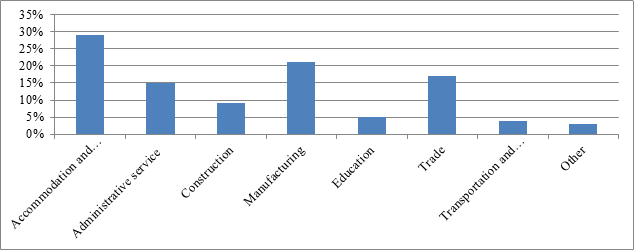
According to the findings from the conducted survey, as illustrated in Figure 1, the majority of companies participating in the survey are from the Accommodation and Food and beverage service activities 29%, 21% from the Manufacturing sector, 9% from the Construction sector, 17% from Trade, Administrative service 15%, Education 5%, Transportation and storage 4% and other %. The highest percentage of companies is from the Accommodation and Food and beverage service activities sector.
Percentage of Automated Operations by Sector
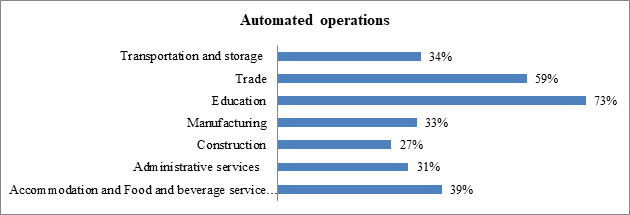
These percentages likely represent the extent to which each sector has integrated digital technologies into their operations. For instance, the education sector has a high adoption rate of 73%, reflecting significant digital transformation efforts, possibly accelerated by the COVID-19 pandemic and the shift to online learning, followed by trade at 59%. In contrast, the construction sector shows a lower adoption rate of 27%, indicating more space for digital innovation. Figure 2 shows the percentages of automated operations by sector.
Factors Have Influenced Digitization
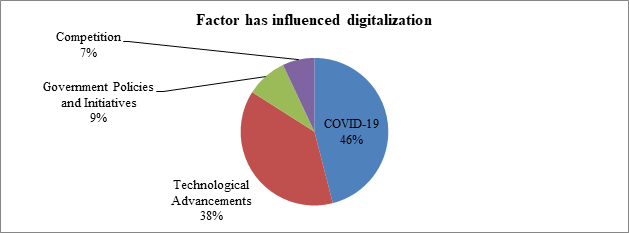
In recent years, several key factors have influenced digitization across industries, particularly in SMEs. The pandemic has been a significant driver of digital transformation. The survey indicated that over 46% of companies accelerated their digital transformation efforts in response to COVID-19, with many organizations adopting remote work, online services, and digital communication tools to maintain operations. Technological advancements have influenced 38% of the companies, and approximately 16% of organizations were influenced by government and competition. These factors are shown in the Figure 3.
Investment Areas in Digitalization
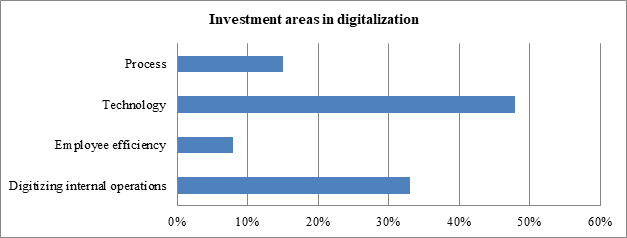
Figure 4 provided highlights different focus areas and their corresponding percentages for investment or impact in digitization initiatives within SMEs. Here's a description of each area: A significant portion (33%) of the focus is on digitizing internal operations. This involves automating and streamlining internal processes to improve efficiency, reduce errors, and enhance overall productivity.
Only 8% of the focus is on employee efficiency. This could involve training employees to use new digital tools effectively, improving collaboration through digital platforms, and enhancing productivity through better resource management. The relatively lower percentage suggests that while important, this area is not the primary focus compared to technology and internal operations.
The largest focus area is technology, comprising 48% of the investment or impact. This includes adopting emerging technologies such as cloud computing, AI, machine learning, IoT, and cyber security solutions. The high percentage strongly emphasizes leveraging advanced technologies to drive digital transformation and stay competitive.
Processes account for 15% of the focus. This involves optimizing business processes to make them more efficient and effective through digitization. It includes process automation, improving workflow management, and implementing best practices in digital process management.
Figure 5 provides updated percentages for the main obstacles that firms, particularly SMEs, face in digitization. The data underscores that limited financial resources are the most significant obstacle (45%) for SMEs, far outstripping other factors. Lack of digital skills (18%) and high costs (15%) are also major barriers, while resistance to change (10%) and data privacy/compliance issues (8%) pose substantial challenges. Although fewer firms struggle with inadequate infrastructure (4%), it remains an important factor to address. These insights highlight the need for comprehensive support mechanisms, including financial aid, training programs, and robust infrastructure development, to facilitate effective digital transformation for SMEs.
Obstacles of Digitalization for SMEs
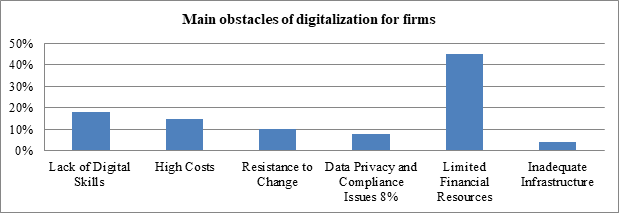
Table 1
Level of Possession
|
Level of possession |
Very poor |
Poor |
Average |
Good |
Excellent |
|
Automation equipment to replace labor |
15% |
27% |
37% |
16% |
5% |
|
Information system of B&B |
16% |
36% |
39% |
7% |
2% |
|
Website |
6% |
14% |
36% |
32% |
12% |
|
Internet (e-commerce) as a sales channel |
4% |
27% |
37% |
24% |
8% |
|
Digital marketing tools |
10% |
35% |
44% |
9% |
2% |
|
Website as a selling channel |
2% |
21% |
40% |
33% |
4% |
|
Social media account and social media advertising |
7% |
18% |
39% |
35% |
1% |
|
Tools for customers’ data analysis |
11% |
29% |
40% |
12% |
8% |
|
Online auction |
16% |
33% |
35% |
15% |
1% |
|
Mobile/digital payment |
48% |
29% |
16% |
7% |
0% |
Based on Table 1, here are some comments on each category of technology possession for businesses:
- Automation equipment to replace labor: Many businesses (15%) have a very poor level of automation equipment to replace labor, while only 5% have an excellent level. This indicates a significant opportunity for improvement in this area.
- Information system of B&B: Only 2% of businesses have an excellent information system for B&B, while a large portion (36%) have a poor level. Investing in improving these systems could enhance efficiency.
- Website: A considerable number of businesses (32%) have a good website, whereas 6% are at a very poor level. A good website is essential for online presence and helps attract customers.
- Internet (e-commerce) as a sales channel: Only 8% of businesses excel in using e-commerce as a sales channel, while 4% are very poor. This highlights an opportunity for growth and development in the e-commerce space.
- Digital marketing tools: Only 2% of businesses have excellent digital marketing tools, while 10% are very poor. Improving these tools can help increase the efficiency of marketing campaigns.
- Website as a selling channel: 4% of businesses have an excellent website as a selling channel, while 2% are very poor. Investing in this aspect can improve online sales.
- Social media account and social media advertising: 35% of businesses have a good presence on social media, while 7% are very poor. Social media is a powerful tool for engaging customers and promoting products/services.
- Tools for customers’ data analysis: Only 8% of businesses have excellent tools for customer data analysis, while 11% are very poor. Utilizing these tools can help better understand customer needs and personalize offers.
- Online auction: Only 1% of businesses have an excellent platform for online auctions, while 16% are very poor. This indicates that most businesses are not leveraging this sales channel effectively.
- Mobile/digital payment: Only 7% of businesses have a good mobile/digital payment system, while 48% are very poor. With the increasing use of digital payments, improvement in this area is crucial.
The analysis of Table 1 reveals significant disparities in the adoption and effectiveness of various marketing and technological tools among businesses. A large proportion of businesses exhibit deficiencies in critical areas such as automation equipment, information systems, digital marketing tools, and mobile/digital payment systems. These shortcomings indicate missed opportunities for improving operational efficiency, customer engagement, and overall competitiveness.
Conclusion
The integration of emerging technologies into SME operations is no longer a choice but a necessity for maintaining relevance and achieving business success in the digital age. Emerging technologies—such as artificial intelligence, cloud computing, Internet of Things (IoT), and so on, are fundamentally reshaping the landscape for SMEs by offering new opportunities for efficiency, innovation, and competitive advantage.
The global crisis of COVID-19 has had a great impact on forcing businesses all over the world and in our country to accelerate the implementation of various digital solutions. Digital transformation has become the most used word, as digital technologies are constantly setting new demands and challenges for societies.
Among the sectors with high digitalization integration is the education sector, likely affected by the transition to online learning during the COVID-19 pandemic. The trade sector also demonstrates notable adoption of digital technologies. In contrast, the construction sector has relatively lower digital integration, suggesting more opportunities for growth in this area. The data underline that the main obstacles faced by firms, especially SMEs, in digitization are limited financial resources, far exceeding other factors.
A large proportion of businesses exhibit deficiencies in critical areas such as automation equipment, information systems, digital marketing tools, and mobile/digital payment systems.
Recommendations
SMEs should focus on adopting technologies aligned with their specific goals, starting small and scaling as benefits are realized. Training employees in digital skills ensure they can effectively implement and use new technologies. Leverage government grants, loans, and incentives designed to support SME digital transformation. Collaborate with technology providers and industry experts to gain access to resources and expertise.
Suggestions for Further Research
Future researchers could conduct similar analyses for all businesses in North Macedonia and design a more in-depth questionnaire. This can help provide more accurate and comprehensive results for such research.
References
Arvidsson, N., & Melander, L. (2020). Barriers to digital transformation in manufacturing: the complexity of digitalization. Journal of Manufacturing Technology Management, 31(7), 1223–1243.
Autio, E. (2017), Strategic entrepreneurial internationalization: A normative framework. Strategic Entrepreneurship Journal, 11(3), 211–227. https://doi.org/10.1002/sej.1261
Becker, W., & Schmid, O. (2020). The Right Digital Strategy for Your Business: An empirical analysis of the design and implementation of digital strategies in SMEs and LSEs. Business Research, 13, 985–1005.
https://doi.org/10.1007/s40685-020-00124-y
Bharadwaj, A., El Sawy, O. A., Pavlou, P. A., & Venkatraman, N. (2013). Digital business strategy: toward a next generation of insights. MIS Quarterly, 37(2), 471–482. https://ssrn.com/abstract=2742300
Bouwman, H., Nikou, S., Molina-Castillo, F. J., & de Reuver, M. (2018). The impact of digitalization on business models. Digital Policy, Regulation and Governance, 20(2), 105–124. http://dx.doi.org/10.1108/DPRG-07-2017-0039
Chanias, S., Myers, M. D., & Hess, T. (2019). Digital transformation strategy making in pre-digital organizations: the case of a financial services provider. The Journal of Strategic Information Systems, 28(1), 17–33. https://doi.org/10.1016/j.jsis.2018.11.003
Clemons, E., & Madhani, N. (2010) Regulation of digital businesses with natural monopolies or third-party payment business models: Antitrust lessons from the analysis of Google. Journal of Management Information Systems, 27(3), 43–80.
Cordero, J., Barba-Guaman, L., & Guamán, F. (2022). Use of chatbots for customer service in MSMEs. Applied Computing and Informatics. https://doi.org/10.1108/ACI-06-2022-0148
Davenport, T. H., & Kirby, J. (2015). Beyond automation: strategies for remaining gainfully employed in an era of very smart machines. Harvard Business Review, 93(6), 58–65.
Eller, R., Alford, P. h.,. Kallmünzer, A., & Peters, M. (2020) Antecedents, consequences, and challenges of small and medium-sized enterprise digitalization, Journal of Business Research, 112, 119–127. https://doi.org/10.1016/j.jbusres.2020.03.004.
Felicetti, A. M., Corvello, V., & Ammirato, S. (2024). Digital innovation in entrepreneurial firms: a systematic literature review. Review of Managerial Science, 18, 315–362. https://doi.org/10.1007/s11846-023-00638-9
Gubbi, J., Buyya, R., Marusic, S., & Palaniswami, M. (2013). Internet of things (iot): a vision, architectural elements, and future directions. Future Generation Computer Systems, 29(7), 1645–1660. http://dx.doi.org/10.1016/j.future.2013.01.010
Huang, Z., & Palvia, P. (2001). ERP implementation issues in advanced and developing countries. Business Process Management Journal, 7(3), 276–284. http://dx.doi.org/10.1108/14637150110392773
, , , & (2020). The relationship between organizational culture, sustainability, and digitalization in SMEs: A systematic review. Journal of Cleaner Production, 275, 122944. https://doi.org/10.1016/j.jclepro.2020.122944
Jarrahi, M. H. (2018). Artificial intelligence and the future of work: human-ai symbiosis in organizational decision making. Business Horizons, 61(4), 577–586. https://doi.org/10.1016/j.bushor.2018.03.007
Jedynak, M., & Czakon, W., Kuźniarska, A., & Mania, K. (2021). Digital transformation of organizations: what do we know and where to go next? Journal of Organizational Change Management, 34(3), 629–652. https://doi.org/10.1108/JOCM-10-2020-0336
Karahanna, E., Straub, D. W., & Chervany, N. L. (1999). Information technology adoption across time: a cross-sectional comparison of pre-adoption and post-adoption beliefs. MIS Quarterly, 23(2), 183–213. https://doi.org/10.2307/249751
Kraus, S., Jones, P., Kailer, N., Weinmann, A., Chaparro-Banegas, N., & Roig-Tierno, N. (2021). Digital Transformation: An Overview of the Current State of the Art of Research. Journal of Business Research,Volume 123, SAGE Open. 11. https://doi.org/10.1177/21582440211047576
Kraus, S., Schiavone, F,. Pluzhnikova, A., & Invernizzi, A. C. (2021) Digital transformation in healthcare: Analyzing the current state-of-research Journal of Business Research, 123, 557–567. https://doi.org/10.1016/j.jbusres.2020.10.030
Li, L., Su, F., Zhang, W., & Mao, J. Y. (2018). Digital transformation by sme entrepreneurs: a capability perspective. Information Systems Journal, 28(6), 1129–1157. https://doi.org/10.1111/isj.12153
Marston, S., Li, Z., Bandyopadhyay, S., Zhang, J., & Ghalsasi, A. (2011). Cloud computing—the business perspective. Decision Support Systems, 51(1), 176–189. https://psycnet.apa.org/doi/10.1016/j.dss.2010.12.006
Nofer, M., Gomber, P., Hinz, O., & Schiereck, D. (2017). Blockchain. Business & Information Systems Engineering, 59(3), 183–187. https://doi.org/10.1007/s12599-017-0467-3
OECD. (2017). Enhancing the contributions of smes in a global and digitalised economy.
Parida, V., Sjödin, D., Lenka, S., & Wincent, J. (2019). Developing global digital platforms: a business model perspective. Journal of Business Research, 95, 454–464.
Porter, M. E., & Heppelmann, J. E. (2015). How smart, connected products are transforming companies. Harvard Business Review, 93(10), 96–114.
Rogers, E. M. (2003). Diffusion of innovations (5th Ed.). Free press.
Venkatesh, V., Bala, H., & Sykes, T. A. (2012). Impacts of information and communication technology implementations on employees' jobs in service organizations in india: a multi-method longitudinal field study. Production and Operations Management, 19(5), 656–675. http://dx.doi.org/10.1111/j.1937-5956.2010.01148.x
Venkatesh, V., Morris, M. G., Davis, G. B., & Davis, F. D. (2003). User acceptance of information technology: toward a unified view. MIS Quarterly, 27(3), 425–478. https://doi.org/10.2307/30036540
Westerman, G., Bonnet, D., & McAfee, A. (2014). Leading digital: turning technology into business transformation. Harvard business review press.
Zamani, S. Z. (2022). Small and Medium Enterprises (SMEs) facing an evolving technological era: a systematic literature review on the adoption of technologies in SMEs. European Journal of Innovation Management, 25(6), 735–757. https://doi.org/10.1108/EJIM-07-2021- 0360
Zhang, Z. H., Jhaveri, D. J., Marshall, V. M., Bauer, D. C., Edson, J., Narayanan, R. K., ... & Zhao, Q. Y. (2014). A comparative study of techniques for differential expression analysis on RNA-Seq data. PLoS ONE 9(8), e103207. https://doi.org/10.1371/journal.pone.0103207
Zhu, K., Kraemer, K. L., & Xu, S. (2006). The process of innovation assimilation by firms in different countries: a technology diffusion perspective on e-business. Management Science, 52(10), 1557–1576. https://doi.org/10.1287/mnsc.1050.0487

Page 1 of
Download Count : 71
Visit Count : 269
Keywords
Digital Transformation; Emerging Technologies; SMEs; Digital Marketing; E-commerce


Author(s) Information



How to cite this article
Veseli -Kurtishi, T., & Chaushi, B. A. (2024). The impact of emerging technologies on digital transformation in small and medium enterprises. European Journal of Studies in Management and Business, 31, 18-30. https://doi.org/10.32038/mbrq.2024.31.02
Acknowledgments
Not applicable.
Funding
Not applicable.
Conflict of Interests
No, there are no conflicting interests.
Open Access
This article is licensed under a Creative Commons Attribution 4.0 International License, which permits use, sharing, adaptation, distribution and reproduction in any medium or format, as long as you give appropriate credit to the original author(s) and the source, provide a link to the Creative Commons license, and indicate if changes were made. You may view a copy of Creative Commons Attribution 4.0 International License here: http://creativecommons.org/licenses/by/4.0/