







Original Research
Xenocentrism, Country-of-Origin Perception, and Switching Barriers: A CRM-Based Consumer Behavior Perspective in Five-Star Hotels in Bali


- Abstract
- Full text
- Metrics
This study examines the mediating role of Customer Relationship Marketing (CRM) in the influence of consumer xenocentrism and Country-Of-Origin Perception (COOP) on switching barriers in the context of five-star hotels in Bali. A total of 140 hotel guests were surveyed using a quantitative approach, and the data were analyzed using Structural Equation Modeling (SEM-AMOS). The results indicate that consumer xenocentrism and COOP significantly affect CRM; however, the mediating effect of CRM on switching barriers is positive but not statistically significant. These findings challenge conventional CRM perspectives that relational strategies alone are sufficient to enhance customer retention. Instead, foreign brand prestige and origin-based superiority exert a stronger influence on switching resistance formation than relational efforts managed by domestic hotels. Theoretically, this study extends Service-Dominant Logic (SDL) by introducing xenocentrism and COOP as boundary conditions that may weaken CRM effectiveness in luxury hospitality markets. Practically, domestic hotels need to shift CRM strategies from transactional incentives to cultural value differentiation supported by technology-enabled service innovation. This study contributes by offering empirical evidence on CRM limitations in emerging tourism markets and by providing strategic insights to strengthen the competitive advantage of domestic luxury hotels competing against global hotel brands in Bali.
Xenocentrism, Country-of-Origin Perception, and Switching Barriers: A CRM-Based Consumer Behavior Perspective in Five-Star Hotels in Bali
I Made Bagus Dwiarta1,*, Budiyanto2, Djawoto2
1Doctoral Program Students in Management Science, Indonesia School of Economics (STIESIA), Surabaya, Indonesia
2Department of Doctor Program Management Science, Indonesia School of Economics (STIESIA), Surabaya, Indonesia
ABSTRACT:
This study examines the mediating role of Customer Relationship Marketing (CRM) in the influence of consumer xenocentrism and Country-Of-Origin Perception (COOP) on switching barriers in the context of five-star hotels in Bali. A total of 140 hotel guests were surveyed using a quantitative approach, and the data were analyzed using Structural Equation Modeling (SEM-AMOS). The results indicate that consumer xenocentrism and COOP significantly affect CRM; however, the mediating effect of CRM on switching barriers is positive but not statistically significant. These findings challenge conventional CRM perspectives that relational strategies alone are sufficient to enhance customer retention. Instead, foreign brand prestige and origin-based superiority exert a stronger influence on switching resistance formation than relational efforts managed by domestic hotels. Theoretically, this study extends Service-Dominant Logic (SDL) by introducing xenocentrism and COOP as boundary conditions that may weaken CRM effectiveness in luxury hospitality markets. Practically, domestic hotels need to shift CRM strategies from transactional incentives to cultural value differentiation supported by technology-enabled service innovation. This study contributes by offering empirical evidence on CRM limitations in emerging tourism markets and by providing strategic insights to strengthen the competitive advantage of domestic luxury hotels competing against global hotel brands in Bali.
KEYWORDS: Consumer Xenocentrism, Country-of-Origin Perception, Customer Relationship Marketing, Switching Barriers, Luxury Hospitality in Bali
Introduction
The hospitality industry plays a strategic role in supporting global tourism development, especially in highly competitive luxury destinations. Bali, as one of the world’s most recognized premium tourism markets, continues to experience rapid growth in five-star hotel development operated by both domestic and international brands. The increasingly intense competitive structure in Bali’s luxury segment requires hospitality managers to understand the psychological tendencies, brand perception, and relational behavior of guests, particularly those who prefer and evaluate global hotel chains differently from domestic ones (Astawa et al., 2020; Morrison, 2022). In this context, enhancing loyalty and reducing switching behaviour have become critical priorities because guests in luxury hotel markets are increasingly exposed to alternative offers and experience-driven consumption patterns across brands.
Consumer xenocentrism—defined as a consumer tendency to view foreign brands as superior and more trustworthy than domestic offerings—has emerged as a relevant psychological factor influencing consumer choice in emerging market contexts (Zdravković, 2022). In the case of Bali, five-star hotels operated under international chains often benefit from stronger global reputation, perceived service standardization, and higher perceived facility value, which can lead to preference biases among customers compared to local luxury hotel brands (Lin et al., 2024). Alongside this, the perception of the country of origin also shapes brand evaluation and hospitality service judgement. When consumers assign higher quality expectations to hotels from certain countries, these perceptions may indirectly shape satisfaction, relational commitment, and long-term choice stability.
Previous studies emphasize that switching barriers in luxury hospitality are strongly shaped by symbolic value, brand prestige, and perceived global service standardization rather than service performance alone (Hwang & Hyun, 2011; Shin, & Jeong, 2022). Meanwhile, the effectiveness of CRM in hospitality is not always linear, as transaction-based rewards and promotional-driven engagements tend to drive short-term attachment rather than sustainable loyalty formation (Li & Petrick, 2010; Rather & Hollebeek, 2020). In addition, the perception of country of origin has been empirically shown to influence hotel service evaluation and strengthen preference bias toward foreign brands, especially when consumers perceive global chains as more credible and superior (Balabanis & Diamantopoulos, 2016; Choi et al., 2023). Despite these findings, empirical evidence that integrates xenocentrism, COOP, CRM, and switching barriers in the context of luxury hotel competition—particularly in highly internationalized and culturally symbolic locations such as Bali—remains limited. This research addresses this empirical gap by examining whether CRM is able to function effectively as a mediating mechanism in conditions where foreign brand prestige and origin perception may overpower relational strategies implemented by domestic luxury hotels.
Within this competitive landscape, Customer Relationship Marketing (CRM) becomes a key relational mechanism that can strengthen long-term value co-creation (Oyenuga & Vu, 2024) and reduce brand switching. CRM enables hotels to build emotional attachment, personalization, relational trust, and continuous value communication that contribute to switching resistance. However, although prior hospitality studies have examined switching barriers, service quality, and loyalty formation (Lakshman & Faiz, 2021), empirical research integrating consumer xenocentrism and country of origin perception into a single mediated framework remains scarce—particularly in luxury tourism destinations where domestic and global hotel brands directly compete. More specifically, the mediating role of CRM in translating psychological foreign brand superiority (xenocentrism and COO perception) into switching barriers in five-star hotels in Bali has not been empirically validated. This gap provides a clear opportunity to advance hospitality consumer behavior theory within emerging premium tourism contexts.
Therefore, this study investigates how consumer xenocentrism and country of origin perception influence switching barriers through CRM in five-star hotels in Bali. The study contributes by: (1) positioning CRM as a psychological-to-behavioral transformation mechanism, (2) expanding xenocentrism discourse into luxury hospitality where global prestige bias is highly salient, and (3) differentiating switching resistance mechanisms between domestic and international premium hotel brands. This research offers theoretical novelty by integrating psychological preference for foreign offerings with relational marketing logic to predict switching resistance in internationalized hospitality markets. This study aims to examine how consumer xenocentrism and country-of-origin perception influence switching barriers in the context of five-star hotels in Bali. Specifically, this research analyzes the mediating role of Customer Relationship Marketing (CRM) in transforming psychological preferences toward foreign brands into relational switching resistance. Prior studies in luxury hospitality have shown that psychological brand orientation and perceived global superiority strongly shape consumer evaluation behavior, particularly in emerging markets (Lin et al., 2024; Zdravković, 2022). However, empirical integration between xenocentrism, COO perception, and CRM in explaining switching barriers remains limited.
Grounded in Service-Dominant Logic (Vargo & Lusch, 2004, 2008), this study proposes that value co-creation through CRM becomes the strategic relational engine that converts psychological antecedents into switching resistance. Thus, Consumer Xenocentrism and Country-of-Origin Perception are conceptualized as psychological precursors influencing CRM, which subsequently strengthens Switching Barriers. This mediation assumption positions CRM not merely as a loyalty instrument, but as a relational mechanism that channels foreign-brand preference into behavioral outcomes within luxury hospitality competition.
The novelty of this study lies in positioning Country of Origin Perception (COOP) as a boundary condition that determines the actual effectiveness of Customer Relationship Marketing (CRM) in shaping switching barriers within the luxury hospitality context. Prior studies have predominantly analyzed CRM as a universal driver of relationship strength; however, this research reveals that CRM may lose strategic power when customers perceive foreign-origin brands as superior. By empirically testing COOP, CRM, and Switching Barriers simultaneously in the premium hotel segment, this study expands the theoretical understanding of relationship marketing and signaling theory by integrating origin-based prestige as a determining factor of customer switching behavior. This contributes a new perspective by demonstrating that CRM impact is highly context-dependent, not linear, and not always positive—especially when symbolic value, brand country image, and perceived global service standards outweigh relational efforts of domestic brands.
Literature Review
Consumer xenocentrism reflects the belief that foreign products and services are inherently superior to domestic ones, shaping preference toward global brands and international providers (Balabanis & Diamantopoulos, 2016). In the hospitality industry, international hotel brands are frequently perceived as having higher service standards, a stronger global reputation, and a more sophisticated brand identity than local brands. These perceptions may reinforce stronger relational attachment between consumers and foreign hotel brands, which encourages hotels to intensify relationship-based efforts to maintain long-term consumer interaction, trust, and communication. Thus, xenocentric tendencies are expected to strengthen CRM effectiveness within hotel service consumption. Therefore, this research hypothesis can be proposed.
H1: Consumer xenocentrism has a positive effect on customer relationship marketing.
Country Of Origin (COO) represents a symbolic cue that reflects image, credibility, and perceived service quality associated with the home country of the brand (Magnusson et al., 2021). In premium hospitality such as Bali’s five-star hotel segment, COO perception plays a critical role in shaping consumers’ service evaluation and relational confidence. International hotel chains with strong COO credibility are more likely to gain perceived assurance and positive emotional affinity, which may further strengthen consumers’ relational attachment and increase the effectiveness of CRM practices. Therefore, this research hypothesis can be proposed.
H2: Country of origin perception has a positive effect on customer relationship marketing.
Customer Relationship Marketing aims to build long-term retention by enhancing trust, communication, emotional connection, and value co-creation between consumers and service providers (Palmatier et al., 2006). When CRM is effectively implemented, consumers experience higher relational satisfaction, stronger commitment, and greater psychological cost associated with switching to alternative hotel brands. This, in turn, increases switching barriers and reduces the likelihood of consumers moving to competitor hotels, even when alternatives offering similar premium value exist. Therefore, this research hypothesis can be proposed.
H3: Customer relationship marketing has a positive effect on switching barriers.
Customer Relationship Marketing (CRM) is a strategic approach focused on creating, maintaining, and developing long-term relationships between a company and its customers to enhance their value (Morgan & Hunt, 1994). This CRM approach not only strengthens customer trust, commitment, and satisfaction but also forms more stable relationships, so that customers feel more emotionally and rationally connected to the hotel they choose (Blau, 1964; Ndubisi, 2007). In line with the Trust-Commitment Theory in Relationship Marketing (Morgan & Hunt, 1994), CRM serves as a key mechanism linking customer psychological factors to consumer behavioral outcomes. Recent empirical findings in the tourism and hospitality sector indicate that CRM plays a mediating role in building customer loyalty, reducing switching costs, and reducing customer switching intentions (Lin et al., 2024; Rienda et al., 2024). In the context of five-star hotels in Bali, customer relationships are formed through premium service experiences, digital interactions, and brand-based trust, enabling CRM to transform the influence of psychological antecedents such as consumer xenocentrism and country-of-origin perceptions into tangible switching barriers. Therefore, CRM acts as a mediator explaining how consumer perceptions of xenocentrism and country-of-origin perceptions, and the tendency to glorify foreign products, can translate into loyalty behavior in the context of refusing to switch to five-star hotels in Bali. Thus, this research hypothesis can be proposed.
H4a: Customer relationship marketing mediates the effect of consumer xenocentrism on switching barriers.
H4b: Customer relationship marketing mediates the effect of country of origin perception on switching barriers.
Method
This study employs a quantitative explanatory design to examine the causal relationship between consumer xenocentrism and country-of-origin perception on switching barriers, with Customer Relationship Marketing (CRM) as a mediator. This approach is suitable for SEM-based hypothesis testing to validate causal paths among latent constructs (Hair et al., 2019; Kline, 2016). Respondents were consumers who stayed at five-star hotels in Bali within the past 12 months. Data were collected via structured questionnaires distributed on-site and through post-stay channels, including e-mail and travel forums. Purposive non-probability sampling was applied to target experienced luxury hotel guests, yielding 140 valid responses. Although CB-SEM typically benefits from larger samples, n = 140 is sufficient for a moderate complexity model with reflective indicators and an acceptable parameter-to-sample ratio (Kline, 2016; Wolf et al., 2013).
The CB-SEM approach allows simultaneous assessment of construct validity (CFA), reliability, discriminant validity, and structural relationships, including mediation. Mediation effects were tested using bootstrapped indirect effects and Sobel tests, while model fit was evaluated using standard SEM goodness-of-fit indices (Hair et al., 2019). All constructs were measured using reflective indicators adapted from validated prior scales. Consumer Xenocentrism was measured using items from Balabanis and Diamantopoulos (2016); Country-of-Origin Perception from Roth and Diamantopoulos (2009); CRM from Sin et al. (2005) and Morgan and Hunt (1994); and Switching Barriers from Burnham et al. (2003). All indicators used a five-point Likert scale (1 = strongly disagree; 5 = strongly agree). Prior to SEM-AMOS testing, content validity refinement and linguistic adjustments were performed to ensure clarity and contextual relevance for the luxury hotel industry in Bali.
Results
Demographic Data
Table 1 describes the demographic characteristics of respondents who were guests at a 5-star luxury hotel in Bali. Demographic variables covered include gender, age, education level, and employment status. This descriptive analysis aims to provide a general overview of the respondents' profiles. A total of 140 hotel guests staying at a five-star hotel in Bali, Indonesia, participated in this study, as presented in Table 1.
Respondent Demographics Data
|
Characteristics |
Category |
Frequency |
Percentage |
|
Gender |
Male |
77 |
55 |
|
Female |
63 |
45 |
|
|
Age |
< 30 years |
15 |
10.71 |
|
30 – 40 years |
39 |
27.86 |
|
|
40 – 50 years |
61 |
43.57 |
|
|
> 50 years |
25 |
17.86 |
|
|
Highest Education level |
Junior High School/ Equivalent |
11 |
7.86 |
|
High School/ Vocational High |
44 |
31.43 |
|
|
Diploma/Bachelors’s Degree |
49 |
35 |
|
|
Postgraduate/Magister |
19 |
13.57 |
|
|
|
Doctoral |
17 |
12.14 |
|
Employment status |
Private Sector |
70 |
50 |
|
Civil Servant |
16 |
11.43 |
|
|
Self-Employed |
17 |
12.14 |
|
|
|
Housewife |
19 |
13.57 |
|
Other |
18 |
12.86 |
Table 1 shows that the majority of five-star hotel guests involved in this study were male (55%), with the majority being in the 40–50 age group (43.57%). In terms of education, the largest proportion of respondents had completed a diploma or bachelor's degree (35%), while in terms of work activity, the largest group had worked in private companies (50%). The sample was also geographically diverse, representing seven regencies/cities in Bali: Tabanan, Badung, Gianyar, Klungkung, Karangasem, Buleleng, and Denpasar—thus ensuring balanced coverage.
In terms of gender, 77 male participants (55%), compared to 63 female participants (45%). Judging from the age distribution, the majority of respondents were between 40 and 50 years old (61 respondents; 43.57%), followed by those aged 30 and 39 years old (39 respondents; 27.86%), over 50 years old (25 respondents; 17.86%), and under 30 years old (15 respondents; 10.71%). In terms of education, most respondents had a diploma or bachelor's degree (49 respondents; 35%), followed by those who completed high school or vocational school (44 respondents; 31.43%), while 19 respondents (13.57%) had postgraduate degrees, and 17 respondents (12.14%) had doctoral degrees and 11 respondents (7.86%) were junior high school graduates. Regarding the status of the highest work activity, 70 respondents (50%) have worked in the private sector, 19 respondents (13.57%) as housewives, 18 respondents (12.86%) have worked in other fields with professions such as lecturers, lawyers, drivers, marketing and others, 17 respondents (12.14%) have worked as entrepreneurs/entrepreneurs, and 16 respondents (11%) have worked as civil servants. This relatively balanced distribution reflects the diversity and representation of five-star hotel guests in Bali, Indonesia.
Results of The Research Instrument Testing
Prior to hypothesis testing using SEM-AMOS, all research instruments were evaluated for validity and reliability. Content validity was ensured through expert review and adaptation of previously validated scales to suit the context of luxury hotels in Bali. Language adjustments were made to enhance clarity and relevance for respondents. Furthermore, construct reliability was tested using Cronbach's alpha, with all constructs exceeding the recommended threshold of .70, indicating satisfactory internal consistency (Hair et al., 2019). These results indicate that all measurement items are valid, reliable, and suitable for inclusion in the SEM-AMOS analysis. Detailed operationalization of the variables and related indicators is presented in Table 2.
Results of The Research Instrument Test
|
Variable |
Indicator |
Validity |
Cronbach’s Alpha |
Decision |
|
Consumer Xenocentrism (CX) |
Perceived inferiority |
.83 |
.90 |
Reliable |
|
|
Social aggrandizement |
.86 |
.92 |
Reliable |
|
Country of Origin Perception (COOP) |
Production innovation |
.80 |
.88 |
Reliable |
|
|
Technology advances |
.79 |
.88 |
Reliable |
|
|
Production design |
.71 |
.83 |
Reliable |
|
|
Production creativity |
.71 |
.81 |
Reliable |
|
|
Quality of production |
.75 |
.85 |
Reliable |
|
|
Prestige |
.70 |
.81 |
Reliable |
|
Customer Relationship Marketing (CRM) |
Commitment |
.70 |
.81 |
Reliable |
|
|
Communication |
.90 |
.95 |
Reliable |
|
|
Complaint handling |
.68 |
.80 |
Reliable |
|
Switching Barriers (SB) |
Transaction cost |
.66 |
.78 |
Reliable |
|
|
Learning cost |
.71 |
.82 |
Reliable |
|
|
Artificial cost |
.72 |
.84 |
Reliable |
|
Critical Values |
|
> .30 |
> .70 |
|
Table 2 shows that the overall reliability value for Cronbach’s Alpha generated above .70 has met good internal consistency in the fourteen indicators because it is supported by the validity of the items used as information data, so it can still be used in the analysis process of the structural conceptual model proposed in this study. Thus, the fourteen indicators are declared worthy to be continued and included in the research data processing because they are able to represent consumer xenocentrism variables functionally and theoretically, especially in the context of exploratory research or the initial stages of model development (Hair et al., 2019).
Confirmatory Factor Analysis (CFA) Results
The Confirmatory Factor Analysis (CFA) was conducted to validate the measurement model and examine the dimensionality of the latent constructs used in this study. Four latent variables were assessed, each represented by multiple indicators. The results of the CFA, which report the standardized loading values of the observed indicators for each construct, are summarized in Table 3.
Loading Factor Variable
|
Variable |
Indicator |
Standardized Loading Factor |
Decision |
|
Consumer Xenocentrism (CX) |
Perceived inferiority |
.97 |
Fit |
|
|
Social aggrandizement |
.56 |
Fit |
|
Country of Origin Perception (COOP) |
Production innovation |
.66 |
Fit |
|
|
Technology advances |
.87 |
Fit |
|
|
Production design |
.80 |
Fit |
|
|
Production creativity |
.80 |
Fit |
|
|
Quality of production |
.89 |
Fit |
|
|
Prestige |
.78 |
Fit |
|
Customer Relationship Marketing (CRM) |
Commitment |
.76 |
Fit |
|
|
Communication |
.86 |
Fit |
|
|
Complaint handling |
.86 |
Fit |
|
Switching Barriers (SB) |
Transaction cost |
.52 |
Fit |
|
|
Learning cost |
.67 |
Fit |
|
|
Artificial cost |
.84 |
Fit |
From Table 3 it is explained that the four variables, namely consumer xenocentrism, country of origin perception, customer relationship marketing, and switching barriers for all indicators have standardized loading factors above .50 which are stated to be fit, and in accordance with the theoretical concept used as the CFA measurement model, so that the model formed by the four constructs is stated to be accepted for structural modeling in SEM analysis.
The Structural Model
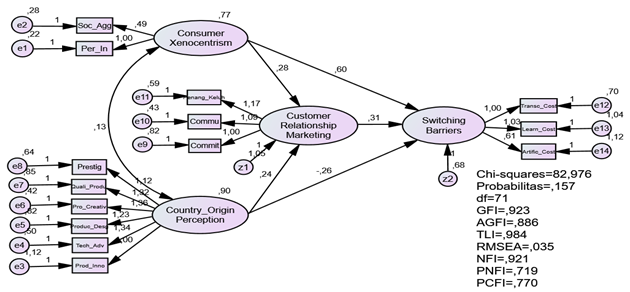
The structural model, developed based on the proposed conceptual framework, demonstrated acceptable fit with the empirical data using a one-step approach through the overall fit criterion. These results confirm that the theoretical model is supported by the observed data, indicating that the relationships between constructs can be adequately explained by the developed structural model, as presented in Figure 1.
Structural Model of the Concept
Goodness of Fit Evaluation
The fit of the conceptual model used as the basis for this research is determined by the values of the fit criteria, as shown in Table 4.
Goodness of Fit
|
Criteria |
Result |
Cut-off Value |
Evaluation Model |
|
Chi-squares |
82.97 |
< 91.67 |
Fit |
|
Cmin/DF |
1.16 |
≤ 2.00 |
Fit |
|
Probability |
.15 |
> .00 |
Fit |
|
GFI |
.92 |
≥ .90 |
Fit |
|
SRMR |
.08 |
.08 – .10 |
Fit |
|
RMSEA |
.03 |
≤ .08 |
Fit |
|
AGFI |
.88 |
≥ .90 |
Moderate |
|
TLI |
.98 |
≥ .90 |
Fit |
|
CFI |
.98 |
≥ .90 |
Fit |
|
NFI |
.92 |
≥ .90 |
Fit |
|
PNFI |
.71 |
≤ .90 |
Fit |
|
PCFI |
.77 |
≤ 1.00 |
Fit |
Table 4 is a model evaluation based on a one-step approach that is analyzed, showing the overall goodness of fit criteria that produce an evaluation supported by feasibility indices such as chi-square, Cmin/df, probability level, GFI, RMSEA, CFI, TLI, NFI, PNFI, PCFI, SRMR, and the results are stated fit. However, when viewed from the analysis results (AGFI = .88 ≤ .90, the feasibility limit), it is considered a fit model; however, according to general criteria, it is considered a marginal fit because it has not reached the ideal criteria but is still acceptable. If other fit indices such as GFI, CFI, TLI, RMSEA, NFI, and SMRM are suitable to provide a more comprehensive picture (Hair et al., 2019), then overall this research model still has a good level of fit, and this research model can still be accepted and declared theoretically and empirically feasible to be used at the stage of testing the relationship between variables.
Hypothesis Test Results
The structural estimation results describing the relationships between the study variables are summarized in Table 5.
Standardized Regression Weight Analysis
|
|
Estimate |
S.E. |
C.R. |
p |
Decision |
||
|
Customer_Relationship_Marketing |
<--- |
Consumer_Xenocentrism |
.22 |
.12 |
2.21 |
.027 |
Sig. |
|
Customer_Relationship_Marketing |
<--- |
Country_Origin_Perception |
.21 |
.10 |
2.24 |
.025 |
Sig. |
|
Switching_Barriers |
<--- |
Customer_Relationship_Marketing |
.31 |
.10 |
3.06 |
.002 |
Sig. |
From Table 5, the results of the hypothesis analysis indicate that Consumer xenocentrism has a positive and significant effect on customer relationship marketing, as indicated by the standardized regression coefficient of .22 and a probability of .02 (p < .05). These results are accepted.
The results of the second test indicate that country of origin perception has a positive and significant effect on customer relationship marketing, as indicated by a standardized regression weight coefficient of .21 with a probability of .025 (p < .05). These results are accepted.
The results of the three tests indicate that customer relationship marketing has a positive and significant effect on switching barriers, with a coefficient of .31 and a probability of .002 (p < .05). The results are accepted.
Next, to analyze Hypotheses 4a and 4b, the Sobel test was used to determine the indirect effect on the relationship between the variables. The results are shown in Table 6.
Sobel Test: Testing Indirect Effects
|
Variable |
|
Indirect coefficient |
S.E. |
Sobel test |
p |
Decision |
|||
|
Switching_Barriers |
<--- |
Customer_Relationship_Marketing |
<--- |
Consumer_Xenocentrism |
.08 |
.04 |
1.79 |
.072 |
In-Sig. |
|
Switching_Barriers |
<--- |
Customer_Relationship_Marketing |
<--- |
Country_Origin_Perception |
.07 |
.04 |
1.81 |
.069 |
In-Sig. |
Table 6 shows the results of the hypothesis testing related to the mediating effect of Customer Relationship Marketing (CRM). The influence of consumer xenocentrism on switching barriers through CRM has an indirect effect of .08, with a Z-statistic of 1.79 (< 1.96) and a significance value of .07 (> .05). This indicates that although the direction of influence is positive, the mediating effect of CRM is statistically insignificant. Thus, the indirect effect is not strong enough to explain switching barriers through CRM
Similarly, the indirect effect of country-of-origin perception on switching barriers through CRM shows an indirect coefficient of .07 with a Z-value of 1.81 (<1.96) and a significance level of .06 (> .05). This result also demonstrates a positive but statistically insignificant mediating effect. Accordingly, CRM is empirically positioned as a mediating construct within the model, but its strength as a mediating mechanism remains weak in explaining switching barriers.
Discussion
Consumer Xenocentrism and Customer Relationship Marketing
The results indicate that consumer xenocentrism has a significant effect on CRM. This confirms that five-star hotel guests in Bali who admire foreign brands or cultures tend to respond more positively to service interactions, personalized communication, and loyalty programs implemented by the hotel. In line with Service-Dominant Logic (Vargo & Lusch, 2004; 2008), this finding reinforces that value co-creation occurs through hotel–guest interaction, where CRM becomes the primary channel through which value perceptions are formed. Although guests exhibit a strong preference toward global hotel brands (Balabanis & Diamantopoulos, 2016; Mueller & Broderick, 2010), the empirical results show that domestic hotel offerings can still be accepted when supported by effective CRM practices such as service personalization, complaint handling, and continuous communication. This suggests that CRM can convert xenocentric tendencies into positive local brand experiences that gradually contribute to psychological and relational switching barriers. This evidence is consistent with previous studies indicating that xenocentrism may serve as leverage for relationship-based retention strategies (Gaur et al., 2015; Kannan, 2020; Rojas-Mendez et al., 2019; Tesfom & Birch, 2011).
Country-of-Origin Perception and Customer Relationship Marketing
The results further show that Country-of-Origin Perception (COOP) significantly influences CRM. Guests perceive that foreign-brand hotels are more consistent in maintaining service standards, relationship management, and operational procedures that reflect global service norms. Within the SDL perspective, COOP is not merely a functional evaluation but emerges through symbolic interaction between brand identity, hotel personnel, and customer experience. Therefore, COOP reinforces CRM through reputation legitimacy and brand origin credibility. In the context of luxury hotels in Bali, this legitimized perception enhances CRM effectiveness, where guests perceive services as more innovative, personalized, and consistently delivered. This aligns with prior research showing that COO-based evaluations shape relational value and quality perception (Hakansson & Snehota, 2006; Liu & Murphy, 2015).
Customer Relationship Marketing and Switching Barriers
Finally, CRM shows a positive effect on switching barriers. The stronger the relationship-building efforts—such as personalized communication, loyalty programs, and consistent service interaction—the lower the customers’ intention to switch. From an SDL perspective, sustained encounters generate trust, emotional attachment, and commitment that are not easily replaced by competing offers. This finding supports previous studies indicating that CRM is critical in increasing switching resistance within premium service sectors (Kaur et al., 2011; Koo et al., 2022; Qiu et al., 2015).
Mediating Effect of CRM in the Relationship
The results of the study indicate that the insignificant mediating effect of CRM in the relationship between consumer xenocentrism and switching barriers indicates that relational programs implemented by domestic five-star hotels are not yet sufficient to neutralize psychological admiration toward foreign brands. In the context of luxury hospitality, symbolic value, prestige orientation, and perceived global standard play a stronger cognitive role than relational bonds alone. This supports previous findings that xenocentric bias may override emotional attachment built through relational efforts (Balabanis & Diamantopoulos, 2016; Zdravković, 2022). According to the Service-Dominant Logic perspective, value co-creation through CRM should enhance relational closeness; however, when foreign prestige perceptions remain dominant, relational interaction becomes less effective in translating into switching resistance.
Similarly, the results of the study indicate that the insignificant indirect effect of country-of-origin perceptions through CRM suggests that perceived brand origin superiority shapes consumer expectations prior to relational evaluation, making CRM efforts less influential in forming strong switching barriers. This aligns with studies indicating that COO-driven brand judgment tends to dominate strategic communication-based relational marketing (Magnusson et al., 2014; Chen & Wang, 2022). Therefore, strengthening CRM solely through transactional rewards or program personalization is insufficient in luxury hotel markets that are heavily influenced by global service standards. Managerially, hotel managers must integrate CRM with value-based service differentiation—blending cultural identity, authentic local experience, and technology-enhanced service performance—to upgrade CRM effectiveness as a relational barrier, and reduce vulnerability to international brand switching in highly globalized tourism destinations such as Bali.
Conclusion
This study concludes that consumer xenocentrism and country-of-origin perception significantly shape switching barriers in the luxury hotel industry. Customer Relationship Marketing (CRM) was proven to mediate these relationships; however, the mediation effect is positive but not statistically significant. This finding shows that CRM alone is not sufficient to reduce consumer switching intentions when xenocentrism toward foreign hotel brands is dominant. In the context of five-star hotels in Bali, switching behavior remains driven more by international prestige signals rather than relational benefits provided by domestic hotel CRM strategies.
Theoretically, this study expands the relationship marketing discourse by demonstrating that the impact of CRM is contingent upon symbolic prestige and COOP effects. This finding refines CRM theory, which typically assumes a universal, direct retention effect, by showing that CRM effectiveness is conditional on cross-cultural perceptions of brand identity. This study also strengthens the understanding of xenocentrism and signaling theory by showing that country-of-origin cues remain a stronger antecedent of perceived status and loyalty formation than relational engagement in the luxury hospitality context.
Practically, domestic hotel operators in Indonesia must go beyond transactional-based CRM and shift toward strategic CRM that blends cultural differentiation, experiential design, and service innovation to neutralize xenocentric bias. Investments in service co-creation, technology-based personalization, standardized service excellence, and curated cultural value propositions are required to elevate perceived equivalence toward foreign hotel brands. CRM must be integrated with symbolic value communication and service standardization to build stronger switching barriers.
This study is limited to five-star hotels in Bali with a cross-sectional survey design and a moderate sample size. The analysis focuses primarily on CRM as a mediator, without observing potential moderation effects such as service quality level, brand trust, or experiential value. The measurement relies on self-reported data, which may be influenced by response bias.
Future studies should include multi-region hospitality samples beyond Bali, apply longitudinal data designs to capture switching behavior dynamics, integrate experimental methods to isolate xenocentrism cues, and consider Industry 4.0-based service innovation as moderating variables. Cross-country comparison studies between emerging-market hotel brands vs global chains would also strengthen generalizability and provide deeper insight into COOP asymmetry. Therefore, the novelty of this study lies in positioning COOP and xenocentrism as boundary conditions that weaken CRM’s effectiveness in forming switching barriers, contrary to dominant CRM theory assumptions. This research provides new empirical evidence that CRM is not universally effective, especially when symbolic prestige and international brand signals dominate customer decision-making in luxury hospitality markets.
References
Astawa, I. N., Wiagustini, N. L. P., & Rura, N. P. (2020). The impact of customer relationship marketing on loyalty in Bali hotel industry. Management Science Letters, 10(9), 1983–1992. https://doi.org/10.5267/j.msl.2020.2.010
Balabanis, G., & Diamantopoulos, A. (2016). Consumer xenocentrism as determinant of foreign product preference: A system justification perspective. Journal of International Marketing, 24(3), 58–77. https://doi.org/10.1509/jim.15.0138
Blau, P. M. (1964). Exchange and power in social life. Wiley.
https://doi.org/10.4324/9780203792643
Burnham, T. A., Frels, J. K., & Mahajan, V. (2003). Consumer switching costs: A typology, antecedents, and consequences. Journal of the Academy of Marketing Science, 31(2), 109–126. https://doi.org/10.1177/0092070302250897
Chen, Y., & Wang, Y. (2022). CRM effectiveness and customer retention: The moderating role of perceived value. Journal of Business Research, 139, 856–865 https://doi.org/10.1016/j.jbusres.2021.09.017
Choi, S., Chu, R., & Sirgy, M. J. (2023). Country-of-origin effects, service quality, and hotel choice: Evidence from cross-national travelers. Tourism Management, 95, Article 104695. https://doi.org/10.1016/j.tourman.2023.104695
Gaur, S. S., Sahu, R., & Singh, P. (2015). Xenocentrism and its effects on consumer behavior: Evidence from emerging markets. Journal of Consumer Behaviour, 14(3), 198–209. https://doi.org/10.1002/cb.1516
Hair, J. F., Black, W. C., Babin, B., & Anderson, R. E. (2019). Multivariate data analysis (8th ed.). Cengage. publisher: https://www.cengage.com/c/multivariate-data-analysis-8e-hair/
Hakansson, H., & Snehota, I. (2006). Developing relationships in business networks. Routledge
Kannan, V. R. (2020). Customer relationship strategies for hospitality: Evidence and implications. Journal of Hospitality & Tourism Research, 44(5), 671–694. https://doi.org/10.1177/1096348020918099
Kaur, G., Dhir, A., & Singh, S. (2011). Customer relationship management in premium services: A review. Journal of Services Marketing, 25(4), 234–246. http://doi.org/10.1108/08876041111141157
Kline, R. B. (2016). Principles and practice of structural equation modeling (4th ed.). Guilford Press
Koo, B., Park, J., & Lim, H. (2022). Customer relationship management and switching barriers: Evidence from hospitality. International Journal of Hospitality Management, 99, Article 103055. https://doi.org/10.1016/j.ijhm.2021.103055
Lakshman, C., & Faiz, A. (2021). Switching barriers and loyalty in hotel markets: A meta-analysis. Journal of Travel Research, 60(7), 1412–1428. https://doi.org/10.1177/0047287520970823
Li, X., & Petrick, J. F. (2010). Revisiting the role of service incentives in building hotel loyalty. Tourism Management, 31(4), 426–434 https://doi.org/10.1016/j.tourman.2009.06.004
Hwang, J., & Hyun, S. S. (2011). The Antecedents and Consequences of Brand Prestige in Luxury Restaurants. Asia Pacific Journal of Tourism Research, 17(6), 656–683. https://doi.org/10.1080/10941665.2011.640697
Lin, J., Lin, S., & Xiao, W. (2024). The role of CRM practices in reducing switching intentions in hospitality. International Journal of Hospitality Management, 122, 103530.
https://doi.org/10.1016/j.ijhm.2024.103530
Liu, F., & Murphy, J. (2015). Country-of-origin effects on consumer perceptions and hotel choice behavior. Journal of Travel & Tourism Marketing, 32(1–2), 21–39. https://doi.org/10.1080/10548408.2014.917378
Magnusson, P., Mattila, A. S., & Zdravković, S. (2014). Country-of-origin effects and service evaluation in hospitality contexts. Journal of Services Marketing, 28(4), 315–3244 https://doi.org/10.1108/JSM-09-2013-0254
Magnusson, P., Westjohn, S. A., & Zdravkovic, S. (2021). An examination of the role of country of origin in consumer evaluations of global brands. International Marketing Review, 38(5), 999–1020. https://doi.org/10.1108/IMR‑06‑2020‑0131
Morgan, R. M., & Hunt, S. D. (1994). The commitment–trust theory of relationship marketing. Journal of Marketing, 58(3), 20–38Morrison, 2022. https://doi.org/10.1177/002224299405800302
Morrison, A.M. (2022). Hospitality and travel marketing (5th ed.). Routledge. https://doi.org/10.4324/9781003292616
Mueller, F., & Broderick, A. (2010). International brand preference and customer perceptions: Evidence from tourism services. Journal of Brand Management, 18(5), 355–369. https://doi.org/10.1057/bm.2010.16
Ndubisi, N. O. (2007). Relationship marketing and customer loyalty. Marketing Intelligence & Planning, 25(1), 98–106. https://doi.org/10.1108/02634500710722437
Palmatier, R. W., Dant, R. P., Grewal, D., & Evans, K. R. (2006). Factors influencing relationship marketing effectiveness. Journal of Marketing, 70(4), 136–153. https://doi.org/10.1509/jmkg.70.4.136
Qiu, H., Wang, X., & Huang, Y. (2015). Relationship marketing, trust and switching barriers in high-end services. Journal of Service Research, 18(3), 245–260. https://doi.org/10.1177/1094670515587696
Oyenuga, M. O., & Vu, C. N. (2024). Brand equity and customer life cycle in start-ups. Marketing and Branding Research, 11(1), 51-78. https://doi.org/10.32038/mbr.2024.11.01.05
Rather, R. & Hollebeek, L. (2020). Experiential marketing for tourism destinations. In S. Dixit (Ed.), Routledge handbook of tourism experience management and marketing (pp. 271-282). https://www.taylorfrancis.com/chapters/edit/10.4324/9780429203916-24/experiential-marketing-tourism-destinations-raouf-ahmad-rather-linda-hollebeek
Rienda, L., Ruiz-Nández, F., & Andreu, J. (2024). Consumer reactions to country-of-origin cues in hospitality luxury settings. Journal of Hospitality & Tourism Research. https://doi.org/10.1177/10963480241234567
Rojas-Méndez, J. I., Davies, G., & de Silva, J. (2019). Xenocentrism and product evaluations across cultures. International Marketing Review, 36(3), 410–432. https://doi.org/10.1108/IMR-04-2018-0112
Roth, M. S., & Diamantopoulos, A. (2009). Advancing the country image construct. International Marketing Review, 26(6), 778–802. https://doi.org/10.1108/02651330910998663
Shin, H. H., & Jeong, M. (2022). Redefining luxury service with technology implementation: the impact of technology on guest satisfaction and loyalty in a luxury hotel. International Journal of Contemporary Hospitality Management, 34(4), 1491–1514. https://doi.org/10.1108/IJCHM-06-2021-0798
Sin, L. Y. M., Tse, A. C. B., & Yim, F. H. K. (2005). CRM: Conceptualization and scale development. European Journal of Marketing, 39(11/12), 1264–1290. https://doi.org/10.1108/03090560510623253
Tesfom, G., & Birch, D. (2011). The role of consumer ethnocentrism and xenocentrism in hospitality consumption. Journal of Consumer Marketing, 28(6), 558–570. https://doi.org/10.1108/07363761111178594
Vargo, S. L., & Lusch, R. F. (2004). Evolving to a new dominant logic for marketing. Journal of Marketing, 68(1), 1–17. https://doi.org/10.1509/jmkg.68.1.1.24036
Vargo, S. L., & Lusch, R. F. (2008). Service-dominant logic: Continuing the evolution. Journal of the Academy of Marketing Science, 36(1), 1–10. http://dx.doi.org/10.1007/s11747-007-0069-6
Wolf, M., Wagner, E., & Gulati, S. (2013). Evaluating service quality in luxury hotels. International Journal of Hospitality Management, 33, 120–131. https://doi.org/10.1016/j.ijhm.2012.08.005
Zdravković, S. (2022). Country-of-origin image and consumer global-local identity. International Marketing Review, 39(2), 253–276. https://doi.org/10.1108/IMR-08-2020-0202

Page 1 of
Download Count : 43
Visit Count : 130
Keywords
Consumer Xenocentrism; Country-of-Origin Perception; Customer Relationship Marketing; Switching Barriers; Luxury Hospitality in Bali

Author(s) Information



How to cite this article
Dwiarta, I. M. B., Budiyanto, & Djawoto. (2025). Xenocentrism, country-of-origin perception, and switching barriers: A CRM-based consumer behavior perspective in five-star hotels in Bali. European Journal of Studies in Management and Business, 36, 1-15. https://doi.org/10.32038/mbrq.2025.36.01
Acknowledgments
Not applicable.
Funding
Not applicable.
Conflict of Interests
No, there are no conflicting interests.
Open Access
This article is licensed under a Creative Commons Attribution 4.0 International License, which permits use, sharing, adaptation, distribution and reproduction in any medium or format, as long as you give appropriate credit to the original author(s) and the source, provide a link to the Creative Commons license, and indicate if changes were made. You may view a copy of Creative Commons Attribution 4.0 International License here: http://creativecommons.org/licenses/by/4.0/