







Original Research
Investigating the Intention of Iranian Consumers to Advocate Luxury Brands: Considering the Role of Purchase Intention and Purchase Commitment


- Abstract
- Full text
- Metrics
Today, the luxury industry in our country continues to grow and accounts for a significant share of our economy. Therefore, in this research, consumers' willingness to advocate for these brands has been examined in relation to the variables of intention and commitment to purchase. The population of this study consists of consumers of the "Armani" and "Boss" brands in Tehran. Three hundred eighty-five people were selected through a multi-stage cluster sampling design. Therefore, based on the objective, the study is an applied work; based on its content, it is a descriptive-survey work. The results of the AMOS-based statistical analysis showed that the variables of personal factors, fashion innovation, fashion involvement, perceived brand value, fashion lifestyle, and social factors have a positive and significant effect on purchase intention. The results also showed that purchase intention has a positive and significant effect on purchase commitment. Finally, the results indicated that purchase commitment has a positive and significant effect on advocacy intentions. Keywords: Luxury Brand; Purchase Intention; Purchase Commitment; Brand Advocacy.
Investigating the Intention of Iranian Consumers to Advocate Luxury Brands: Considering the Role of Purchase Intention and Purchase Commitment
Hossein Norouzi, Shiva Barzegar
Faculty of Management, Kharazmi University, Tehran, Iran
ABSTRACT:
Today, the luxury industry in our country continues to grow and accounts for a significant share of our economy. Therefore, in this research, consumers' willingness to advocate for these brands has been examined in relation to the variables of intention and commitment to purchase. The population of this study consists of consumers of the "Armani" and "Boss" brands in Tehran. Three hundred eighty-five people were selected through a multi-stage cluster sampling design. Therefore, based on the objective, the study is an applied work; based on its content, it is a descriptive-survey work. The results of the AMOS-based statistical analysis showed that the variables of personal factors, fashion innovation, fashion involvement, perceived brand value, fashion lifestyle, and social factors have a positive and significant effect on purchase intention. The results also showed that purchase intention has a positive and significant effect on purchase commitment. Finally, the results indicated that purchase commitment has a positive and significant effect on advocacy intentions. Keywords: Luxury Brand; Purchase Intention; Purchase Commitment; Brand Advocacy.
Keywords: Iranian Consumers, Luxury Brands, Purchase Intention, Purchase Commitment, Willingness to Advocate the Brand
In the vibrant world of consumerism, the luxury industry stands as a symbol of exclusivity, innovation, and quality. The luxury industry is unique in that it extends into all other industries, from fine jewelry to luxury automobiles to luxury hospitality and travel (Björkqvist, 2024).
The luxury industry has a remarkable share in the global market, and luxury brands have experienced significant growth since 1995 (Kaufmann et al., 2016). The concept of luxury is defined as the highest level of authentic brands, encompassing several physical and psychological values (Ajita& sivakumar, 2017). Luxury consumption, of course, is an obvious distinction and can serve as a social marker that enhances status. The main motivation for purchasing luxury brands is to impress others (Shukla et al., 2016).
Global luxury spending is expected to reach $368.9 billion by 2024, with the market growing at a compound annual growth rate of 3.22% through 2028. These figures highlight the industry's significant and growing economic contribution. Luxury marketers typically aim to foster a strong emotional connection and engagement between consumers and their brands, often by emphasizing the social status and exclusivity of the brand (Arya et al., 2024). In recent years, the demand for luxury goods in Iran has increased despite the country's economic recession, a trend reflected in the growing use of luxury brands by Iranian women (Janpors et al., 2023). The rise of global luxury brands such as Prada, Polo, Gucci, and Versace is evident in Iran (Kheiri & Fathali, 2015). The growth of the luxury market is the direct result of extensive urbanization, economic development, affluent lifestyles, and free exchange of ideas and news among people through international travel and the Internet (Ajitha & Sivakumar, 2017). In Iran, as an Islamic country, religion plays a crucial role in the intention to purchase the luxury brands. The consumption of luxury goods in Iran provides a deep understanding of consumer behavior (Davari et al, 2020). Generally, people's purchases are influenced by various factors, such as cultural, social, and psychological factors (Ahmadi & Dehdashti Shahrokh, 2016).
Despite the importance of brand in consumer behavior, it is brand attachment that affects brand advocacy. The attachment theory suggests that an individual's emotional attachment to a brand increases interaction with the brand (Thomson et al., 2005), thereby leading to consumer satisfaction and advocacy. This feeling will increase brand advocacy, which typically occurs after a positive incident or experience and prompts consumers to recommend the brand to others. However, industry analysts believe that luxury brand consumers are less likely to rely on a single brand when shopping in-store. This reduces customer commitment and loyalty to luxury brands (Shukla et al., 2016). Although extensive research has been conducted on consumer attitudes, social norms, and efficacy in the luxury industry, reliable studies on the factors that drive customer purchase intention are scarce. In this study, the influence of factors related to commitment and advocacy of Iranian consumers towards luxury brands is examined.
Literature Review and Research Background
Luxury brands are defined as "significant consumption" and make consumers feel credible by purchasing these products (O'cass & McEwen, 2004) to shape their social or professional position, so they can be used as symbolic markers of group membership. Researchers believe that the word luxury represents the physical and psychological values and is a conceptual and symbolic dimension that includes values extremely correlated with cultural factors and socio-economic dimensions. The purpose of many studies on luxury brands is to identify the value dimensions of luxury products across markets in different countries (Ajitha & Sivakumar, 2017). Researchers tested the theory that if consumers have a higher intention to purchase the luxury brands, they would also be willing to pay the fees for the same product. This concept of purchase intention, highlighted by early research suggesting that it is the best predictor of customers who really want to buy, leads to actual behavior. Customers intend to show a certain level of commitment to their favorite brand due to the unique specifications of the luxury brand. Commitment to luxury brands leads to satisfaction from consumption and brand advocacy and, as a critical component in maintaining and developing a beneficial long-term relationship, can act as a key driver in achieving outcomes such as future goals and benefits. Purchase commitment is related to other factors, such as brand loyalty, customer loyalty, and brand attachment, in which customers demonstrate their loyalty through frequent purchases of a particular brand (Kaufmann et al., 2016). With his commitment to the brand, he will usually act as its advocate, thereby increasing others' understanding of the brand (Shukla et al., 2016). The customer's intention to advocate the brand is one of the outcomes of this commitment, which illustrates the customer's willingness to justify the brand to others. Therefore, this research investigates Iranian consumers' willingness to advocate for luxury brands.
Expanding the Research Hypothesis
Personal Factors and Purchase Intention
Personal factors refer to an individual's behaviour based on emotional perceptions and include three dimensions: self-identity, hedonism, and materialism. Personal factors are a kind of self-centered evaluation in which consumers tend to their thoughts and inner feelings. Self-identity refers to self-image, self-esteem, and self-perception. People try to express themselves by labeling their identity, which is a reflection of who they are (Ajitha & Sivakumar, 2017). Consumers purchase luxury brands in response to the perceptions of others and also to improve their own self-esteem (Ajitha & Sivakumar, 2017). Previous research has mostly focused on the influence of materialism on the consumption of luxury goods (Ang et al, 2001). Hedonism is the inner pleasure of a person that refers to the value of beauty (inner feelings and thoughts) (Ajitha & Sivakumar, 2017). Researchers have identified these characteristics as important variables in motivating the purchase of luxury brands, which affect purchase intention. Labib et al. (2023), Salsabila and Hartono (2023), and Kim and Oh (2022) examined the influence of personal factors on purchase intention. Therefore, the first hypothesis of the research is as follows:
Hypothesis 1. Personal factors have a significant positive effect on the purchase intention luxury brands.
Fashion Innovation and Purchase Intention
A fashion product meets the criteria of innovation when the innovator introduces it to the market for the first time to gain a temporary monopoly (Wulf, 2016). Fashion innovation demonstrates a willingness to adopt new ideas, goods, or services more quickly than others (Zhang & Kim, 2013). Fashion innovators are constantly seeking new styles to maintain their position as seekers of the new and differentiate themselves from others. Previous research shows that fashion innovators are those who follow fashion magazines, purchase new fashion products, and are more sensitive to brands in their decision-making (Li et al., 2007). In fact, empirical studies show that consumers who have identified the brands have a higher awareness of the brand position fixed in their minds and show more interest in familiar fashion products, and as a result have a stronger intention to buy luxury brands (Macdonald & Sharp, 2000). Kaur et al (2024) and Chen et al (2021) investigated the effect of fashion innovation on purchase intention. Therefore, the second hypothesis of this research is as follows:
Hypothesis 2. Fashion innovation has a significant positive effect on purchase intention for luxury brands.
Fashion Involvement and Purchase Intention
Fashion involvement is the consumer's participation in a fashion product, namely clothing, driven by the need or interest to purchase it, or, in other words, the customer's interest in fashion products. Fashion involvement is closely related to personal characteristics and fashion knowledge, which in turn influence impulse buying. Fashion involvement focuses on the consumer's interaction with fashion clothing as a market stimulus, and the more important fashion clothing is in a consumer's life, the greater the involvement with it (Kumbara et al., 2024). fashion involvement as one's perception of fashion based on natural needs, values, and interests, and points to a level at which a consumer considers a purchase decision and recognizes its importance. Luxury brands have higher involvement than other products and receive more consumer attention due to their quality and uniqueness, which reflects perceived superiority relative to ordinary non-luxury brands (Summers et al., 2006). Consumers with high fashion involvement are more interested in styles and trends and have a higher intention to accept and use luxury brands than those with lower fashion involvement (Zhang & Kim, 2013). This suggests that consumers with high fashion involvement have a higher purchase intention for luxury brands (Suh & Yi, 2006). Satriyo et al. (2024), Dewi et al. (2023), and Panta et al (2022) investigated the effect of fashion involvement on purchase intention. Therefore, the third hypothesis of the research is as follows:
Hypothesis 3. Fashion involvement has a significant positive effect on the purchase intention of luxury brands.
Brand Equity and Purchase Intention
Perceived value, a concept deeply rooted in subjective individual experience, has gained prominence in the early new millennium, especially in marketing studies. Consumer behavior research emphasizes the pivotal role of perceived value as one of the most influential factors in consumer decision-making (Zhu & Jiao, 2025). Researchers define brand equity as the difference in consumer responses to luxury brands versus ordinary brands (Li & li, 2001) measure it across three dimensions: perceived quality, brand awareness, and brand loyalty. The quality of the product significantly increases purchase motivation and therefore influences the consumer's purchase decision. Normally, when perceived value is high, consumers have positive feelings about their previous experiences, which increases their satisfaction with the product and promotes their loyalty to the brand (Gholipour et al., 2014). Loyalty is the probability of purchase, the probability of repurchasing the same product, the frequency of purchase, and the repeatability of the consumer's purchase behavior (Ajitha & Sivakumar, 2017). Brand awareness is the customer's familiarity with a particular brand and the buyer's ability to recall it in a given product category, akin to the information nodes in one's memory about the brand (Jahan khan et al., 2015). Whenever the awareness of luxury brands is high, the likelihood of brand eligibility is also high. Therefore, brand value has a positive effect on the consumer's willingness to pay higher prices (Li et al., 2012). Luxury products have such value and status that they affect customer evaluations and purchase intentions for luxury brands (Wiedman et al., 2007). Chen and Wareewanich (2024), Farhan and Mersasi (2023), and Yang (2022) have investigated the effect of perceived value on purchase intention. Therefore, the fourth hypothesis of the research is as follows:
Hypothesis 4. The brand equity has a significant positive impact on the purchase intention of luxury brands.Fashion Lifestyle and Purchase Intention
Lifestyle refers to people's daily behavior characterized by uniqueness and includes a wide range of actions, interests, and opinions, and is defined by cultural affiliation, social status, and family background (Li et al., 2012). Fashion lifestyle is an individual's behavior or way of life that includes attitudes, beliefs, and interests in fashion. Fashion lifestyle has a significant impact on consumers' purchasing decisions for fashion products.
The growing importance of lifestyle, together with the media's role in disseminating fashion and lifestyle developments, makes teenagers feel a greater need to keep up with the latest trends to avoid falling behind (Widyaratna & Zainuri, 2023). Researchers show that a fashion lifestyle is an important characteristic of consumers, crucial for predicting consumer behavior towards products and brands. The consumer's decision to purchase luxury brands in a predictable sequence is influenced by the person's lifestyle (Li & li, 2001). Kim and Yu (2019) and Sarah et al. (2019) investigated the influence of fashion lifestyle on purchase intention. Therefore, the fifth hypothesis of the study is as follows:
Hypothesis 5. Fashion lifestyle has a significant positive influence on purchase intention for luxury brands.
Social Factors and Purchase Intention
Social factors refer to the influence of others on consumer behavior and are the perceived benefit of a product in increasing social welfare (Ang et al., 2001). Consumers develop specific social perceptions about what they should have in society and classify these perceptions through interactions to attract others' attention in the social field (Stryker, 1980). Creating or re-creating one's own perception and social image as a person who is different from others is one of the reasons why people buy luxury brands. Another determining factor is the uniqueness of luxury products, which serves as a public symbol of the desire to be different (Jahan Khan et al., 2015). Othman et al. (2019) and Tuwo and Pandowo (2015) investigated the influence of social factors on purchase intention. Therefore, the sixth hypothesis of this study is as follows:
Hypothesis 6. Social Factors have a significant positive impact on the intention of purchasing luxury Brands.
Purchase Intention and Purchase Commitment
One reason for purchasing luxury brands and paying higher prices is the perceived superior quality of the brand, as reflected in its name and its monopoly. Therefore, purchasing these luxury brands is known as entertainment and consumers not only find themselves by purchasing these brands, but also understand themselves better (Khan et al, 2017) and show higher commitment in purchasing these products. In general, purchase intention and purchase commitment are highly intertwined and mutually reinforcing concepts in the purchase process. Therefore, the purchase of luxury brands requires a high level of participation among people who are also highly committed to buying these products. Khodadad Hosseini et al. (2022) examined the effect of purchase intention on purchase commitment. Therefore, the seventh hypothesis of the research is as follows:
Hypothesis 7. Luxury Brand’s Purchase Intention has a significant positive impact on the purchase commitment.
Purchase Commitment and Willingness to Advocate the Brand
Involvement is the perception of the personal relevance of an object or concept based on an individual's needs, interests, and values. If a consumer believes a brand has strong personal relevance to their perspective, work, or life, they are likely to spend more time and effort seeking out more information about that brand. The more time and effort the consumer devotes to the brand, the more they will want to learn about its relative advantages, such as any unique value or superior functional quality (Cheung & To, 2024). Commitment is defined as the consumer's level of effort and involvement with luxury products. Morgan and Hant (1994) recognized that trust in a brand is an important determinant of commitment. Consumers consider the advantages and disadvantages of a product more closely when they are more concerned about their purchase .Consumers are expected to spend more time gathering the necessary information about the high-value products. Thus, it is highly unlikely that the purchase decision for a luxury brand is random which indicates high consumer involvement and buyer commitment (Jahan Khan et al., 2015). Therefore, consumers' involvement and awareness of the brand will affect purchase decisions, and brand and buyer advocacy must be wholehearted, eager, and committed to the purchase. Hassan et al. (2016) investigated the effect of purchase commitment on brand advocacy. Therefore, the eighth hypothesis of the research is as follows:
Hypothesis 8. Luxury Brand’s Purchase Commitment has a significant positive impact on the Willingness to advocate the Brand.
Conceptual Model
In this research, in order to investigate the willingness to endorse the luxury brands among Iranian consumers, models and factors used in the works of Li et al. (2012); Zhang and Kim (2013); Jahan Khan et al. (2015); Shukla et al. (2016); Ajitha and Sivakumar (2017) were combined and a conceptual model was developed using the factors shown in Figure 1.
Research Conceptual Model
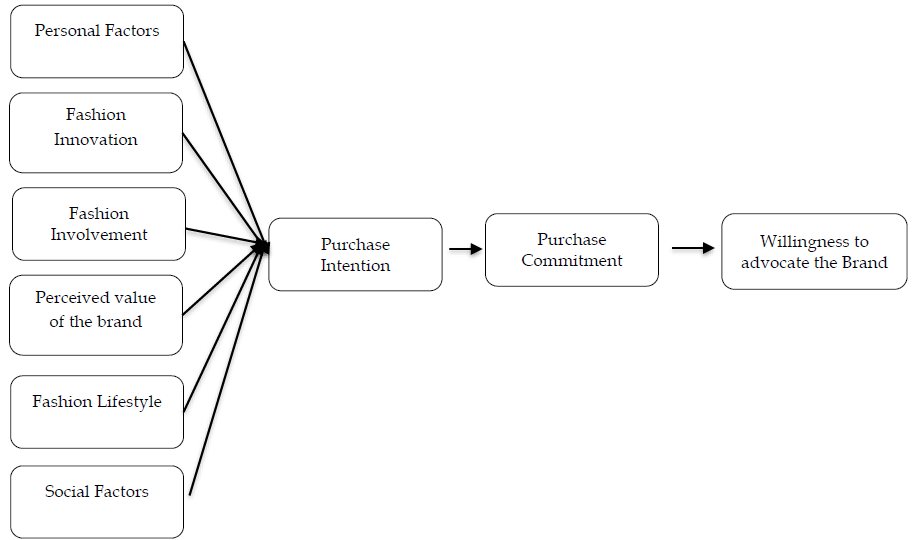 Source: Ajitha & Sivakumar, 2017, Jahan Khan et al., 2015; Li et al., 2012; Murti & Setyawan., 2024, Nurrosidah et al., 2025; Shukla et al., 2016; Zhang & Kim, 2013
Method
Based on the objective, the study is an applied work; based on its content, it is a descriptive-survey work. The population of this study consists of consumers of two luxury brands, "Armani" and "Boss," which provide men's clothing in Tehran. According to the infinite consumers of these brands in Tehran, the Cochran formula for an infinite population was used, resulting in 385 people being studied as the sample, which were selected through multi-stage cluster sampling. The process began by identifying the stores and sales centers of the selected brands, and customers at these stores were interviewed using the sampling method on different days. To maintain the confidence interval, 450 questionnaires were distributed, out of which 385 were approved. Likert scale was used to design the research questions. The questionnaire includes: personal factors (5 items: from item 1 to 5) and social factors (6 items: from item 30 to 35) adapted from Ajitha and Sivakumar (2017); fashion innovation (3 items: from item 7 to 9) and fashion involvement (4 items: from item 10 to 13) adapted from Zhang and Kim (2013); brand perceived value (8 items: from item 14 to 21) and fashion lifestyle (8 items: from item 22 to 29) adapted from Li et al. (2012), purchase intention (3 items: from item 36 to 38) adapted from Jahan Khan et al. (2015); and commitment (9 items: from item 39 to 47) and brand advocate (3 items: from item 48 to 50) adapted from Shukla et al. (2016). The validity of the research was tested through convergent validity using the Average Variance Extracted (AVE) and Cronbach's alpha tests in SPSS 19, which were used to assess the reliability of the research instrument (questionnaire).
Results
The demographic characteristics of the research sample are shown in Table 1 by age, gender, and education level.
Demographic Characteristics of the Respondents
|
Characteristic |
Modalities |
Population |
Percentage |
|
Age |
Under 30 |
225 |
58.44 |
|
Between 31 and 40 |
96 |
24.93 |
|
|
Between 41 and 50 |
35 |
9.10 |
|
|
51 years and above |
29 |
7.53 |
|
|
Gender |
Male |
298 |
77.39 |
|
Female |
87 |
22.59 |
|
|
Marital Status |
Married |
172 |
36.88 |
|
Single |
243 |
63.12 |
|
|
Educational Level |
High School and Below |
148 |
38.44 |
|
Associate Degree |
16 |
4.16 |
|
|
Bachelor Degree |
137 |
35.58 |
|
|
Master Degree and higher |
84 |
21.82 |
According to the demographic analysis of the samples, the most frequent group by age, gender, marital status, and educational level is males under 30 years old, single, with a high school degree or less. In this part of the research, prior to conducting the structural equation modeling test, convergent validity was assessed using factor loadings and AVE to evaluate the instrument's validity. In order to confirm the analyses, the factor loading of each variable must not be less than .40. According to Table 2, the factor loadings of all variables are confirmed. Also, the AVEs are greater than .50; therefore, the convergent validity of the research variables is confirmed. In addition, the Cronbach's alpha test was used to assess the reliability of the questionnaire. In Table 2, the reliability is measured separately for all variables, and the reliability according to the Cronbach alpha scale was higher than .70 for all variables, indicating appropriate reliability of the research tool.
Validity and Reliability of the Research Variables
|
Factor Loadings |
Indicators |
Cronbach Alpha |
AVE |
Variable |
|
.65 |
No. 1 |
.96 |
.62 |
Personal Factors |
|
.64 |
No. 2 |
|||
|
.52 |
No. 3 |
|||
|
.73 |
No. 4 |
|||
|
.60 |
No. 5 |
|||
|
.44 |
No. 6 |
.73 |
.59 |
Fashion Innovation |
|
.46 |
No. 7 |
|||
|
.67 |
No. 8 |
|||
|
.44 |
No. 9 |
|
|
|
|
.64 |
No. 10 |
|||
|
Factor Loadings |
Indicators |
Cronbach Alpha |
AVE |
Variable |
|
.65 |
No. 11 |
.84 |
.57 |
Fashion Involvement |
|
.76 |
No. 12 |
|||
|
.44 |
No. 13 |
|||
|
.38 |
No. 14 |
.92 |
.50 |
Perceived value of the brand |
|
.87 |
No. 15 |
|||
|
.74 |
No. 16 |
|||
|
.47 |
No. 17 |
|||
|
.44 |
No. 18 |
|||
|
.41 |
No. 19 |
.75 |
.51 |
Fashion Lifestyle |
|
.56 |
No. 20 |
|||
|
.50 |
No. 21 |
|||
|
.35 |
No. 22 |
|||
|
.40 |
No. 23 |
|||
|
.41 |
No. 24 |
.80 |
.59 |
Social Factors |
|
.56 |
No. 25 |
|||
|
.50 |
No. 26 |
|||
|
.55 |
No. 27 |
|||
|
.42 |
No. 28 |
|||
|
.81 |
No. 29 |
.84 |
.73 |
Purchase Intention |
|
.71 |
No. 30 |
|||
|
.68 |
No. 31 |
|||
|
.43 |
No. 32 |
.84 |
.52 |
Purchase Commitment |
|
.42 |
No. 33 |
|||
|
.56 |
No. 34 |
|||
|
.66 |
No. 35 |
|||
|
.53 |
No. 36 |
|||
|
.43 |
No. 37 |
|||
|
.67 |
No. 38 |
|||
|
.50 |
No. 39 |
|||
|
.44 |
No. 40 |
|||
|
.64 |
No. 41 |
.76 |
.64 |
Willingness to advocate the Brand |
|
.37 |
No. 42 |
|||
|
.48 |
No. 43 |
Hypothesis & Model Testing
The Pearson correlation between the research variables is shown in Table 3. As shown, there is a strong positive correlation among all variables at the 95% confidence level.
Correlation Between Research Variables
|
Correlation |
Significance |
Margin of Error |
Hypotheses |
|
.54 |
.000 |
.01 |
Personal factors with purchase intention |
|
.47 |
.000 |
.01 |
Fashion innovation with purchase intention |
|
.70 |
.000 |
.01 |
Fashion involvement with purchase intention |
|
.45 |
.000 |
.01 |
Perceived Value of the Brand with purchase intention |
|
.41 |
.000 |
.01 |
Fashion Lifestyle with purchase intention |
|
.62 |
.000 |
.01 |
Social factors with purchase intention |
|
Correlation |
Significance |
Margin of Error |
Hypotheses |
|
.62 |
.000 |
.01 |
Intention of purchasing luxury brands with purchase commitment |
|
.40 |
.000 |
.01 |
Luxury Brand’s Purchase Commitment with Willingness to advocate the Brand. |
Table 4 shows the goodness of fit results for the conceptual model. As shown in Table 4, the normalized chi-squared index is within the acceptable range of 1 to 5. In addition, the NFI, CFI, TLI, and GFI indices exceed .90, and the Root Mean Square Error of Approximation (RMSEA) is less than .08. Therefore, the estimation results for the general pattern indicate the acceptability of the goodness-of-fit indexes, and, overall, the proposed conceptual model of the research is acceptable.
Goodness of Fit Indexes
|
Conclusion |
Model Index Value |
Standard Index Value |
Index |
|
Fit is considered good |
.91 |
More than .9 |
NFI |
|
Fit is considered good |
.90 |
More than .9 |
CFI |
|
Fit is considered good |
.95 |
More than .9 |
TLI |
|
Fit is considered good |
.95 |
More than .9 |
GFI |
|
Fit is considered good |
.07 |
Less than .10 |
RMSEA |
|
Fit is considered good |
.63 |
More than .5 |
PNFI |
|
Fit is considered good |
.66 |
More than .5 |
PCFI |
|
Fit is considered good |
2.93 |
Less than 5 |
CMIN/DF |
Structural equation modeling is used to test the research hypotheses. Figure 2 shows the structural equation model of the research.
Structural Equation Model
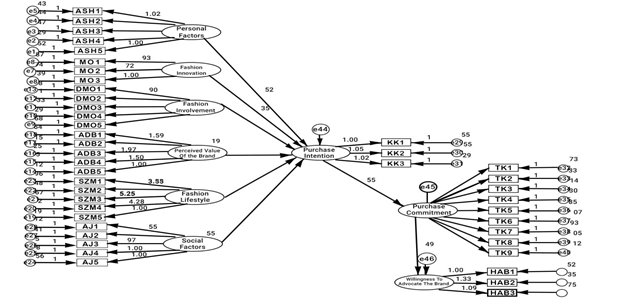
According to the results of the structural equation model (Figure 2), changes in purchase intention are .52 percent by personal factors, .35 percent by fashion innovation, 1.06 percent by fashion involvement, .50 percent by perceived brand value, .37 percent by fashion lifestyle, and .78 percent by social factors. Also, .55 percent of purchase commitment is determined by purchase intention, and finally, purchase commitment influences brand advocacy by .49 percent. Fashion involvement and social factors have the greatest impact on purchase intention, while fashion innovation has the least. According to the model presented in Figure 2, the results of the research hypotheses test are presented in Table 5.
Research Hypotheses
|
C.R. |
Estimate |
Hyphothesis |
|
|
Approved |
7.24 |
0.52 |
Personal Factors has a significant positive impact on the intention of purchasing luxury Brands. |
|
Approved |
8.06 |
0.35 |
Fashion Innovation has a significant positive impact on the intention of purchasing luxury Brands. |
|
Approved |
12.77 |
1.08 |
Fashion Involvement has a significant positive impact on the intention of purchasing luxury Brands. |
|
Approved |
11.46 |
0.50 |
Perceived Value of the Brand has a significant positive impact on the intention of purchasing luxury Brands. |
|
Approved |
6.79 |
0.37 |
Fashion Lifestyle has a significant positive impact on the intention of purchasing luxury Brands. |
|
Approved |
12.82 |
0.78 |
Social Factors has a significant positive impact on the intention of purchasing luxury Brands. |
|
Approved |
12.08 |
0.56 |
Luxury Brand’s Purchase Intention has a significant positive impact on the purchase commitment. |
|
Approved |
12.28 |
0.49 |
Luxury Brand’s Purchase Commitment has a significant positive impact on the Willingness to advocate the Brand. |
The study of the hypotheses shows that, as stated in the first hypothesis, personal factors have a positive effect on the purchase intention of luxury brands (C.R.: 7.24) and its effect is .52. The results of the second hypothesis study shows that fashion innovation has a positive impact on the purchase intention of luxury brands (C.R.: 8.06) with an effect of .35. The third hypothesis showed that the impact of fashion involvement on the purchase intention of luxury brands (C.R.: 12.77) is approved and its effect is 1.08. In the fourth hypothesis, the results supported the impact of brand perceived value on purchase intention for luxury brands (C.R.: 11.46), with an effect size of .50. The fifth hypothesis, which had stated that the fashion lifestyle has an impact on the intention to purchase the luxury brands, is approved (C.R.: 6.79) and showed an effect of .37. The sixth hypothesis claimed that social factors have an impact on the intention to purchase luxury brands, and this claim was supported (C.R.: 12.82), with an effect size of .78. The seventh hypothesis tested the impact of purchase intention on purchase commitment, which was approved (C.R.: 12.08) and showed an effect of .56; the eighth hypothesis approved the impact of purchase commitment of luxury brands on the willingness to advocate the brand (C.R.: 12.28) with an effect of .49.
Conclusion and Suggestions for Future Studies
The business of luxury brands is growing so fast, and deep insight into customer psychology is crucial to succeed in this industry. In this regard, consumer intention and attitude towards these brands in the Tehran clothing industry have been studied. The results of the first hypothesis showed that personal factors have a positive and significant impact on consumer purchase intention for luxury brands. Personal factors, such as self-assessment, lead consumers to follow their emotions, feelings, and internal attitudes during the purchase process, and the greater these factors are, the stronger the consumer's intention toward luxury brands will be. These results are consistent with the findings of the studies by Ajitha and Sivakumar (2017) and Ang et al, (2001). The test of the second hypothesis showed the positive effect of fashion innovation on purchase intention for luxury brands in the apparel industry. This means that greater awareness of innovations and new ideas leads to greater consumer interest in purchasing luxury brands, consistent with the findings of research by Xuan (2012) and Macdonald and Sharp (2000). The positive effect of fashion involvement on luxury brand purchase intention was confirmed in hypothesis three. Since fashion involvement is higher for luxury brands than for other brands, purchase intention for luxury brands is also higher. The results of this hypothesis are similar to the studies of Zhang and Kim (2013) and Summers et al. (2006). The results of the fourth hypothesis confirmed the significant positive effect of the perceived value of the brand on the purchase intention of luxury brands, which is consistent with the results of the hypotheses tested by Li et al (2012). According to the results of the fifth hypothesis, fashion lifestyle has a positive impact on purchase intention. Consumer decision-making regarding luxury brands is influenced by one's lifestyle in a predictable sequence, and a person's lifestyle can indicate the preference type during purchase. These results are consistent with the research conducted by Li et al (2012). The last independent effective variable in this research was social factors, which, according to hypothesis number 6, have a positive effect on purchase intention for luxury brands. Social factors make people use luxury brands to differentiate themselves from others in society; therefore, they play a significant role in consumers' intentions and desires toward luxury brands. These results are consistent with the findings of Jahan Khan et al. (2015). The results of the seventh hypothesis showed the positive effect of purchase intention on consumer commitment. Purchase intention and purchase commitment are two related concepts in any purchase. As a result, people need to make a high contribution to purchasing luxury brands and also have a high commitment to purchasing these products. These findings are consistent with the hypothesis in Macdonald and Sharp’s (2000) research and finally, the eighth hypothesis supported a significant positive effect of purchase commitment on willingness to advocate the brand, consistent with the results of Jahan Khan et al. (2015). The research also faced some limitations, among which the most important ones are: the duration of the interviews with the customers was time consuming, so some of them did not really cooperate as needed; the difficulty in identifying the stores and main centers of the studied brands in the research; the arrangements with the responsible representatives to get in touch with the customers took so long.
Considering the close relationship with the customers of the studied brands and their representatives, the following proposal can be made: 1) Improve the product design and make it diverse for consumers by adding emotional values such as design and considering the appearance. 2) Active presence of these brands on social media in order to achieve more involvement of the customers. 3) Emphasizing the importance of the social level of consumers of these brands through integrated advertising channels. 4) Presenting and emphasizing the values of the studied brands in comparison with other brands and even fake brands.
At the end, the most important practical applications of this research are: increased communication between brand representatives and sales centers with customers, and attention by the studied brand representatives and sales centers to the effective variables for increased product purchases.
References
Ajitha, S., & Sivakumar, V. J. (2017). Understanding the effect of personal and social value on attitude and usage behavior of luxury cosmetic brands. Journal of Retailing and Consumer Services, 39, 103–113. https://doi.org/10.1016/j.jretconser.2017.07.009
Arya, V., Sethi, D., & Hollebeek, L. D. (2024). Using augmented reality to strengthen consumer/brand relationships: the case of luxury brands. Journal of Consumer Behaviour. https://doi.org/10.1002/cb.2419
Ahmadi, M., & Dehdashti shahrokh, Z. (2016). Avamel-e Moasser bar Negaresh va Ghasd-e Kharid-e Barandha-ye Lakcheri. [Factors Affecting the Attitudes and Intention of Buying Luxury Brands]. Business Management Perspective, 15(1), 69–88. https://doi.org/10.29252/jbmp.15.26.123
Ang, S. H., Cheng, P. S., Lim, E. A. C., & Tambyah, S. K. (2001). Factors effecting the attitude and intention of buying luxury brands. Journal of Management Perspective, 25, 69–88. https://doi.org/10.1108/07363760110392967
Björkqvist, V. (2024). Customer loyalty in the luxury industry: Innovative strategies for sustainable customer loyalty in luxury fashion brands: A brand personification approach [Bachelor’s thesis, Aalto University]. Aaltodoc. https://aaltodoc.aalto.fi/items/cce77546-a37b-4fe3-9464-44b8d1c94108
Chen, L., Qie, K., Memon, H., & Yesuf, H. M. (2021). The empirical analysis of green innovation for fashion brands, perceived value and green purchase intention—mediating and moderating effects. Sustainability, 13(8), 4238. https://doi.org/10.3390/su13084238
Chen, J., & Wareewanich, T. (2024). The influence of perceived value, cultural identity, and product familiarity on consumers' purchase intention of Jingdezhen ceramic products. https://doi.org/10.33168/JLISS.2024.0822
Cheung, M. F., & To, W. M. (2024). Effect of consumer brand involvement on brand advocacy: a moderated mediation model. Journal of Marketing Theory and Practice, 1–16. https://doi.org/10.1080/10696679.2024.2427207
Davari, A., Iyer, P., Guzman, F., & Veloutsou, C. (2022). The determinants of personal luxury purchase intentions in a recessionary environment. Journal of Marketing Management, 38(13-14), 1401–1432.
Dewi, A. S., Nursanti, A., Marhadi, M., & Tarigan, M. A. (2023). The effect of shopping lifestyle and fashion involvement on purchase decision with impulse buying as an intervening variable in E-commerce Shopee. International Journal of Economic, Business & Applications, 8(1), 49–68. https://doi.org/10.31258/ijeba.83
Farhan, G. M., & Marsasi, E. G. (2023). The influence of information quality and perceived value on purchase intention of game shop E-commerce in generation Z based on framing theory. Jurnal Pamator: Jurnal Ilmiah Universitas Trunojoyo, 16(3), 620–631. https://doi.org/10.21107/pamator.v16i3.21160 .
Gholipour, R., Aghazadeh, H., & Bakhshizadeh, E. (2014). Ta’sir-e sarvat-e brand bar ghased-e kharid-e dobare ba mideyate arzeshe darak shode [The effect of brand equity on repurchase intention with the mediating role of perceived value]. Business Management Perspective, 14(3), 157–175. (In Persian).
Hassan, M., Rafi, A., & Kazmi, S. S. (2016). Impact of differentiated customer service, brand trust, brand commitment, and brand salience on brand advocacy. International Review of Management. https://www.econjournals.com/index.php/irmm/article/view/2493
Jahan Khan, N., Abdur Razzaque, M., & Mohd Hazrul, N. (2015). Intention of and commitment towards purchasing luxury products: a study of Muslim consumers in Malaysia. Journal of Islamic Marketing, 8(3), 476–495 https://doi.org/10.1108/JIMA-12-2015-0091
Janpors, N., Raeisi Ziaran, M., Taghavi, S. M. (2023). Demand prediction for luxury fashion clothing: The role of customers’ values, brand consciousness, and behavioral intentions. International Conference on Innovation and Marketing. https://ssrn.com/abstract=4320394
Kaufmann, H. R., Petrovici, D. A., Gonçalves Filho, C., & Ayres, A. (2016). Identifying moderators of brand attachment for driving customer purchase intention of original vs counterfeits of luxury brands. Journal of Business Research, 69(12), 5735–5747. https://doi.org/10.1016/j.jbusres.2016.05.003
Kaur, J., Malik, P., & Singh, S. (2024). Expressing your personality through apparels: Role of fashion involvement and innovativeness in purchase intention. FIIB Business Review, 13(3), 318–330. https://doi.org/10.1177/23197145221130653
Khan, N. J., Razzaque, M. A., & Hazrul, N. M. (2017). Intention of and commitment towards purchasing luxury products: A study of Muslim consumers in Malaysia. Journal of Islamic Marketing, 8(3), 476–495. https://doi.org/10.1108/JIMA-12-2015-0091
Khodadad Hosseini, S. H., Tabesh Moghdam, M., & Fatah Naserabad, S. (2022). The aesthetic effect of products on purchase intention and purchase commitment at the point of sale with the mediating role of emotional attachment and the moderating role of consumer goals. Journal of Business Administration Researches, 13(26), 477–502. https://doi.org/10.22034/bar.2022.14243.3580
Kheiri, B., & Fathali, M. (2015). Barrasi asar-e avamel-e mo’asser bar ghased-e kharid-e kala-haye lavazem-e ashrarfi [A review of factors affecting the purchase intention of luxury products]. Journal of Marketing Management, 10(26), 1–24. (In Persian). https://sanad.iau.ir/Journal/jomm/Article/810832/FullText
Kim, Y., & Oh, K. W. (2022). The effect of materialism and impression management purchase motivation on purchase intention for luxury athleisure products: the moderating effect of sustainability. Journal of Product & Brand Management, 31(8), 1222–1234. https://doi.org/10.1108/JPBM-07-2021-3578
Kim, M. K., & Yu, J. (2019). The impact of the experience marketing satisfaction with fashion lifestyle shops on purchase intention and loyalty. The Research Journal of the Costume Culture, 27(2), 109–122 https://doi.org/10.29049/rjcc.2019.27.2.109
Kumbara, V. B., Ridwan, M., Mohd Kodri, A. N., & Hanapiyah, Z. M. (2024). The influence of shopping lifestyle, fashion involvement, and Hedonic shopping on e-Commerce and moderating effect of impulse buying. Global Business & Management Research, 16(2). http://www.gbmrjournal.com/pdf/v16n2s/V16N2s-59.pdf
Labib, A., Negm, E., & Elshafie, S. (2023). Investigating consumers' personal values that triggers luxury fashion purchase intentions: With a moderating role of consumer's demographics. Journal of Business and Retail Management Research, 17(2), 1–15. https://doi.org/10.24052/JBRMR/V17IS02ART01
Li, G., Li, G., & Kambele, Z. (2012). Luxury fashion brand consumers in China: Perceived value, fashion lifestyle, and willingness to pay. Journal of Business Research, 65(10), 1516–1522. https://doi.org/10.1016/j.jbusres.2011.10.019
Macdonald, E. K., & Sharp, B. M. (2000). Intention of and commitment towards purchasing luxury products: a study of Muslim consumers in Malaysia. Journal of Islamic Marketing, 8(3), 476–495 https://doi.org/10.1016/S0148-2963(98)00070-8
Morgan, R. M., & Hunt, S. D. (1994). The commitment-trust theory of relationship marketing. Journal of Marketing, 58(3), 20–38. https://doi.org/10.2307/1252308
Murti, A. C., & Setyawan, A. A. (2024). The influence of fashion innovativeness and electronic innovativeness on the purchase intention of fashion products mediate by brand attitude. Proceeding ISETH (International Summit on Science, Technology, and Humanity, 272–281. https://doi.org/10.23917/iseth.5371
Nurrosidah, A., Djatmika, E. T., & Dewi, T. S. (2025). Exploring the role of perceived value and customer attitude in Co-Branding: Impact on purchase intention for somethinc cosmetics X Bittersweet by Najla. Journal of Applied Business, Taxation and Economics Research, 4(3), 445–458.
Othman, A. K., Hassan, L. F. A., Hamzah, M. I., Razali, A. R., Saim, M. A. S., Ramli, M. S., & Azhar, M. A. A. (2019). The influence of social commerce factors on customer intention to purchase. Asian Themes in Social Sciences Research, 3(1), 1–10. https://doi.org/10.33094/journal.139.2019.31.1.10
Panta, N. S., Ellitan, L., & Wibowo, W. (2022). Influence of fashion involvement, attitude, and price, toward purchase intention of ethnic weaving. Influence of Fashion Involvement, Attitude, and Price, Toward Purchase Intention of Ethnic Weaving, 5(2), 424–434. https://doi.org/10.47191/ijcsrr/V5-i2-16
Salsabila, P., & Hartono, A. (2023). The effect of green self- identity, self-congruity, perceived value on bioplastic product purchase intention: Evidence from Indonesian consumers. International Journal of Research in Business and Social Sc. https://doi.org/10.20525/ijrbs.v12i1.2259
Sarah, S., Rachman, A., & Febrianti, T. (2019). Pengaruh fashion lifestyle, design, dan selebrity endorser terhadap purchase intention. Jurnal Indonesia Membangun, 18(03), 60–75. https://jurnal.inaba.ac.id/
Satriyo, C. H. P., Sancoko, A. H., & Simamora, A. L. (2024). Peran dari Fashion Innovativeness dan Fashion Involvement terhadap Purchase Intention Produk Vandka melalui Attitude Toward Purchase Behavior [The role of fashion innovativeness and fashion involvement on purchase intention for Vandka products through attitude toward purchase behavior]. Journal of Entrepreneurial Studies, 1(2), 102–108. https://doi.org/10.33508/jes.v1i2.7218
Shukla, P., Banerjee, M., & Singh, J. (2016). Customer commitment to luxury brands: Antecedents and consequences. Journal of Business Research, 69(1), 323–331. https://doi.org/10.1016/j.jbusres.2015.08.004
Stryker, S. (1980). Symbolic interactionism: A social structural version. Benjamin Cummings Publishing Company : https://archive.org/details/symbolicinteract0000stry
Suh, J. C., & Yi, Y. J. (2006). When brand attitudes affect the customer satisfaction– loyalty relation: the moderating role of product involvement. Journal of Consumer Psychology, 16(2), 145–155. https://doi.org/10.1207/s15327663jcp1602_5
Summers, T. A., Belleau, B. D., & Xu, Y. (2006). Predicting purchase intention of a controversial luxury apparel product. Journal of Fashion Marketing and Management, 10(4), 405–419. https://doi.org/10.1108/13612020610701947
Thomson, M., MacInnis, D. J., & Park, C.W. (2005). Identifying moderators of brand attachment for driving customer purchase intention of original vs counterfeits of luxury brands. Journal of Business Research, 69(12), 5735–5747. https://doi.org10.1016/j.jbusres.2016.05.003
Tuwo, H. J., & Pandowo, M. (2015). The influence of social factors on customer purchase intention in using wedding organizer in Manado. Jurnal EMBA: Jurnal Riset Ekonomi, Manajemen, Bisnis dan Akuntansi, 3(3) https://doi.org/10.35794/emba.3.3.2015.9308
Widyaratna, L., & Zainuri, A. (2023). Pengaruh brand image, harga, dan fashion lifestyle terhadap keputusan pembelian pakaian preloved di thriftshop [The influence of brand image, price, and fashion lifestyle on the purchase decision of preloved clothing at thrift shops]. Journal of Comprehensive Science (JCS), 2(4), 941–948. https://doi.org/10.59188/jcs.v2i4.300
Xuan, A. (2012). Luxury fashion consumption in China: Factors affecting attitude and purchase intent. https://doi.org/10.1016/J.JRETCONSER.2012.10.007
Yang, X. (2022). Consumers' purchase intentions in social commerce: the role of social psychological distance, perceived value, and perceived cognitive effort. Information Technology & People, 35(8), 330–348. https://doi.org/10.1108/ITP-02-2022-0091
Zhang, B., & Kim, J. H. (2013). Luxury fashion consumption in China: Factors affecting attitude and purchase intent. Journal of Retailing and Consumer Services, 20(1), 68–79. https://doi.org/10.1016/j.jretconser.2012.10.007
Zhu, W., & Jiao, Y. (2025). Steering decisions: Exploring the impact of perceived value and perceived risk on consumer intentions for adopting driverless cars in China. Transportation Research Part F: Traffic Psychology and Behavior, 109, 164–179. https://doi.org/10.1016/j.trf.2024.12.009

Page 1 of
Download Count : 30
Visit Count : 70
Keywords
Iranian Consumers; Luxury Brands; Purchase Intention; Purchase Commitment; Willingness to Advocate the Brand


Author(s) Information



How to cite this article
Norouzi, H., & Barzegar, S. (2025). Investigating the intention of Iranian consumers to advocate luxury brands: Considering the role of purchase intention and purchase commitment. European Journal of Studies in Management and Business, 36, 16-31. https://doi.org/10.32038/mbrq.2025.36.02
Acknowledgments
Not applicable.
Funding
Not applicable.
Conflict of Interests
No, there are no conflicting interests.
Open Access
This article is licensed under a Creative Commons Attribution 4.0 International License, which permits use, sharing, adaptation, distribution and reproduction in any medium or format, as long as you give appropriate credit to the original author(s) and the source, provide a link to the Creative Commons license, and indicate if changes were made. You may view a copy of Creative Commons Attribution 4.0 International License here: http://creativecommons.org/licenses/by/4.0/