






Original Research
An Information Architecture Framework for High-performance Professionals Development


- Abstract
- Full text
- Metrics
Qualifying high-performance professionals to meet the rigorous quality expectations of society is an ongoing challenge. This research proposes the application of concepts such as Information Organization, Information Architecture, Informational Spaces, Multimodality, Relevance Theory, and Gamification to address the informational needs of high-performance professionals. The core proposition is that an Information Architecture Model, supported by Multimodality and coupled with the principles of Information Organization and Gamification, can enhance the training of high-performance professionals. Information Architecture enables an effective flow of information within informational environments, while Multimodality contributes to diverse semiotic learning objects organized within informational spaces. According to Buckland (1991), information can be understood in three dimensions: a. Information-as-process; b. information-as-knowledge; c. information-as-thing, referring to things understood as informative. Brookes (1980) explored the scientific foundations of information and presented a formula that describes the incorporation of information into an individual's body of knowledge through communication. Wurman (2005) defines informational spaces as structurally designed environments created by information architects to meet the specific informational needs of users, effectively filtering essential and relevant information from an overwhelming amount of available data. The IAAM (Information Architecture Associated with Multimodality) model has been implemented in professional training courses. It serves as a guide for planning and constructing Informational Spaces tailored for training high-performance professionals. This model applies to the work of information architects, whether they are professors in a specific discipline or auxiliary educators. In an applied exploratory research approach, questionnaires were distributed to students (the intended users of the proposed model) and their immediate managers, who evaluated their performance. The evaluations indicated a high level of acceptance of the IAAM model. This research is representative since it includes several professionals.
An Information Architecture Framework for High-performance Professionals Development Abstract
Tomás Roberto Cotta Orlandi *, Cláudio Gottschalg-Duque
University of Brasília – UNB, Brazil
| ABSTRACT |
Qualifying high-performance professionals to meet the rigorous quality expectations of society is an ongoing challenge. This research proposes the application of concepts such as Information Organization, Information Architecture, Informational Spaces, Multimodality, Relevance Theory, and Gamification to address the informational needs of high-performance professionals. The core proposition is that an Information Architecture Model, supported by Multimodality and coupled with the principles of Information Organization and Gamification, can enhance the training of high-performance professionals. Information Architecture enables an effective flow of information within informational environments, while Multimodality contributes to diverse semiotic learning objects organized within informational spaces. According to Buckland (1991), information can be understood in three dimensions: a. Information-as-process; b. information-as-knowledge; c. information-as-thing, referring to things understood as informative. Brookes (1980) explored the scientific foundations of information and presented a formula that describes the incorporation of information into an individual's body of knowledge through communication. Wurman (2005) defines informational spaces as structurally designed environments created by information architects to meet the specific informational needs of users, effectively filtering essential and relevant information from an overwhelming amount of available data. The IAAM (Information Architecture Associated with Multimodality) model has been implemented in professional training courses. It serves as a guide for planning and constructing Informational Spaces tailored for training high-performance professionals. This model applies to the work of information architects, whether they are professors in a specific discipline or auxiliary educators. In an applied exploratory research approach, questionnaires were distributed to students (the intended users of the proposed model) and their immediate managers, who evaluated their performance. The evaluations indicated a high level of acceptance of the IAAM model. This research is representative since it includes several professionals. |
| KEYWORDS: |
| Information Architecture, Informational Spaces, Gamification, Multimodality, Information Organization |
Introduction
We place our trust in professionals within higher education, relying on doctors and other healthcare specialists for our well-being, engineers and architects for our homes, and teachers for our own education and that of our children. Society has ingrained in us the belief that the work of these professionals will be entirely dependable and cater to our needs.
Oliveira (2012), defined “informational space” as "the interconnected web of organizational information that facilitates relationships among individuals, providing them with the necessary information to achieve their objectives." This concept caters to the information requirements of people within their respective organizations.
Lyra (2012) argues that a key goal of Information Architecture (IA) is to streamline the flow of information by crafting well-designed informational environments. On a related note, Macedo (2005) suggests that IA serves as a "design methodology" applicable to informational environments, which exist within a given context and comprise dynamic content that serves specific communities.
As per Wurman (2005), informational spaces require structural design by information architects to fulfill the unique informational needs of users, helping them sift through an overwhelming volume of available information to identify what is indispensable and relevant.
Buckland (1991) regards 'information as a thing,' viewing it as an informative entity that can inform us about various subjects. For Buckland, the concept of a document encompasses physical informational resources that have been refined through models designed to represent ideas and objects, including works of art, texts, Figures, audio, and videos.
Wurman (2005) asserts that the primary challenge for information architects, when employing information architecture, is to strategically structure informational spaces with the specific goal of meeting user needs. This involves discerning essential information from the surplus available. Wurman argues that IA's focus should encompass not only identifying information needs but also comprehending content and addressing the challenges associated with organizing information. In his words, "the true architects of information bring clarity to complexity, transforming data into comprehensible information for fellow human beings" (Wurman, 2005, p. 23).
Justifications
To cater to the informational requirements of high-performance professionals during their training, this study introduces an evaluation of an organizational model for multimodal informational spaces. These spaces are meticulously structured to offer semiotic learning objects, encompassing texts, sounds, Figures, and videos. The primary aim is to significantly enhance the learning experience for these professionals.
Interestingly, the realm of Information Architecture is conspicuously absent in both websites and professional development and training portals that present informational spaces containing diverse learning objects, often lacking established criteria. In light of this, it becomes evident that the implementation of an Information Architecture that aligns with the specific information needs of users in distinct situations becomes imperative, echoing the insights of Lima Marques and Macedo (2006):
"Within this context, the utilization of Information Architecture is indispensable, as it endeavors to harmonize the intricate landscape of informational spaces, replete with a myriad of learning objects, ensuring that user-centric criteria guide the organization and presentation of content."
Monteiro (2013) asserts that a Learning Object (LO) serves as a systematically organized resource designed to deliver instructional content, making it particularly well-suited for the development of materials in Distance Education (DE). In DE, training courses are primarily composed of learning objects strategically arranged within Virtual Learning Environments (VLEs).
The theoretical framework
The information´s meanings
For Buckland (1991, p. 351), the term "information" encompasses three distinct meanings: a. Information-as-process; b. information-as-knowledge; c. information-as-thing. The last interpretation attributes "information" to objects or entities that convey knowledge or understanding. Under this perspective, the information-as-thing forms encompass documents, text, data, other objects, and events. Buckland, Gontijo, and Araujo (2021) further underscore that, within this context, the term "information" transcends mere communication, encompassing the intricacies of information storage and retrieval systems.
Furthermore, Buckland defines information worked upon as 'things' as entities capable of providing us with insights or knowledge about a subject. In Buckland's (1991) framework, the concept of a document is characterized as a physical informational resource that serves as a representation of ideas and objects.
Information and knowledge
In his research, Brookes (1980) delved into the scientific foundations of information and introduced a formula that elucidates how the state of knowledge changes when information received through a communication process is incorporated into an individual's existing body of knowledge. The formula, as articulated by Brookes (1980): K[S] + ΔI = K[S + ΔS]. K[S] denotes the original knowledge, ΔI represents the information assimilated by an individual, and K[S + ΔS] signifies the resultant transformation of the individual's knowledge. The ΔS component accounts for the alterations brought about by this information assimilation, thus highlighting the dynamic interplay between individuals, information, and knowledge.
Dahlberg (2006) provides insights into the field of Knowledge Organization, defining it as a science that methodically organizes and structures units of knowledge, guided by the inherent attributes of its constituent elements and their relevance to diverse objects and subjects. According to Dahlberg, there are two main applications of knowledge organization:
1- The process of constructing conceptual systems entails the deliberate development of structured frameworks that categorize and organize knowledge elements into cohesive and meaningful systems.
2- The correlation of these conceptual systems with real-world objects: This pertains to the alignment of organized knowledge with tangible aspects of reality, facilitating practical applications and connections between knowledge and the physical world.
Concepts used in the proposed model
For Rosenfeld et al. (2015, p. 24), Information Architecture is defined as either the structural design of shared informational environments or the synthesis of labeling, organization, navigation, and search systems, the science and art of crafting information products and experiences, a discipline dedicated to integrating design and architectural principles into the digital landscape. Information Architecture (IA) fosters the efficient flow of information by shaping well-defined informational environments.
Sperber and Wilson (1986) defined there are two fundamental principles in “Relevance Theory” that underpin this inferential approach to pragmatics:
1- The cognitive principle, in which human cognition is aimed at 'maximizing relevance’.
2- Communicative principle, in which utterances generate 'optimal relevance expectations'.
For Kress and Van Leeuwen (2001) multimodality is using various semiotic modes to design a semiotic product or an event. This involves employing different means of communication, such as text, Figure, and sound, to create and shape meaning within a given semiotic context. Additionally, they suggest that it serves as "the common terminology for all semiotic data", emphasizing its role in encompassing various forms of symbolic representation.
For Kapp (2012) gamification is "using mechanisms, aesthetics, and game thinking to encourage active participation among professionals, motivating actions, and fostering knowledge and problem-solving." This concept involves incorporating elements typically found in games, such as competition, challenges, rewards, and interactivity, into non-game contexts, such as education and workplace training, to engage and motivate individuals while fostering learning and problem-solving skills.
Culture and organizational culture
Schein’s (2022) perspectives on "Organizational Culture" align with the notion that it emerges because of shared experiences within a group. This view allows for the understanding that there can be multiple cultures coexisting within a single organization.
In support of Schein's (2022) ideas of diverse cultures within an organization, Buckland (2017, p. 58) argues that our modes of communication, knowledge, and methods of reasoning are deeply rooted in individuals' "small personal worlds." He emphasizes that even the smallest of these personal worlds is intricate and unique. Additionally, Buckland asserts that no single individual can possess knowledge about everyone or everything in the world.
The primary goal of this research is to assist in the improvement of organizational culture within institutions. It aims to facilitate increased access to training opportunities for high-performance professionals. These individuals, owing to their personal and professional attributes, are poised to disseminate the knowledge they acquire within their organizations and among their peers. This dissemination is anticipated to play a pivotal role in significantly improving the organizational culture within these institutions. In essence, this work strives to encourage a culture of continuous learning and development that benefits both individuals and the organizations they are a part of.
High-performance professionals
Mazurkiewicz's (2010) definition of a High-Performance Professional (HPP) characterizes them as individuals who exhibit exceptional performance in their professional endeavors and actively contribute to the professional development of their colleagues. These professionals are known for consistently delivering outstanding results and are integral to the growth and success of their teams and organizations. Key attributes of HPPs include their mastery of a diverse range of disciplines and their unwavering commitment to cooperation and collaboration for the collective benefit of all involved. In essence, HPPs are individuals who not only excel individually but also uplift and support the professional advancement of their peers and teams.
Mazurkiewicz (2010) outlines IBM's focus on developing exceptional business and technology professionals, creating a unique identity known as the "IBMer." Over the years, IBM has dedicated itself to identifying and fostering specific competencies demonstrated by the best IBMers. These competencies are continually integrated into various development processes to align with evolving business needs and global changes. In response to the evolving business landscape, IBM has established a new set of nine characteristics, termed the "IBM Competencies," that delineate the expectations for modern IBMers. When an IBMer is at their best, they exhibit qualities such as facing challenges, partnering for a client's success, fostering global collaboration, approaching situations systemically, cultivating mutual trust, exerting influence based on one’s expertise, working towards continuous transformation, conveying messages with significant impact, also helping fellow colleagues to succeed.
The revised competencies signify a tangible response to the dynamic shifts occurring in both the global landscape and the business realm. This fresh perspective on leadership consolidates and harmonizes all of IBM's existing career development initiatives, offering IBMers across the globe a more defined understanding of the comprehensive leadership knowledge, skills, and behaviors essential for success in the current marketplace (Mazurkiewicz, 2010, p. 6).
Indeed, the distinguishing characteristics of a high-performance professional, as per the provided definition, set them apart from other professionals. Their standout performance is marked by a proactive approach to taking on challenges, a dedication to collaborative efforts, a willingness to share information, and a positive influence on their colleagues. These attributes are geared towards achieving superior results for the organizations they are part of and contributing positively to society.
In summary, a high-performance professional not only excels individually but also stand out through their ability to foster cooperation, share knowledge, and inspire their peers, all with the overarching goal of delivering exceptional outcomes for their organizations and the broader community.
Knowledge and information organization
For Svenonius (2000) and Lehmkuhl (2023), the act of organizing information establishes a connection with the constructs disposition logic that will form an understanding of the data and information represented, revealing itself as a particular type of language use. For Hjørland (2002), an Information Organization's function is to help users navigate through information spaces: retrieve documents, make decisions in search activities, and have an overall view of information resources.
According to Sousa (2015), knowledge organization can be perceived through several basic functions: functions to facilitate searches through information retrieval, to provide document information through notes or summaries, to help find the document or even the ordering of an informational set. Still for this author, the knowledge organization's systematization must consider that knowledge can be found in two formats: tacit knowledge (a user's perception, intellect, thoughts, or memory), and explicit knowledge (in notes, inscriptions or supports). So, for Sousa (2015. p. 26) "the information and knowledge organization and its tools prove to be necessary and present in studies related to informational objects, especially in this digital age".
Information Architecture
For this research IA – Information Architecture is defined by Rosenfeld et al. (2015, p. 24) as a "structural project of informational environments." It involves integrating organization, search, labeling, and navigation systems across digital, physical, and hybrid ecosystems. Information Architecture (IA) is characterized as both an art and a science, dedicated to shaping informational products and experiences to improve findability, usability, and information comprehension. Additionally, IA is portrayed as a burgeoning discipline and a pragmatic community centered on design principles within the digital landscape. Camossi and Rodas (2023) also defined techniques for information findability based on Rosenfeld et al.’s (2015) works.
The Information Ecology model was introduced by Rosenfeld et al. (2015, p. 32), which forms the basis for representing Information Architecture. This model is built upon three fundamental pillars: Context, Content, and Users. Dos Santos (2013) applies these definitions in informational environment projects, where Context refers to the cultural and policy aspects of organizations, as well as their business objectives; Content encompasses the structures, volumes, and formats of information present within organizations; and Users require an understanding of their habits, needs, processes, and behaviors.
It is emphasized that each organization's information architecture should be tailored to its unique context. The vocabulary and structure of an organization's website and intranet play a pivotal role in shaping the relationship between the organization, its customers, and employees. The Information Architecture of these digital platforms serves as a tangible manifestation of a corporate identity. It serves as a communication tool, setting expectations for interactions between customers and employees and reflecting the organization's context.
In the realm of Information Architecture, content is broadly defined to encompass documents, applications, services, and metadata that individuals need to access or locate on a website. The internet primarily relies on words, phrases, and objects to convey meaning and facilitate various tasks and transactions. On the websites of contemporary organizations, distinct facets of each information ecology are observable, as delineated by Rosenfeld et al. (2015).
Moreover, it is acknowledged that disparities in user preferences in the physical world result in diverse information-seeking and needs behaviors in the virtual realm. This is particularly relevant when considering the context of organizations' websites and intranets, users from different roles and levels within an organization may have unique requirements and approaches to information retrieval. For instance, senior executives might require rapid access to specific documents, while research analysts may dedicate substantial time to comprehensive research. Understanding these differences is crucial for effectively designing Information Architectures that cater to the needs of diverse user groups within an Information Ecology.
Relevance theory
The Relevance Theory (RT) proposed by Sperber and Wilson (1986) is a highly influential research program that has greatly contributed to our comprehension of the connection between communication and cognition. The RT theory represents a departure from previous rigid models of communication and offers a more dynamic and comprehensive approach to human cognition. The RT is built upon two foundational principles:
1- Cognitive Principle of Relevance: this principle posits that “human cognition” is inherently oriented towards optimizing relevance. It recognizes that the human reasoning process is dynamic and influenced by factors such as attention, memory, and conceptual representation. These factors significantly influence the processing of deductions and contribute to shaping the way individuals perceive and interpret information.
2- Communicative Principle of Relevance: According to this principle, statements made in communication create expectations of optimal relevance. When an individual communicates an idea, whether orally or in writing, it automatically generates an expectation of "optimal relevance" because it addresses someone. The communicative act is designed to convey information that is relevant enough to be processed effectively. In essence, utterances are designed to capture the recipient's attention and encourage them to engage in a process of inference to derive their own knowledge.
Sperber and Wilson (1986) argue that human cognition is inherently oriented towards relevance. This means that our brains and minds tend to prioritize information that is most relevant to a given individual or context. The "principle of relevance" explains why certain communicative acts take precedence over others, based on their perceived relevance to the individual.
In terms of the communicative principle, when an issuer communicates an idea, they intentionally or "ostentatiously" create a context of expectation for relevance. The receiver of this information, on the other hand, engages in an "inferential" process, drawing upon their own inferences to generate knowledge. This duality in communication, where the sender emphasizes relevance and the receiver employs inference, underscores the dynamic nature of human communication and cognition within the framework of Relevance Theory.
Multimodality
For Kress and Van Leeuwen (2001) Multimodality is defined as utilizing a variety of different semiotic modes to design a semiotic event or product. It draws its origins from Semiotic Theory, which is concerned with the analysis of text to understand both what it conveys and how it conveys it.
Bateman (2008) introduces the concept of a "multimodal document," which is a multifaceted artifact that incorporates multiple modes, predominantly visual components, to collectively achieve a set of interconnected communicative objectives in an orchestrated manner.
Steinmetz et al. (2013) offer a broader perspective, defining multimodality as the use of various communicative modes during interactions between individuals or between individuals and documents. Concrete examples of this definition are internet pages, which incorporate descriptive text, Figures, and even sound to represent different discursive genres.
Steinmetz (2015) introduces the concept of Multimodal Sociosemiotic Analysis, which delves into the meanings, production, and reception of messages within interpretive communities. This approach emphasizes the analysis of meanings in the interaction between message producers (authors) and receivers (readers). Kress and Van Leeuwen's (2001) work and Lima et al. (2023) also explore the interpretation of context's meaning, focusing on how meanings are constructed through interactions involving both information producers and observers.
Visual Grammar plays a significant role in understanding how Figures represent relationships between people, places, and objects within multimodal texts. Kress and Van Leeuwen (2001) identify three key principles of Figure composition as perceived by the reader: information value, salience, and frame. These principles apply not only to individual visual elements but also to complete multimodal texts.
Multimodal Interactional Analysis, as described by Norris (2004), addresses aspects related to direct face-to-face interactions between individuals in everyday life. It encompasses various ways of representing reality, including gestures, gaze, body language, and spatial arrangement, among other modes. This analytical approach explores the intricate dynamics of human interactions and the semiotic resources employed to convey meaning in real-time situations.
Duque (2011) highlights a distinctive feature of software-based presentations compared to traditional lectures: the simultaneous presence of diverse communication elements. These elements encompass spoken and written language, the presenter's gestures and facial expressions, the content displayed on projected slides, audiovisual components such as movies, and audio cues. The amalgamation of these various communicative forms characterizes scientific presentations as multimodal.
According to Lobin (2009), in presentations, multimodality unfolds into three modalities for the various modes of communication, combined and synchronized when presentations are made: linguistic (in the sense of spoken language), visual, and performative modality. In essence, when delivering scientific presentations, individuals engage with these three modalities, weaving together spoken language, visual elements, and performative expressions to effectively communicate their message to the audience. This multimodal approach recognizes the complexity and richness of communication in presentations, where multiple channels of expression work in concert to convey information and engage the audience.
Gamification
Gaming has become an integral part of contemporary society, with individuals of all ages regularly engaging in games for both entertainment and learning purposes. To Huizinga (2000), games are inherent human activities that enable individuals to connect, have a good time, and prepare for more complex future endeavors.
Clementi (2014) highlights the substantial presence of gamification in the business world, particularly in educational applications. Navarro (2013) underscores the evolving role of games within the context of gamification, emphasizing their impact on psychomotor development in players.
In the works of Fardo (2013) and Jacques (2023), a framework for gamification is presented. This framework has been adapted for use in this research, directing its implementation to align with the information requirements of high-performance professionals. This framework aligns with the five pillars of this stage, which are further described below.
- Game Project: games must start from a first document, which describes the steps for their creation.
- Experimenting with Fast Feedback: mistakes are a part of an individual's learning process; providing the possibility of working with experiments without punishing the participant.
- Tasks Adaptation: to make gamification attractive to student players, different skill and complexity levels must be put to the test.
- Rewarding Success: for each step achieved, a reward must be attributed, which can range from mere knowledge to a significant advantage for completing the challenge.
- Having Fun Experimenting Roles: during the game's narrative, the information architect can create the context for student players to experience different roles.
As noted by McGonigal (2012) and Souza (2023), the objective is not to diminish the significance of teaching and learning processes, but rather to harness the concept of "productive well-being." This concept suggests that players exhibit an ideal "learning pattern" when immersed in games.
McGonigal's perspective underscores the idea that games can serve as powerful tools for learning and problem-solving. They have the capacity to engage individuals in a manner that fosters motivation, creativity, and persistence—attributes often associated with productive learning experiences. Rather than trivializing education, the aim is to leverage the inherent qualities of games to promote effective learning and personal growth.
The assessed information architecture model
As per the insights from Orlandi et al. (2019), it is recommended that informational spaces be designed by information architects, especially to align with the needs of their users. This approach ensures the selection of the most relevant and essential information. In contemporary times, numerous training websites and portals have been developed without the assistance of an Information Architecture (IA) model that offers direct guidance to information architects for crafting solutions that effectively cater to the information requirements of professional users in these spaces.
The Information Architecture model presented in this research offers a structured approach to organizing informational spaces designed for the training of High-Performance Professionals (HPPs). It follows the principles outlined by Orlandi et al. (2019) and is composed of five distinct steps. These steps guide information architects in constructing informational spaces with the overarching goal of continuously enhancing the qualifications of high-performance professionals:
The specifics of these five steps may vary, depending on the particular Information Architecture model used, but they typically include processes like information organization, content design, user experience optimization, and more to ensure the effective creation of informational spaces customized to meet the requirements of high-performance professionals.
Step 1 - Information Organization. According to Dahlberg (2006), it concerns the organization of learning objects in an informational space, using definitions of information, knowledge, and metadata organization, constructing conceptual themes, and establishing correlations among the objects.
Step 2 – Use of IA Models. Rosenfeld et al. (2015) suggest applying Information Architecture (IA) models related to instructional design to facilitate the flow of information within the constructed informational spaces with multimodality.
Step 3 – Use of Relevance Theory (RT). The objective of Spelberg and Wilson's work (1985) is to choose learning objects that are pertinent to high-performance professionals.
Information architects, who are in charge of building the informational space, must choose the most relevant content according to the information needs presented.
Step 4 – Incorporation of Multimodality. Kress and Van Leeuwen (2001) advocate for the integration of multimodal learning objects, including videos, texts, audio, and presentations, as standard teaching materials. They emphasize the importance of these materials for the training of high-performance professionals, encouraging the exploration of diverse semiotic modes and moving beyond traditional texts and presentations that are commonly used.
Step 5 – Gamification. According to Kapp (2012), educational learning games serve as a method to enhance engagement and arouse students' interest in the learning objects presented in the informational space. The application of games aimed at objective learning promotes a student's "awakening" and greater engagement in the discipline presented in the informational space.
Figure 1.
Information architecture model
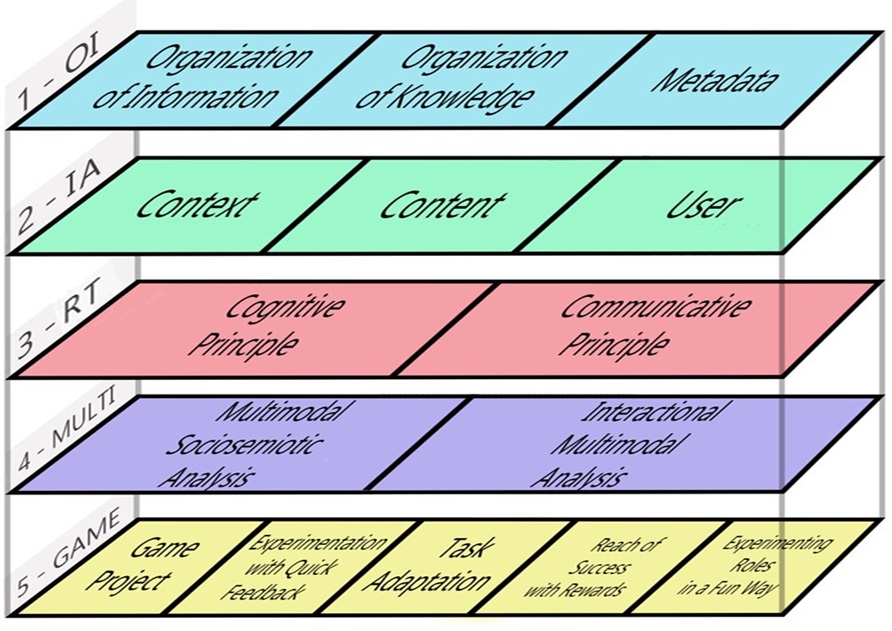
The IAAM model, which stands for Information Architecture Associated with Multimodality, was employed in practical experiments within professional training courses. This model is primarily designed to serve as a guide for the design and development of informational spaces intended for the training of High-Performance Professionals (HPPs). It emphasizes the critical role of the information architect, who may be a course professor, or another professional involved in the training process.
One of the significant outcomes of this research is the presentation of a proposal that holds the potential to make valuable contributions to the future development and establishment of Information Architecture frameworks specifically tailored for professional training purposes. This proposal represents a step forward in defining methodologies and approaches for designing and structuring informational environments that effectively cater to the unique needs and objectives of training high-performance professionals.
Scientific methodology
In terms of categorization according to objectives, the nature of the problem, and technical procedures employed, this study can be classified as follows:
Nature of Research: This research aligns with the characteristics of applied research, as defined by Gil (2022). Applied research aims to generate knowledge that can be directly applied to practical problems, with a specific focus on resolving particular issues.
Objective Classification: The research falls under the category of exploratory research based on its stated objectives. Exploratory research is designed to establish familiarity with the problem at hand, making it more explicit. This is accomplished through methods such as a comprehensive literature review and interviews with individuals possessing practical experience in the subject area. Ultimately, this approach provides an overview of a specific phenomenon, in line with Gil's (2022) conceptualization of exploratory research.
Scientific procedures
Data Collection Instrument: Questionnaires, following the definition by Lakatos and Marconi (2009), consist of an organized set of questions designed to gather responses from participants without the presence of the researcher.
In this research respondents were High-Performance Professionals, 100 students of a Postal Business postgraduate course, where the IAAM Model was fully implemented. They received the questionnaire through email and returned it using the same medium. It is important to accompany the questionnaire with a note or explanatory text that highlights the research's nature, significance, and the importance of respondents' answers. This is done to engage participants' interest and encourage them to complete and return the questionnaire within a reasonable timeframe. The questionnaires used as evaluative instruments in this section were created and administered through the Google Forms tool.
Research results
As depicted in the figures below, the researcher has highlighted certain responses for emphasis. It's important to note that all responses were provided directly by the participants.
Answers highlighted in this survey in Questionnaire 1 were as follows:
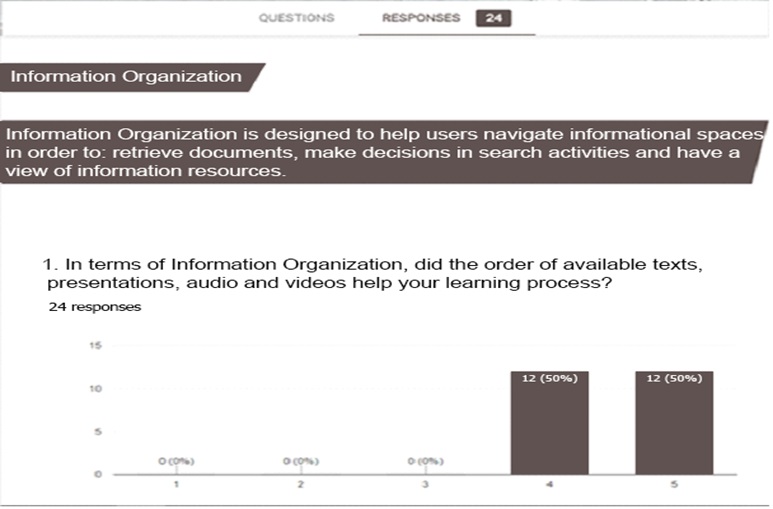
• Answer 1: A higher concentration was observed in the answers of values 4 and 5 (Figure 2), presenting the students’ good evaluation and understanding of the first stage of the IAAM model: Information Organization. This indicates that in Figure 2, a significant number of students responded with values of 4 and 5, signifying a positive evaluation and a strong comprehension of the first stage of the IAAM model, which focuses on Information Organization.
Figure 2.
Answers to question 1
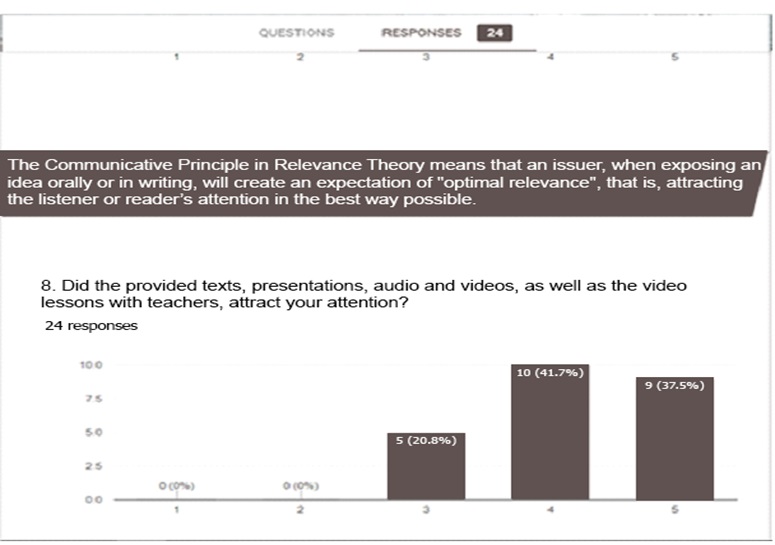
• Answer 8: there is a greater distribution in answers 3, 4, and 5 (Figure 3), due to the Relevance Theory Communicative Principle’s concept complexity.
Figure 3.
Answers to question 8
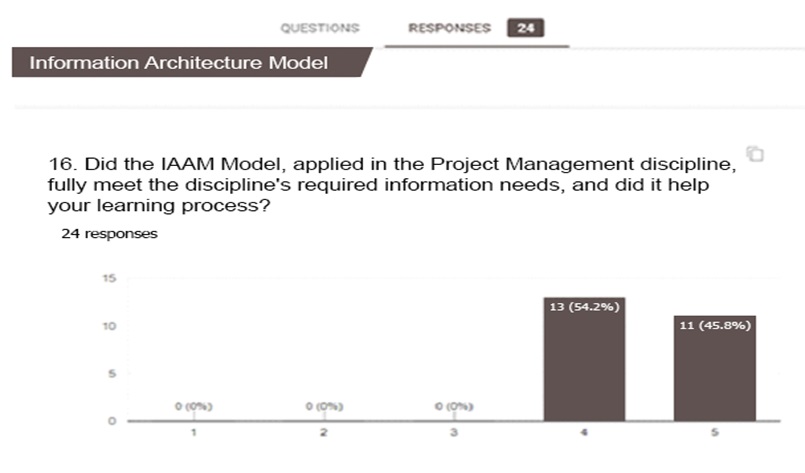
•Answer 16: a high concentration was again observed in answers 4 and 5 (Figure 4). The answers to this question indicate that, despite the research’s limitations, the IAAM model was very well evaluated by the high-performance professional students participating in this research.
Figure 4.
Answers to question 16
In the second questionnaire, answers highlighted in this research were as follows:
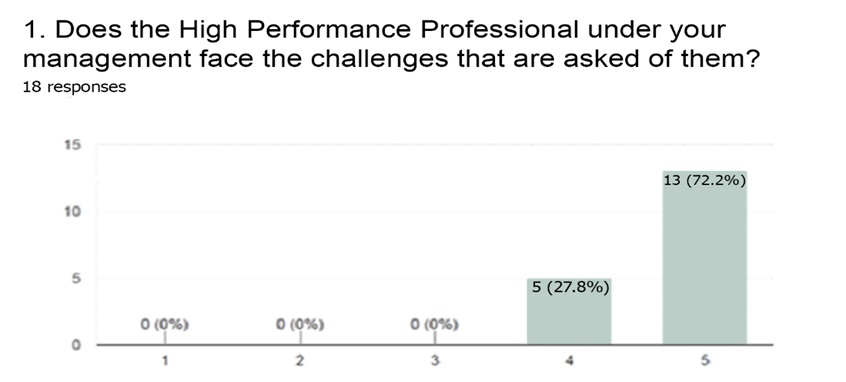
• Answer 1: a high concentration is observed in answers 4 and 5 (Figure 5). These responses indicate that, in their immediate managers’ view, high-performance professionals face the required challenges, which according to Mazurkiewicz (2010) is one of the main characteristics of HPPs.
Figure 5.
Answers to question 5
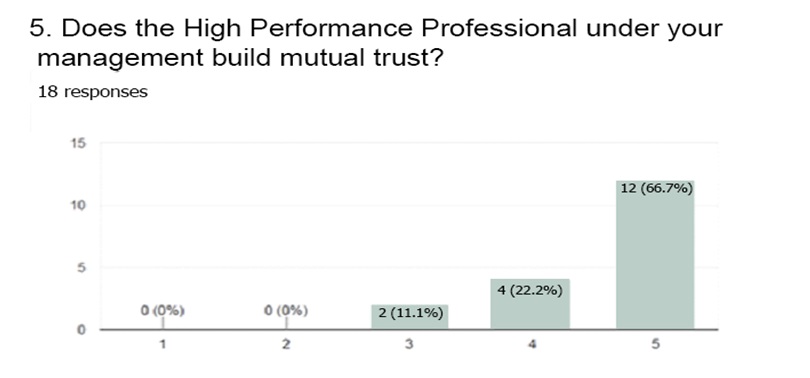
• Answer 5: In this question, there is a greater distribution between answers 3, 4, and 5 (Figure 6), which may be a specific question of the sample of high-performance professionals in this surveyed population.
Figure 6.
Answers to question 5
Statistical results and analysis
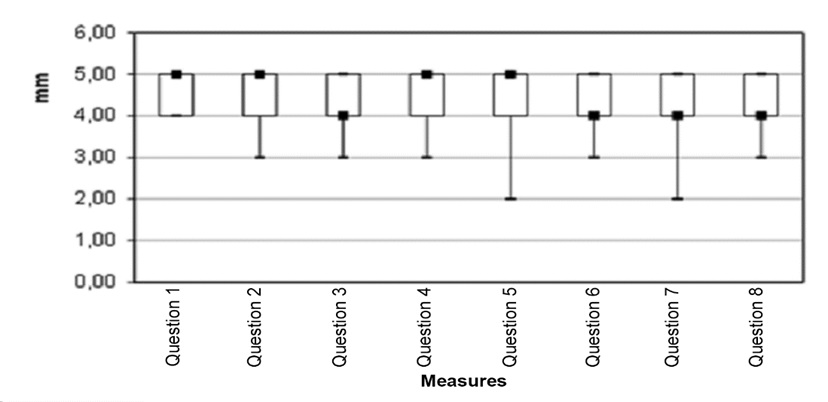
The research encompassed a total population of 100 responding high-performance professionals. Among them, 42 students in the Project Management discipline from the postgraduate Business Management course answered the 16 questions. To statistically describe the research findings, the 'BOXPLOT' graph model was selected. This model presents a graphical summary using five key statistics.
The graph consists of a box parallel to the data scale axis (either horizontal or vertical). The box spans from the first quartile to the third quartile, with a line indicating the position of the median. This box encapsulates the central 50% of the data distribution and is common to all variations of the Boxplot. This graphical representation was chosen due to its ability to convey the research's key findings in a single graph.
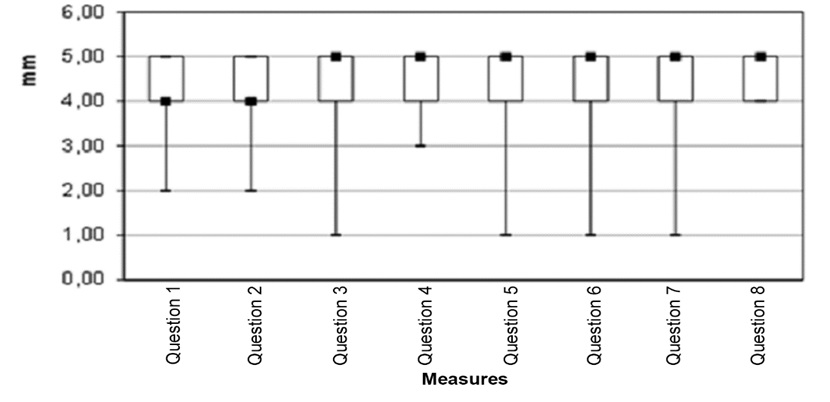
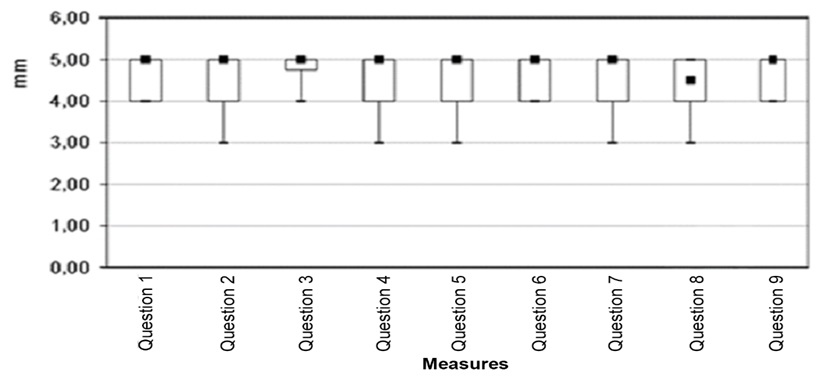
As indicated by Graphs 1 and 2, there is a notable concentration of evaluations falling between the ratings of 4 and 5 for all questions in the first questionnaire. Particularly noteworthy are the median values (represented as points in the Boxplot), with a rating of 5 for questions 1, 2, 4, 5, and 11 to 16, while other questions exhibit a median rating of 4. This concentration around higher ratings indicates a favorable overall evaluation by high-performance professionals, emphasizing the strength of their responses to these specific questions.
Graph 1.
First questionnaire - questions 1 to 8
Graph 2.
First questionnaire - questions 9 to 16
Responses gathered from the second questionnaire, which sought to gauge the perceptions of high-performance professionals' managers regarding their professional profiles following their completion of the postgraduate course in Business Management, it's worth noting that 18 out of 24 managers (representing a substantial 75% of valid responses) participated in the survey.
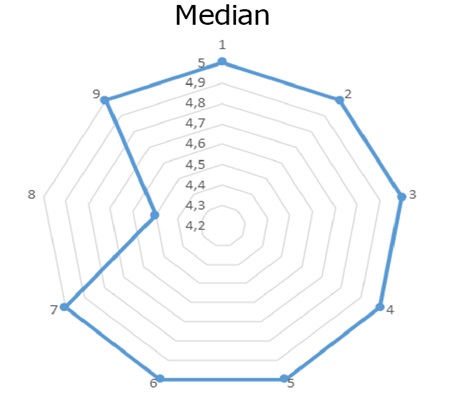
Graph 3, illustrating the data, reveals a concentration of median ratings at a value of 5 for most questions. This indicates a consistent and high level of evaluation across various aspects of the high-performance professionals' profiles, as assessed by their immediate managers. Notably, there was only a slight deviation in Question 8, where the median value was 4.5. This uniformity in the evaluations aligns with the criteria established by Mazurkiewicz (2010) and underscores the favorable assessment of high-performance professionals who completed the Business Management course in accordance with the manager's perspective.
Graph 3.
Second questionnaire - questions 1 to 9
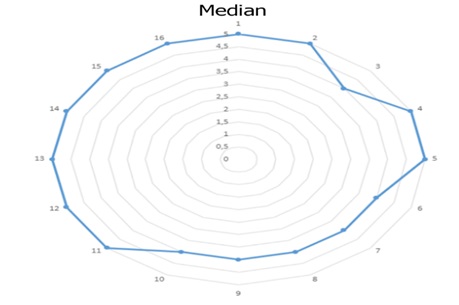
A noteworthy observation in both Radar 4 and 5 graphs is the minimal dispersion of the medians. From the researcher's perspective, this consistency in responses, despite the research's acknowledged limitations, signifies strong acceptance of the model. These limitations are discussed below.
One crucial aspect to consider is the limited sample size; nevertheless, it is important to emphasize that this research holds representativeness. It encompasses students from diverse Brazilian states, each with distinct backgrounds and perspectives. Importantly, all these participants had equal access to informational spaces. What further strengthens the reliability of these results is that the opinions expressed by these students were not influenced by other participants in the research. This absence of influence helps ensure the authenticity and credibility of their responses.
Graph 4.
First questionnaire median distribution
Graph 5.
Second questionnaire median distribution
Research instruments
The first questionnaire named "High-Performance Professional Assessment on the Information Architecture Model," was created to assess the perceptions of high-performance professionals regarding the Information Architecture Model Supported by Multimodality. Specifically, it focused on evaluating the model's five stages and fifteen pillars. The survey aimed to investigate whether each element of the model significantly contributed to improving professionals' learning experiences.
First questionnaire
1. In terms of Information Organization, did the order of available texts, presentations, audio, and videos help your learning process?
2. In terms of Knowledge Organization, did the correlation of available texts, presentations, audio, and videos, help your learning process?
3. Did the metadata of available texts, presentations, audio, and videos help your learning process?
4. Did the context of available texts, presentations, audio, and videos help your learning process?
5. Did the available content help your learning?
6. Did the discipline meet your information needs and preferences?
7. Considering the Cognitive Principle’s definition, were the available texts, presentations, videos, and audio relevant to your learning?
8. Did the provided texts, presentations, audio, and videos, as well as the video lessons with the teachers, attract your attention?
9. Did the available texts, presentations, audio, online classes, and videos help your learning?
10. Were the video classes effective in making the content available, aiding in your learning?
11. Was the Kahoot Game Project effective in helping you learn?
12. Did playing Kahoot with quick feedback help your learning process?
13. While playing, did the task adaptation in Kahoot help your learning process?
14. Did the achievement of rewarded success, such as in the disclosure of the first-placed players in Kahoot, help your learning process?
15. Did playing different roles while having fun in Kahoot help your learning process?
16. Did the IAAM Model, applied in the Project Management discipline, fully meet the discipline's required information needs, and did it help your learning process?
Second questionnaire
The second questionnaire, titled "High-Performance Professional Manager's Perceptions about Their Professional Profile," was developed based on the definitions provided by Mazurkiewicz (2010, p. 6) regarding the characteristics of High-Performance Professionals (HPPs). This research instrument was intended to assess the professional competence of recent graduates to determine whether they exhibited HPP characteristics following their completion of the postgraduate course in Business Management.
1. Does the High-Performance Professional under your management face the challenges that are asked of him/her?
2. Is the High-Performance Professional under your management a partner in the clients' success, that is, does he participate in the actions that lead to the clients' success?
3. Does the High-Performance Professional under your management, whenever requested, collaborate globally, that is, throughout the Company?
4. Does the High-Performance Professional under your management act from a systemic perspective?
5. Does the High-Performance Professional under your management build mutual trust?
6. Does the High-Performance Professional under your management influence through their expertise?
7. Does the High-Performance Professional under your management work for continuous transformation?
8. Does the High-Performance Professional under your management communicate in order to have an impact, that is, putting themselves on the recipient’s side, in the communication process?
9. Does the High-Performance Professional under your management help Colleagues to succeed?
Conclusions
Qualifying high-performance professionals to meet society's stringent quality expectations is an ongoing and formidable challenge. This research endeavors to address this challenge through the introduction of an Information Organization model tailored for informational spaces. The primary goal is to provide substantial support for the training of these professionals by incorporating concepts of Multimodality, Information Architecture, Gamification, and Relevance Theory. It's worth noting that the proposed model garnered positive evaluations from participants.
The principal limitations of this research predominantly manifest in quantitative aspects. Specifically, the Information Architecture Associated with Multimodality (IAAM) model introduced here was fully implemented solely within a controlled environment—a corporate educational unit, specifically in an MBA postgraduate class.
As highlighted in the research, Buckland (1991, p. 351) discerns three distinct dimensions of information: a) information-as-process, b) information-as-knowledge, and c) information-as-thing. This work predominantly focuses on the notion of “Information-as-thing”, making it accessible within informational learning spaces. The objective is to ensure that Information-as-Process effectively caters to information’s requirements of high-performance professionals pursuing education. This allows Information-as-knowledge to bring about a transformation in the "state of knowledge" for these professionals, in accordance with Brookes' (1980) proposition as articulated in the formula K[S] + ΔI = K [S + ΔS].
The research outcomes indicate that the informational space constructed received favorable evaluations from most high-performance professionals who participated in the survey. Additionally, their immediate managers, who assessed them following the completion of training employing the IAAM model, also expressed positive sentiments regarding the model's effectiveness.
References
Bateman, J. A. (2008). Multimodality and Genre: A Foundation for the Systematic Analysis of Multimodal Documents. Ed. Palgrave MacMillan. http://dx.doi.org/10.1057/9780230582323
Brookes, B. C. (1980). The foundations of information science. Part I. Philosophical aspects. Information Scientist, 2(3-4), 125-133. https://doi.org/10.1177/016555158000200302
Buckland, M. K. (1991). Information as thing. Journal of the American Society for Information Science, 42(5), 351-360. https://doi.org/10.1002/(SICI)1097-4571(199106)42:5%3C351::AID-ASI5%3E3.0.CO;2-3
Buckland, M. K. (2017). Information and Society. The MIT Press Essential Knowledge Series.
Camossi G.; Rodas C. M. (2023). Contributions of search engine optimization techniques to information findability. Encontros Bibli, Florianópolis, v. 28, 2023: e93371 University Federal de Santa Catarina. https://doi.org/10.5007/1518-2924.2023.e93371
Clementi, J. A. (2014). Motivational Guidelines for Communities of Practice Based on Gamification (Master's Thesis). University Federal de Santa Catarina.
Dahlberg, I. (2006). Knowledge organization: a new science? Knowledge Organization, 33(1), 11-19.
Duque, C. G. (2011). Multimodality and knowledge in scientific presentations. In Information Science Studies and Practices. Editorial Center.
Dos Santos (2013). Information Architecture that enables integration between Organizational Information, Business Processes, and Information Systems (Master's Thesis). University of Brasília–UNB.
Fardo, M. L. (2013). Gamification as a method: Study of game elements applied in teaching and learning processes (Master's Thesis). University of Caxias do Sul.
Gil, A. C. (2022). How to Prepare Research Projects (7th ed.). Ed. Atlas.
Gontijo, M. C. A.; Araujo, R. F. (2021). Article online attention “Information as thing” of Michael K. Buckland. Ciência da Informação Express, Lavras, v. 2, n. 6, p. 1-9, 8-jun.
Hjørland, B. (2002). Epistemology and the Socio-Cognitive Perspective in Information Science. Journal of the American Society for Information Science and Technology, 53(4), 257-270. https://doi.org/10.1002/asi.10042
Huizinga, J. (2000). Homo Ludens: The game as an element of culture. Ed. Perspectiva.
Jacques, E. de F., Lopes, L. F., & da Silva, T. C. (2023). Gamification as a Pedagogical Tool in Teaching and Learning Mathematics. Revista Interinstitucional Artes De Educar, 9(1), 318–329. https://doi.org/10.12957/riae.2023.69765
Kapp, K. M. (2012). The gamification of learning and instruction: game-based methods and strategies for training and education. Ed. Pfeiffer.
Kress, G., & Van Leeuwen, T. (2001). Multimodal discourse: the modes and media of contemporary communication. Hodder Arnold Publication.
Lakatos, E. M., & Marconi, M. A. (2009). Scientific work methodology (7th ed.). Ed. Atlas.
Lima, G.O.S; Santana, I. M; Nascimento; J. P. F; Matos, S. S.; Cardoso, T. G. (2023). Textual linguistics and the creation of LETTEC: interdisciplinary trajectories. Revista da Anpoll, 54(1), e1891 https://doi.org/10.18309/ranpollv54i1.1891
Lima-Marques, M., & Macedo, F. L. O. (2006). Information architecture: basis for Knowledge Management. In K. O. Tarapanoff (Ed.), Intelligence, information and knowledge (pp. 241-255). IBICT.
Lehmkuhl, C. S., & SILVA, E. C. L. (2023). The Organization of Knowledge and Information: conceptual aspects and their application in archival functions. Em Questäo, Porto Alegre, 29, e-125811. https://d0i.org/10.19132/1808-5245.29.125811
Lyra, M. R. (2012). The Contribution of Information Architecture to IT Service Management (Doctoral Thesis). University of Brasília–UNB.
Lobin, H. (2009). Staged Speech on the Media Stage. New York.
Macedo, F. L. O. (2005). Information Architecture: epistemological, scientific, and practical aspects (Master's Thesis). University of Brasília–UNB.
Mazurkiewicz, L. G. (2010). The role of the company in the career development of professionals considered high performers. XIII SEMEAD – Seminars in Administration.
McGonigal, J. (2012). Reality at play: why games make us better and how they can change the world. Ed. Best Seller.
Monteiro, F. de S. (2013). Semantic web and educational digital repositories in the health area: modeling focused on the learning objective to refine search results. (Master's Thesis) University of Brasília–UNB.
Navarro, G. (2013). Gamification: the transformation of the concept of the term game in the context of postmodernity. Final work of the Specialization Course (lato sensu) in Media, Information and Culture. University of São Paulo-USP.
Norris, S. (2004). Analyzing Multimodal Interaction: a methodological framework. New York: Routledge.
Oliveira, C. B. (2012). An Information Architecture proposal for the innovation process in research centers (Doctoral Thesis) University of Brasília–UNB.
Orlandi, T. R. C., Duque, C. G., & Mori, A. (2019). An Information Architecture Model Associated with Multimodality for Training High Performance Professionals. Encontro Nacional de Pesquisa em Ciência da Informação–ENANCIB.
Rosenfeld, L., Morville, P., & Arango, J. (2015). Information Architecture: For the Web and Beyond. O’Reilly Media Inc.
Schein, E. H. (2022). Organizational Culture and Leadership (5th ed.). Ed. Atlas.
Sperber, D., & Wilson, D. (1986). Relevance: Communication and Cognition. Blackwell.
Sousa, E. E. (2015). The organization of information and technical education in the DF: A model to promote feedback for teachers in classrooms (Master's Thesis). University of Brasília–UNB.
Souza, V. L (2023) Games and gamification in the field of education. Revista Científica Multidisciplinar Núcleo do Conhecimento. Ano. 08, Ed. 06, Vol. 02, pp. 143-158. https://10.32749/nucleodoconhecimento.com.br/tecnologia/ambito-da-educacao
Steinmetz, E. H. R. (2015). The contribution of Information Architecture to the construction and use of Collaborative Teaching/Learning Information Environments (Doctoral Thesis). University of Brasília–UNB.
Steinmetz, E. de F. P. da S., Steinmetz, E. H. R., Duque, C. G., & Costa, R. da S. (2013). Converging Points between Information Science, Relevance Theory and Multimodality. VI IBERIAN MEETING–EDICIC 2013.
Svenonius, E. (2000). The Intellectual Foundation of Information Organization. Boston: Ed. MIT Press.
Wurman, R. S. (2005). Information Anxiety 2: A Guide for Communicators and Instructors. Ed. Cultura.

Page 1 of
Download Count : 77
Visit Count : 199
Keywords
Informational Spaces; Information Architecture; Gamification; Multimodality; Information Organization


Author(s) Information



How to cite this article:
Orlandi, T. R. C., Duque, C. G. (2024). An Information Architecture Framework for high-performance Professionals Development. European Journal of Studies in Management and Business, 30, 27-48. https://doi.org/10.32038/mbrq.2024.30.02
Acknowledgments
Not applicable.
Funding
Not applicable.
Conflict of Interests
No, there are no conflicting interests.
Open Access
This article is licensed under a Creative Commons Attribution 4.0 International License, which permits use, sharing, adaptation, distribution and reproduction in any medium or format, as long as you give appropriate credit to the original author(s) and the source, provide a link to the Creative Commons license, and indicate if changes were made. You may view a copy of Creative Commons Attribution 4.0 International License here: http://creativecommons.org/licenses/by/4.0/