





Review Article
The Role of Wisdom in Managerial Decision-Making: A Systematic Review with a Meta-Analytic Approach


- Abstract
- Full text
- Metrics
Wisdom in management, leadership, and decision-making is an interdisciplinary approach crucial for enhancing organizational performance and increasing sustainability. This research employs a meta-analytic method to systematically review studies on practical wisdom, wise management, decision-making, leadership, organizational sustainability, and related dimensions. By analyzing 71 selected articles, the present study provides a comprehensive conceptual model of the role of wisdom in management. The findings indicate that managerial wisdom influences strategic and ethical decision-making and is key to effective leadership, change management, innovation, and sustainable development. Additionally, organizations whose leaders operate based on organizational wisdom and continuous learning demonstrate better performance regarding flexibility, organizational justice, empathy, and employee satisfaction. This research, which examines various dimensions of wisdom, offers suggestions for knowledge management, improving organizational culture, and developing wisdom-oriented capabilities in organizational policymaking, thereby serving as a foundation for future research and the design of training programs for managers.
The Role of Wisdom in Managerial Decision-Making: A Systematic Review with a Meta-Analytic Approach
Taher Javadi1,* , Rizki Damayanti2
1Ph.D. student in Public Administration at Azad University, Ardabil Branch, Ardabil, IRAN; Employee of Bank Mellat, Branch Management of Ardabil Province, Iran
2Department of International Relations Paramadina University, Jakarta, Indonesia
Abstract:
Wisdom in management, leadership, and decision-making is an interdisciplinary approach crucial for enhancing organizational performance and increasing sustainability. This research employs a meta-analytic method to systematically review studies on practical wisdom, wise management, decision-making, leadership, organizational sustainability, and related dimensions. By analyzing 71 selected articles, the present study provides a comprehensive conceptual model of the role of wisdom in management. The findings indicate that managerial wisdom influences strategic and ethical decision-making and is key to effective leadership, change management, innovation, and sustainable development. Additionally, organizations whose leaders operate based on organizational wisdom and continuous learning demonstrate better performance regarding flexibility, organizational justice, empathy, and employee satisfaction. This research, which examines various dimensions of wisdom, offers suggestions for knowledge management, improving organizational culture, and developing wisdom-oriented capabilities in organizational policymaking, thereby serving as a foundation for future research and the design of training programs for managers.
KEYWORDS: Practical Wisdom, Wise Management, Decision-Making, Leadership, Meta-Analysis, Organizational Sustainability, Management Development
Introduction
In today's complex, dynamic, and unpredictable world, organizations need leaders with specialized knowledge, managerial skills, and a form of "balanced judgment," or wisdom (Rowley, 2006). Practical wisdom in management is recognized as the ability to make decisions that lead to responsible, sustainable, and humane choices, given specific conditions, ethical values, past experiences, and long-term perspectives (McKenna et al., 2009).
Wise leadership is presented as one of the fundamental dimensions of wisdom-based management in this context. Leaders who utilize wisdom can understand organizational complexities, balance conflicting interests, and make decisions based on empathy, transparency, and accountability (Intezari & Pauleen, 2014). This approach contrasts with a purely data-driven perspective in management, which emphasizes only quantitative and logical analyses while ignoring the human, cultural, and ethical dimensions of decision-making (Nonaka & Takeuchi, 2011).
Given today's ethical, environmental, and social crises, emphasis on ethical leadership, organizational sustainability, and social responsibility has become increasingly prominent. In this regard, wisdom is recognized as the intermediary between rational and value-driven decision-making, which can solve complex managerial challenges (Glück et al., 2013).
This research aims to systematically examine the literature on wisdom in management through a meta-synthesis approach, providing a conceptual framework for a better understanding of this phenomenon. This framework can be a foundation for effective decision-making, developing ethics-based leadership skills, and enhancing organizational sustainability.
Importance of the Topic
Wisdom in management, leadership, and decision-making is recognized as a key factor for the success of organizations in complex and dynamic environments. In today's world, where rapid technological changes and increasing competition significantly impact organizations, managers need to consider not only quantitative data but also ethical values, experiences, and human insights in their decision-making processes. Wisdom-based decision-making allows managers to adopt sustainable and practical solutions by integrating data analysis, intuition, and human values.
Studies have shown that organizations whose leaders operate based on wisdom are more successful in improving financial performance and excel in fostering innovation, employee satisfaction, and sustainable development. Wise leadership is a crucial aspect of wisdom in management, encompassing self-awareness, transparency, balanced information processing, and empathy towards employees. Leaders who embody these qualities can create an environment that enhances organizational learning and cultivates a culture of innovation.
The distinction between managers who rely solely on quantitative data and those who utilize wisdom in their leadership is evident in their interactions with employees and their understanding of organizational needs. Leaders who make decisions based on wisdom and experience manage organizational changes more effectively, thereby creating a stable and balanced environment that fosters business growth.
Furthermore, wisdom plays an essential role in knowledge management and organizational learning. Organizations that create and share knowledge based on wisdom and practical experience are more adaptable to change and can achieve a more sustainable competitive advantage. Ethical and responsible decision-making at the organizational level contributes to improved performance, increased public trust, and sustainable development.
Analyzing companies such as Google and Toyota shows that incorporating principles of wisdom into management boosts productivity and innovation, guiding the company's culture towards accountability and fairness. This research seeks to present a structured review of earlier studies, providing an extensive framework for understanding the significance of wisdom in management and decision-making processes. This framework will be a foundation for future studies and the establishment of wisdom-oriented organizational policies.
Research Questions
- How does practical wisdom affect managerial decision-making?
- What is the role of wisdom in effective organizational leadership?
- What role does wisdom have in organizational sustainability and adaptability?
- What factors influence the development and implementation of practical wisdom within organizations?
Research Objective
This research aims to analyze and synthesize the findings of studies on wisdom in management, decision-making, and leadership to gain a deeper understanding of this concept and lay the groundwork for future studies. It evaluates existing theoretical frameworks and outlines a roadmap for future investigations. Additionally, it seeks to provide solutions for enhancing the level of wisdom in organizational management and improving the quality of managerial decision-making. The ultimate goal of this research is to present a comprehensive model for applying wisdom in management that enables managers to make more effective and ethical decisions.
Method
This study employs a meta-synthesis approach to review and analyze published research on wisdom in management. To conduct this research, scientific articles were selected from reputable databases and evaluated based on qualitative criteria. Subsequently, the extracted data were coded and analyzed to identify conceptual patterns. This approach facilitates the development of a comprehensive model for understanding wisdom in management.
This research employed a content analysis approach to extract key concepts from scientific articles, examining the evolution of wisdom in management. Keywords such as "wisdom," "management," "decision-making," "leadership," "meta-synthesis," "organizational sustainability," "crisis management," "innovation," and "ethics" were utilized in the search for articles across scientific databases.
Using the Meta-Synthesis method, this study analyzed 71 scientific articles related to wisdom in management. The research process comprised the following steps: First, the research question was defined, and the criteria for selecting articles and the scope of the review were established. Next, a systematic search for articles was conducted in reputable scientific databases such as Web of Science, Scopus, and Google Scholar. In the subsequent stage, articles were qualitatively assessed based on validity, reliability, research methods, and citation frequency. Following this, coding and content analysis of the data were performed, extracting key concepts that were categorized based on the main themes of wisdom in management. Finally, the findings were synthesized and interpreted, presenting a new conceptual framework for a better understanding of wisdom in management.
Article Selection Process
The studies conducted in this research followed the PRISMA guidelines, which clarified the stages of searching, screening, and selecting articles. In the initial search phase, 785 articles were identified. After removing 320 duplicate articles, 315 articles were screened based on their titles and abstracts, resulting in the exclusion of 180 articles due to a lack of relevance. The full text of the remaining 135 articles was examined, with 64 articles removed because of low quality or irrelevance, and 71 were ultimately selected for final analysis.
The inclusion criteria for articles were scientific publications in reputable journals with an appropriate impact factor and indexed in international databases; publications from 2000 to 2024 covering recent studies in managerial wisdom; qualitative, quantitative, or mixed research methods addressing practical wisdom in management; and articles related to wisdom in decision-making, leadership, and organizational sustainability. Conversely, the exclusion criteria included review articles lacking empirical data and studies focusing solely on general management theories rather than practical wisdom.
The PRISMA method provides a systematic process for searching and selecting articles, facilitating a comprehensive systematic review. Its application in this research enhances the credibility and reproducibility of the findings, ensuring that the selected articles are highly relevant to wisdom in management, decision-making, and leadership.
Quality Assessment of Articles
To ensure the accuracy and credibility of the analysis, the quality of the selected articles was evaluated using the Weight of Evidence (WoE) index and Gough's (2007) model. This assessment was based on several criteria: the research method (qualitative, quantitative, mixed) and its alignment with the research question; the validity and robustness of the findings (reasoned and supported by research data); the relevance to the research topic (direct connection to practical wisdom in management); and the citations and sources used (utilization of credible and up-to-date resources). Each article was rated on a scale from 1 to 5, with only those scoring three or higher included in the final analysis.
Gough's Weight of Evidence method, developed by Ian Gough for assessing studies in systematic reviews, is a quality evaluation approach. It is specifically designed for evaluating qualitative studies, but it applies to quantitative studies. The method is founded on the premise that not all studies are of equal value, with some providing more substantial evidence than others. Thus, their quality must be assessed to utilize studies in systematic reviews effectively, and studies providing stronger evidence should be given more weight.
The assessment of article quality employed Gough's Weight of Evidence, which includes three main criteria: methodological validity (WoE A), assessing the robustness of the research method used in the study; content relevance (WoE B), evaluating the degree of alignment between the study and the research question; and overall quality of evidence (WoE C), a combination of the previous two criteria that assesses the overall quality of the evidence presented in the study.
The formula for assessing quality is defined as follows:
To evaluate the quality of studies using Gough's method, each is assessed based on three criteria, with a score assigned to each criterion. These scores can be used to calculate an overall quality score for the study. Finally, the studies are ranked according to their overall quality score, with higher-scoring studies receiving greater weight in the systematic review.
Scoring Criteria Based on WoE Method
For a more precise evaluation of the articles, each of the criteria mentioned above is scored on a scale from 1 to 5, as follows:
- Score 5: Very high quality (strong methodology, complete alignment with the research question)
- Score 4: Good quality (appropriate research method, high relevance to the research)
- Score 3: Average quality (acceptable research method, moderate relevance to the research)
- Score 2: Low quality (weak research method, low relevance to the research)
- Score 1: Very low quality (deficient research method, no relevance to the research)
Articles scoring below 3 in WoE C were excluded from the final analysis to maintain the accuracy and quality of the systematic review.
Table 1 presents the research method and the scores obtained using the WoE method for the selected articles.
Quality Assessment of Selected Articles
|
Author |
Year |
Research Method |
WoE A |
WoE B |
WoE C |
WoE Final |
|
Nonaka & Toyama |
Qualitative |
5 |
5 |
5 |
5 |
|
|
Ekmekçi et al. |
Quantitative |
4 |
4 |
5 |
4.33 |
|
|
Caniglia et al. |
Mixed |
5 |
5 |
5 |
5 |
|
|
Karami et al. |
Qualitative |
4 |
3 |
4 |
3.67 |
|
|
Rocha & Pinheiro |
Mixed |
5 |
4 |
5 |
4.67 |
|
|
Akgün et al. |
Qualitative |
4 |
4 |
4 |
4 |
|
|
Küpers, W.M. |
Qualitative |
4 |
3 |
4 |
3.67 |
|
|
Ferrero et al. |
Quantitative |
3 |
4 |
4 |
3.67 |
|
|
Trinh & Castillo |
2020 |
Mixed |
5 |
5 |
5 |
5 |
|
Khan & Altaf |
Qualitative |
4 |
4 |
4 |
4 |
|
|
McKenna & Rooney |
Qualitative |
4 |
4 |
5 |
4.33 |
|
|
Adams, A. |
Quantitative |
3 |
4 |
4 |
3.67 |
|
|
Baden & Higgs |
Mixed |
5 |
5 |
5 |
5 |
|
|
Bratianu & Bejinaru |
Qualitative |
4 |
4 |
4 |
4 |
|
|
Bierly et al. |
Quantitative |
3 |
4 |
4 |
3.67 |
|
|
Billsberry & Bimik |
Qualitative |
4 |
3 |
4 |
3.67 |
|
|
Intezari et al. |
Mixed |
5 |
5 |
5 |
5 |
|
|
Crosweller, M. |
Qualitative |
4 |
4 |
5 |
4.33 |
|
|
Mora Cortez & Johnston |
Mixed |
5 |
5 |
5 |
5 |
|
|
Anwar et al. |
Qualitative |
4 |
4 |
4 |
4 |
Theoretical Foundations and Research Background
Wisdom, as the highest level of knowledge and understanding, encompasses various dimensions that manifest in human decision-making and behavior. Understanding these dimensions and distinguishing between them can help managers and leaders make wise and practical decisions. Below, we outline the types of wisdom that have been examined in various studies:
The Significance of Practical Wisdom in Leadership and Decision-Making
Practical wisdom, rooted in Aristotle's philosophy, refers to the ability to discern the right course of action in specific situations and to perform the best possible action under those circumstances. This concept embodies the capacity for moral and practical decision-making in complex, real-world scenarios. Practical wisdom is frequently linked with self-awareness, balanced processing, and ethical values. In other words, an individual endowed with practical wisdom understands how to apply their knowledge and experience to make the best decision, considering the specific conditions.
Managers and leaders with practical wisdom can accurately analyze complex situations, identify key factors, and make ethical and responsible decisions while considering the long-term consequences. They effectively confront ambiguity and uncertainty, make sound decisions under challenging circumstances, and find creative and innovative solutions to problems by leveraging their experience and intuition. Furthermore, they communicate effectively with their employees and stakeholders, involving them in the decision-making process. Various studies have identified practical wisdom as a key element in leadership and ethical decision-making. For instance, research by Akgün et al. (2019), Caniglia et al. (2023), Ferrero et al. (2020), Trinh and Castillo (2020), Alammar and Pauleen (2016), Ardelt (2003), Glück (2018), Bratianu and Bejinaru (2023a), Kristjánsson et al. (2021), Winch and Hajikazemi (2025), and Cugueró-Escofet and Rosanas (2020a) has explored various dimensions of practical wisdom and its impact on managerial decision-making.
The Role of Theoretical Wisdom in Managerial Decision-Making
In contrast to practical wisdom, theoretical wisdom primarily relates to deep knowledge and understanding of general concepts and principles. It applies to management education and psychological research (Akgün et al., 2019). Although theoretical wisdom does not directly influence everyday decision-making, it can indirectly contribute to developing practical wisdom (Alammar & Pauleen, 2016). Sometimes referred to as "sophia," theoretical wisdom encompasses a profound understanding of the world, human nature, and the governing laws that apply to them (Ardelt, 2003).
Managers with theoretical wisdom may possess a broader perspective on issues, enabling them to view them in a larger context. This wider perspective can enhance their ability to anticipate trends and formulate appropriate strategies (Bratianu & Bejinaru, 2023b). Additionally, they may have a deeper understanding of human behavior, allowing them to communicate more effectively with their employees and apply scientific and philosophical theories to solve problems and make decisions (Caniglia et al., 2023). For instance, managers familiar with philosophical principles and scientific theories may be better equipped to think critically about complex issues and make superior decisions (Cugueró-Escofet & Rosanas, 2020b). Organizational wisdom refers to the ability of organizations to utilize knowledge and experience for innovation and performance improvement. This concept is often associated with organizational learning, knowledge management, and organizational culture. Organizational wisdom enables organizations to capitalize on past experiences and refine their processes and products.
The Importance of Organizational Wisdom in Enhancing Performance
Organizational wisdom encompasses an organization's ability to learn from past experiences, accumulate knowledge, and leverage it for performance improvement and innovation. This type of wisdom includes creating and maintaining organizational memory, facilitating knowledge sharing, and fostering a culture that encourages learning and continuous improvement.
Organizations with organizational wisdom can learn from past experiences and avoid repeated mistakes. They can manage the knowledge and expertise of their employees and use it to solve problems and make decisions. Additionally, they can shape their organizational culture to encourage learning, innovation, and continuous improvement while continually enhancing their processes and products and adapting to environmental changes. Studies by Akgün et al. (2019), Bratianu and Bejinaru (2023b), Cugueró-Escofet and Rosanas (2020a), and Pinheiro et al. (2012) have explored various dimensions of organizational wisdom and its impact on organizational performance.
The Role of Ethical Wisdom in Leadership and Decision-Making
Ethical wisdom emphasizes moral values and human virtues, applying them in areas such as ethical leadership, crisis management, and ethical decision-making. It helps managers make ethical and responsible decisions in challenging situations. This concept refers to recognizing and performing right and ethical actions. Such wisdom encompasses understanding moral values and ethical principles and making decisions accordingly.
Managers and leaders who possess ethical wisdom can make responsible and ethical decisions, even in complex and high-pressure situations. They serve as role models for ethical behavior within the organization, fostering an ethical culture, treating their employees and stakeholders fairly and justly, and fulfilling their social responsibilities toward the community and the environment. A study conducted by Ciulla (2004), have examined this type of wisdom and its impact on leadership and management.
The Significance of Executive Wisdom in Leadership and Decision Making
Executive wisdom refers to leaders' and managers' ability to utilize wisdom to guide organizations through complex and challenging situations. It helps managers make effective decisions by gaining a deep understanding of intricate circumstances. This wisdom combines knowledge, experience, insight, and ethical judgment, enabling leaders to make timely and accurate decisions in the face of ambiguity and uncertainty.
Executive wisdom integrates various types of wisdom needed explicitly for leadership and management in complex and challenging conditions. It combines knowledge, experience, insight, and ethical judgment to make effective decisions and steer the organization in the right direction. Leaders with executive wisdom can articulate a clear vision for the organization's future and communicate it effectively to their employees, develop and implement strategies to achieve organizational goals, adapt to environmental changes, guide the organization through uncertainty, and lead teams while motivating employees to accomplish their objectives. Studies by Kets de Vries (2006) and Senge (2006) have examined various dimensions of executive wisdom and its impact on leadership and management.
Below, we will outline the various dimensions of wisdom explored in different studies:
Wisdom is viewed as a moral trait in managerial decision-making, closely tied to ethical values. This aspect includes justice, fairness, honesty, and accountability. Wise managers routinely assess the ethical ramifications of their decisions, aiming to align their choices with the organization's and society's ethical standards. Managers and leaders possessing moral wisdom can make ethical and responsible choices, even in difficult and high-pressure circumstances. They act as examples of ethical conduct within the organization, foster an ethical culture, treat their employees and stakeholders fairly and justly, and meet their social responsibilities to the community and environment.
Additionally, wisdom is recognized as a social characteristic encompassing collaboration, communication, and leadership. This dimension highlights the significance of human interactions and interpersonal relationships in the decision-making process. Wise managers can make better decisions by establishing positive and constructive relationships with employees, stakeholders, and other relevant individuals, thereby gaining their support and cooperation. Managers and leaders who possess social wisdom can effectively communicate with others, involve them in decision-making processes, foster positive relationships with employees and stakeholders, promote collaboration and participation within the organization, and leverage collective wisdom to enhance informed decision-making.
Some studies refer to cognitive dimensions, such as reasoning and judgment, and emotional dimensions, such as self-regulation and emotional intelligence, of wisdom. The cognitive dimension encompasses analyzing and evaluating information, employing logical reasoning, and exercising sound judgment. The emotional dimension encompasses the ability to manage one's emotions and those of others, empathy, and self-awareness. Wise managers can make decisions that are both logical and aligned with human emotions by utilizing these dimensions. Managers and leaders with cognitive and emotional wisdom can effectively analyze and evaluate information, make logical decisions, manage their own emotions and those of others well, communicate with empathy, and make decisions that balance logic with human emotions.
Some studies also examine wisdom as a measurable and experience-based concept. This dimension emphasizes the importance of experience and the learning that comes from it in developing wisdom. Wise managers can draw on past experiences—both their own and others'—to inform better decision-making in the future. Managers and leaders who possess experiential wisdom learn from past experiences, make better decisions in the future by applying their insights, share their knowledge and experiences with others, and continually engage in learning and self-development.
Ultimately, wisdom is a complex and multifaceted attribute that encompasses various dimensions. Managers and leaders seeking success in today's intricate world must strive to cultivate all these dimensions of wisdom and apply them in their decision-making and behaviors. Beyond mere knowledge, wisdom is a powerful tool for managers, enabling them to excel in numerous aspects of their work, from complex decision-making to motivating teams.
In leadership and decision-making, wisdom is essential for ethical leadership, navigating complex choices, and guiding organizations effectively. Wise leaders leverage their insight to create a clear organizational vision, select the appropriate course of action, and inspire employees to meet their goals. With a profound understanding of situations and the repercussions of their decisions, they can make prompt and accurate choices, confidently steering the organization toward success. Additionally, wisdom enables leaders to cultivate a culture of trust and empathy, engage employees in decision-making processes, and harness collective intelligence to achieve better outcomes.
In the area of knowledge management and innovation, organizational and practical wisdom significantly enhance the management of knowledge and the innovation of products and services. Wise organizations continuously learn and innovate by collecting, storing, and sharing their knowledge and experiences. By establishing effective knowledge management systems, they optimize their employees' knowledge and experiences, encouraging a culture of learning and innovation that fosters new ideas and continuous improvement. In this context, wisdom enables organizations to analyze and evaluate information effectively, making informed decisions about developing new products and services while also preventing the repetition of past mistakes by leveraging previous experiences.
In education and development, wisdom is applicable in training managers and developing leadership and decision-making skills. By teaching wisdom to managers, they can be empowered to make more informed, better, and more ethical decisions. Wisdom-based training programs help managers gain a deeper understanding of themselves and others, enabling them to make decisions that are logical and aligned with ethical and human values. Such training equips managers to think critically and analyze issues from multiple perspectives, finding the best solutions to managerial challenges while effectively communicating with employees to support them in achieving organizational goals.
Ethical and practical wisdom are crucial for managing crises and emergencies in crisis management. In critical situations, wise managers can make quick and effective decisions, maintain composure, and prevent further damage. With a deep understanding of the crisis conditions and their implications, they can make swift and decisive choices, helping to prevent escalation while keeping themselves and their employees calm. Wisdom in these situations enables managers to focus on priorities and manage resources effectively, allowing them to navigate the crisis in the best possible way and turn it into an opportunity for learning and enhancing future organizational performance.
In summary, wisdom is a key element in management. It plays a significant role across various dimensions and assists managers and leaders in making better decisions, leading more effectively, and managing more efficiently.
Table 2 presents a synthesis of key conceptualizations, dimensions, and applications of wisdom in management as identified in the reviewed literature.
Literature Review of Selected Articles in the Field of Wisdom
|
Authors |
Concept of Wisdom |
Dimensions of Wisdom |
Managerial Application |
Type of Wisdom |
Summary of Key Topics |
|
Practical wisdom as a distributed process |
Ethical decision-making, collaboration |
Strategic management |
Practical Wisdom |
Strategic management should be a distributed process rooted in practical wisdom, incorporating members’ experiences and insights. |
|
|
Wisdom as a combination of knowledge and experience |
Ethical dimensions, cognitive complexity |
Leadership and decision-making |
Theoretical Wisdom |
Introduces wisdom as a blend of knowledge, experience, and moral considerations, highlighting its role in decision-making. |
|
|
Practical wisdom in sustainability science |
Normative challenges, values |
Research collaboration |
Practical Wisdom |
Emphasizes the role of practical wisdom and virtue ethics in knowledge production within sustainability science and examines normative challenges. |
|
|
Wisdom in education |
Self-regulation, sound judgment |
Teacher education |
Practical Wisdom |
Develops a new scale for assessing teachers’ understanding of wisdom and explores its various dimensions. |
|
|
Practical wisdom in organizations |
Spiritual values, knowledge management |
Organizational culture |
Practical Wisdom |
Investigates the connection between organizational spirituality and practical wisdom, emphasizing the role of spiritual values in managing knowledge. |
|
|
Organizational wisdom and innovation |
Reasoning, aesthetics |
Product innovation |
Organizational Wisdom |
Explores how organizational wisdom enhances product innovation and financial performance. |
|
|
Authors |
Concept of Wisdom |
Dimensions of Wisdom |
Managerial Application |
Type of Wisdom |
Summary of Key Topics |
|
Wisdom as a multidimensional quality |
Emotional and social dimensions |
Ethical leadership |
Practical Wisdom |
Investigates wisdom as a multidimensional trait in leadership and organizations, emphasizing its emotional and social aspects. |
|
|
Practical wisdom as a leadership virtue |
Self-awareness, balanced processing |
Authentic leadership |
Moral Wisdom |
Presents practical wisdom as a vital virtue for leaders, stressing its influence on ethical decision-making. |
|
|
Wisdom as an adaptive algorithm |
Ethical decision-making |
Leadership in complex environments |
Practical Wisdom |
Describes wisdom as an adaptive algorithm for leadership in complex organizational settings. |
|
|
Practical wisdom and human capital |
Knowledge creation, innovation |
Human resource management |
Practical Wisdom |
Highlights the role of human capital in fostering innovation by applying practical wisdom. |
|
|
Wisdom as a human quality |
Ethical and human dimensions |
Organizational management |
Theoretical Wisdom |
Discusses the challenges of integrating wisdom into modern management and calls for a more comprehensive approach. |
|
|
Wisdom as a measurable construct |
Self-regulation, social behavior |
Psychological research |
Practical Wisdom |
Proposes a new scale to measure wisdom and explores its multiple dimensions. |
|
|
Leadership wisdom in public service |
Value-based decision-making |
Leadership in public service |
Practical Wisdom |
Emphasizes the importance of wisdom in public service leadership and related training programs. |
|
|
Wisdom in management |
Emotional intelligence, counseling |
Executive management |
Practical Wisdom |
Examines managers’ perceptions of wisdom, highlighting emotional and advisory aspects. |
|
|
Wisdom as a managerial virtue |
Social and ethical dimensions |
Managerial decision-making |
Moral Wisdom |
Reframes wisdom as a forgotten virtue in management, stressing its ethical and social dimensions. |
|
|
Authors |
Concept of Wisdom |
Dimensions of Wisdom |
Managerial Application |
Type of Wisdom |
Summary of Key Topics |
|
Wisdom as a key concept |
Ethical and social dimensions |
Organizational management |
Theoretical Wisdom |
Conducts a semantic analysis of wisdom in management, emphasizing the role of values. |
|
|
Wisdom as organizational learning |
Experiential dimension |
Organizational learning |
Organizational Wisdom |
Introduces wisdom as a key component of organizational learning processes. |
|
|
Wisdom as contextualized practice |
Practical and academic aspects |
Management education |
Practical Wisdom |
Examines management as a contextualized practice and highlights the importance of wisdom. |
|
|
Executive wisdom in leadership |
Cultural dimensions |
Organizational leadership |
Executive Wisdom |
Explores executive wisdom in leadership and emphasizes its cultural foundations. |
|
|
Wisdom in crisis management |
Ethical dimensions |
Crisis leadership |
Moral Wisdom |
Examines the role of wisdom and virtue in leading during crises. |
|
|
Wisdom in management theories |
Ethical dimensions |
Management education |
Theoretical Wisdom |
Critiques existing management theories and emphasizes the need for ethical frameworks. |
|
|
Organizational wisdom and innovation |
Cultural dimensions |
Market innovation |
Organizational Wisdom |
Emphasizes the importance of organizational wisdom in value innovation. |
|
|
Wisdom in learning organizations |
Ethical dimensions |
Leadership and vision |
Theoretical Wisdom |
Investigates the relationship between knowledge, wisdom, and leadership. |
|
|
Islamic wisdom in management |
Ethical dimensions |
Values-based management |
Moral Wisdom |
Reviews Islamic wisdom in management with a focus on ethical values. |
|
|
Wisdom as a three-dimensional scale |
Cognitive and emotional dimensions |
Psychological research |
Practical Wisdom |
Develops a three-dimensional wisdom scale and explores its facets. |
|
|
Practical wisdom in management |
Ethical dimensions |
Management and leadership |
Practical Wisdom |
Examines applications of practical wisdom in management contexts. |
|
|
Authors |
Concept of Wisdom |
Dimensions of Wisdom |
Managerial Application |
Type of Wisdom |
Summary of Key Topics |
|
Wisdom as a measurable concept |
Experiential dimensions |
Psychological research |
Theoretical Wisdom |
Reviews methods for measuring wisdom. |
|
|
Managerial wisdom |
Experiential dimensions |
Management education |
Practical Wisdom |
Develops managerial wisdom and emphasizes its role in decision-making. |
|
|
Wisdom in organizations |
Ethical dimensions |
Organizational management |
Practical Wisdom |
Explores the role of wisdom in organizational innovation. |
|
|
Wisdom in knowledge management |
Ethical dimensions |
Knowledge management |
Theoretical Wisdom |
Compare knowledge management and wisdom. |
|
|
Wisdom and folly |
Social dimensions |
Organizational management |
Theoretical Wisdom |
Critiques traditional definitions of wisdom, emphasizing social aspects. |
|
|
Wisdom as a new scale |
Experiential dimensions |
Psychological research |
Practical Wisdom |
Develops a new scale to assess wisdom. |
|
|
Wisdom as a self-assessment scale |
Experiential dimensions |
Psychological research |
Practical Wisdom |
Analyzes the self-assessed wisdom scale. |
|
|
Wisdom as a personality trait |
Experiential dimensions |
Psychological research |
Practical Wisdom |
Studies personality traits associated with wisdom. |
|
|
Wisdom in leadership |
Social dimensions |
Leadership and management |
Practical Wisdom |
Investigates wisdom in leadership and its social impact. |
|
|
Wisdom in education |
Ethical dimensions |
Management education |
Practical Wisdom |
Highlights the importance of teaching wisdom in management. |
|
|
Wisdom as a multidimensional concept |
Social dimensions |
Psychological research |
Theoretical Wisdom |
Examines the concept and types of wisdom. |
|
|
Practical and theoretical wisdom in management |
Ethical dimensions |
Management and leadership |
Theoretical Wisdom |
Reviews practical and theoretical wisdom in management. |
|
|
Practical wisdom in collaboration |
Social dimensions |
Leadership and management |
Practical Wisdom |
Explores practical wisdom in collaborative settings. |
|
|
Wisdom and ethical virtues |
Ethical dimensions |
Management and decision-making |
Moral Wisdom |
Investigates the role of ethical virtues and wisdom in management. |
|
|
Authors |
Concept of Wisdom |
Dimensions of Wisdom |
Managerial Application |
Type of Wisdom |
Summary of Key Topics |
|
Wisdom as a new science |
Social dimensions |
Psychological research |
Practical Wisdom |
Investigates wisdom as an emerging scientific field. |
|
|
Wisdom in leadership |
Social dimensions |
Leadership and management |
Practical Wisdom |
Examines wisdom in leadership and its effects on employee behavior. |
|
|
Executive wisdom in management |
Ethical and experiential dimensions |
Executive management |
Executive Wisdom |
Investigates executive wisdom and its influence on management. |
|
|
Wisdom in leadership |
Social dimensions |
Leadership and employee behavior |
Practical Wisdom |
Examines the impact of wisdom on leadership and employee behavior. |
|
|
Practical wisdom in strategic management |
Ethical and social dimensions |
Strategic management |
Practical Wisdom |
Explores practical wisdom in the context of strategic management. |
|
|
Wisdom in management and organization |
Ethical dimensions |
Organizational management |
Theoretical Wisdom |
Discusses wisdom in management and organizations. |
|
|
Wisdom in governance |
Social and ethical dimensions |
Governance and oversight |
Practical Wisdom |
Explores wisdom in governance and supervisory roles. |
|
|
Wisdom as self-transcendence |
Ethical dimensions |
Management and employee performance |
Practical Wisdom |
Studies wisdom as a process of self-transcendence. |
|
|
Practical wisdom in intercultural knowledge management |
Social dimensions |
Intercultural management |
Practical Wisdom |
Explores wisdom in managing knowledge across cultures. |
|
|
Practical wisdom in sustainable management |
Ethical dimensions |
Sustainable management |
Practical Wisdom |
Examines practical wisdom in the context of sustainable management. |
|
|
Practical wisdom in project leadership |
Social dimensions |
Project management |
Practical Wisdom |
Examines wisdom in leading projects effectively. |
|
|
Practical wisdom and leadership in different cultures |
Social dimensions |
Leadership and culture |
Practical Wisdom |
Studies practical wisdom in cross-cultural leadership contexts. |
|
|
Organizational wisdom and its measurement |
Ethical and social dimensions |
Organizational management |
Organizational Wisdom |
Reviews organizational wisdom and measurement methods. |
|
|
Authors |
Concept of Wisdom |
Dimensions of Wisdom |
Managerial Application |
Type of Wisdom |
Summary of Key Topics |
|
Wisdom in education and sustainable governance |
Social dimensions |
Education and governance |
Practical Wisdom |
Explores the role of wisdom in education and governance for sustainability. |
|
|
Wisdom as a key concept |
Social dimensions |
Management and decision-making |
Theoretical Wisdom |
Discusses the need for understanding wisdom in organizations. |
|
|
Wisdom as a multidimensional concept |
Social dimensions |
Management and decision-making |
Theoretical Wisdom |
Examines various conceptions of wisdom. |
|
|
Wisdom in organizations |
Ethical dimensions |
Organizational management |
Theoretical Wisdom |
Reviews wisdom in organizations and its impact on decision-making. |
Results
This study employed the meta-synthesis method to gain a comprehensive understanding of the role of wisdom in management, decision-making, and organizational leadership. This method enables systematic synthesis and comparative analysis of previous studies, creating a coherent framework for understanding the various dimensions of managerial wisdom. Meta-synthesis is a qualitative research method that helps create theoretical frameworks and comprehensive models by systematically combining and analyzing the findings of previous studies (Hoon, 2013).
After selecting the articles, the qualitative data analysis consists of three main stages: open coding, axial coding, and selective coding. Key concepts extracted from the articles' text are identified and categorized in open coding. These concepts are organized into principal axes during axial coding to determine their internal connections. Finally, in selective coding, a conceptual model is developed that illustrates the relationships between the key components of wisdom in management. To clarify the connections between key concepts, details of the coding process, an analysis of key findings, and the final conceptual model will be presented.
Coding Findings
The meta-synthesis method is employed as a qualitative research approach to synthesize and analyze the findings of various studies in a specific field. A key step in this approach is data coding, which assists the researcher in identifying, categorizing, and analyzing important concepts. After selecting the articles, qualitative content analysis was conducted using MAXQDA software. In the meta-synthesis process, three main types of coding are recognized: open coding, axial coding, and selective coding. Below, each of these coding types is described in detail, utilizing the texts provided in the previous question for further explanation.
Open coding: Identifying key concepts
Open coding is the first step in the coding process, where we closely examine the data (article text, interviews, etc.) and identify key concepts. In this stage, the data is divided into smaller units (codes) labeled accordingly. Open coding aims to discover and name all concepts related to the research topic.
In the analyzed articles, during the open coding stage, concepts such as "ethical decision-making", "wisdom-based leadership", "organizational flexibility", "organizational learning", "systems thinking", "organizational justice", "change management", "sustainable development", and "organizational empathy" have been identified as initial codes. These codes demonstrate that, in the studies under review, attention has been paid to various aspects of wisdom in management, including ethical, leadership, organizational, and communication dimensions. Table 3 represents the codes developed during the open coding phase.
Codes Extracted in the Open Coding Phase
|
Initial Code |
Description |
Frequency |
|
Ethical Decision-Making |
Making decisions based on ethical principles and human values |
15 |
|
Wisdom-Based Leadership |
Leading the organization using wisdom, experience, and insight |
12 |
|
Organizational Flexibility |
Ability to quickly adapt to environmental changes and new challenges |
18 |
|
Organizational Learning |
Utilizing past experiences to develop knowledge and improve performance |
10 |
|
Systemic Thinking |
Understanding the interactions and impacts of organizational components on each other |
14 |
|
Organizational Justice |
Creating balance in the distribution of resources and opportunities among employees |
9 |
|
Change Management |
Leading the organization in unstable and transformative conditions |
13 |
|
Sustainable Development |
Balancing current and future needs within the organization |
11 |
|
Organizational Empathy |
Understanding the emotions and perspectives of employees in the workplace |
8 |
|
Organizational Transparency |
Providing information honestly and accessibly for employees |
10 |
|
Wisdom in Innovation |
Utilizing creative thinking and experience in designing new solutions |
12 |
|
Employee Empowerment |
Creating a space for skill enhancement and career growth for employees |
14 |
|
Transformational Leadership |
Creating positive changes and sustainable impacts in the organization |
13 |
|
Transparency in Decision-Making |
Clarity in presenting the reasons and consequences of managerial decisions |
11 |
|
Initial Code |
Description |
Frequency |
|
Development of Cognitive Skills |
Strengthening the analytical, problem-solving, and decision-making skills of managers |
9 |
|
Conflict Management |
Resolving conflicts among organization members through fair methods |
10 |
|
Wisdom-Based Organizational Culture |
Creating an environment where knowledge, ethics, and experience are prioritized |
12 |
|
Knowledge Management |
Collecting, organizing, and utilizing knowledge within the organization |
14 |
|
Focus on Lifelong Learning |
Strengthening a culture of continuous learning among employees and managers |
8 |
|
Strategic Insight |
Ability to forecast and analyze environmental and competitive developments |
15 |
|
Cognitive Flexibility |
Ability to change managerial attitudes and approaches |
9 |
The results of the open coding phase indicate that wisdom in management consists of multiple components, which can be classified into three main areas: wisdom in decision-making, wisdom in leadership, and wisdom in organizational sustainability. Ethical decision-making, organizational transparency, and organizational justice are fundamental principles in managerial decisions. In the leadership dimension, characteristics such as employee empowerment, change management, and transformational leadership hold special significance. Additionally, organizational learning, sustainable development, and knowledge management are essential components of organizational sustainability. The next phase is axial coding, where the extracted concepts are organized into broader conceptual groups to clarify their relationships.
Axial Coding: Establishing Connections Between Concepts
In the axial coding phase, the open codes identified in the previous stage are categorized and grouped according to their relationships. This phase aims to establish connections between the concepts and organize them into coherent and meaningful categories. The codes are classified based on similarities, differences, and causal relationships during this stage.
In the provided texts, the open codes identified in the previous stage have been organized into categories such as "Wisdom in Decision-Making," "Wisdom in Leadership," "Organizational Wisdom," "Continuous Learning," "Systemic Analysis," "Change Management," "Ethical Values," "Sustainable Organizational Development," and "Empathy and Social Interaction." These classifications show that the initial codes extracted during the open coding phase have been structured around broader concepts related to wisdom in management.
For example, the codes "ethical decision-making," "organizational justice," and "ethical values" fall under the category of "Wisdom in Decision-Making," illustrating that these codes are interconnected and pertain to ethical and value-based decisions in management. Table 4 shows the axial coding of the articles along with their main classification.
Classification of Core Codes
|
Main Category |
Axial Code |
Related Descriptions |
Frequency |
|
Wisdom in Decision-Making |
Ethical Decision-Making |
Making decisions based on ethical values and human principles. |
15 |
|
|
Data Analysis |
Utilizing information for optimal decision-making. |
10 |
|
|
Systemic Thinking |
Understanding the interdependence of organizational components in decision-making. |
14 |
|
|
Organizational Justice |
Ensuring fairness and justice in decision-making processes. |
9 |
|
|
Organizational Transparency |
Providing information honestly and accessibly to stakeholders. |
10 |
|
Wisdom in Leadership |
Wisdom-Based Leadership |
Leading the team using wisdom, experience, and ethical principles. |
12 |
|
|
Organizational Empathy |
Understanding employee emotions and creating effective communication. |
8 |
|
|
Transparency and Self-Awareness |
Increasing self-awareness in managers for better decision-making. |
10 |
|
|
Employee Empowerment |
Creating growth and development opportunities for human resources. |
11 |
|
|
Change Management |
Ability to lead the organization through transformation and change. |
13 |
|
Wisdom in Organizational Sustainability |
Organizational Resilience |
The organization's ability to adapt to environmental changes. |
18 |
|
|
Organizational Learning |
Utilizing past experiences to improve organizational performance. |
10 |
|
|
Sustainable Development |
Balancing current and future needs of the organization. |
11 |
|
|
Organizational Innovation |
Developing creative ideas to improve business processes. |
9 |
|
|
Social Responsibility |
Considering the social and environmental impacts of organizational decisions. |
12 |
In the analysis of axial coding, wisdom was classified into three main areas of management: decision-making, leadership, and organizational sustainability.
Wisdom encompasses ethical factors and data analysis that empower managers to make informed and equitable decisions. Information transparency and organizational justice also significantly contribute to enhancing this dimension. In other words, by relying on ethical principles and comprehensive data analysis, managers can make decisions that benefit the organization while adhering to principles of justice and fairness.
In leadership, wisdom addresses the role of managers in creating an environment centered on insight and empowering employees. Empathy, self-awareness, and change management are vital elements of this dimension. Wise leaders can enhance employee motivation and productivity by empathizing with them, understanding their needs and emotions, and fostering an atmosphere of trust and respect. Self-awareness helps leaders identify their strengths and weaknesses and manage changes effectively to guide the organization toward its goals.
In organizational sustainability, wisdom refers to organizations' long-term strategies for survival and growth. Resilience, organizational learning, innovation, and social responsibility are influential factors in this area. By relying on these factors, wise organizations can adapt to environmental changes, continuously learn and innovate, and achieve long-term sustainability while fulfilling their social responsibilities.
In the next stage (selective coding), these categories will be developed into the final model of wisdom in management. In this stage, the relationships among these three areas and the factors influencing them will be examined and analyzed in greater detail, and a comprehensive model will be presented to illustrate the role of wisdom in management.
Selective Coding: Choosing the Core Concept and Creating a Model
During the selective coding stage, one of the core categories that holds greater significance and comprehensively explains the phenomenon under study is identified as the "core concept." Subsequently, other categories and codes are organized around this core concept, creating a comprehensive and coherent model of the studied phenomenon. This stage presents an overarching theory or model regarding the phenomenon in question.
In the provided texts, "practical wisdom in management" has been chosen as the core concept. Other codes, such as "wise leadership," "sustainable organizational development," "change management," "organizational justice," and "empathy and human communications," are considered subcategories of this core concept. This model illustrates that practical wisdom, as a key concept in management, plays a crucial role in leadership, organizational development, change management, organizational justice, and human communication. In other words, these various dimensions are all influenced by practical wisdom in management and are essentially manifestations of it in practice. For example, wise leadership, which utilizes wisdom in guiding teams and making strategic decisions, is one aspect of practical wisdom in management. To conclude the coding phase, the final coding is presented in Table 5.
Final Selective Coding Model
|
Final Code |
Related Descriptions |
Frequency |
|
Practical Wisdom in Management |
Combining knowledge, experience, and ethical values for managerial decision-making. |
20 |
|
Wise Decision-Making |
Utilizing data analysis, systems thinking, and ethical principles in decision-making. |
18 |
|
Wisdom-Based Leadership |
Leveraging wisdom and experience in guiding teams and strategic decisions. |
17 |
|
Organizational Transparency and Justice |
Providing transparent information, ensuring fairness and justice in all managerial processes. |
14 |
|
Organizational Flexibility |
The organization's ability to adapt to environmental changes and market transformations. |
16 |
|
Innovation and Organizational Learning |
Promoting creative thinking, utilizing past experiences, and managing organizational knowledge. |
13 |
"Practical Wisdom in Management" has been selected as this stage's final code and central category. Other codes, such as Wise Leadership, Sustainable Organizational Development, Change Management, Organizational Justice, and Empathy and Human Communications, are considered subsets of this final code. This model demonstrates that practical wisdom, as a key concept in management, plays a significant role in leadership, organizational development, change management, organizational justice, and human communication. In other words, these various dimensions are all influenced by practical wisdom in management and are, in a sense, manifestations of it in practice.
Final Conceptual Model
The conceptual model of wisdom in management, designed based on findings from the meta-synthesis, examines how practical wisdom impacts organizational sustainability through leadership and decision-making. This model encompasses three key dimensions: wisdom in decision-making, leadership, and organizational sustainability.
Wisdom in decision-making is based on ethical values and strategic insight. Wise managers consider the long-term consequences of their decisions and rely on knowledge, experience, and moral judgment to make informed choices that benefit the organization. This approach enhances the organization's economic performance while also addressing its social and environmental goals. In other words, wisdom in decision-making entails a comprehensive perspective that considers the interests of various stakeholders and fosters the organization's long-term sustainability.
Wisdom in leadership involves influencing individuals through insight and empathy. By establishing close, trust-based relationships with employees, wise leaders can guide them toward achieving organizational goals. Inspiring and motivating employees creates an environment where creativity and innovation can flourish. Furthermore, wise leaders foster a culture of organizational learning, helping employees continuously enhance their knowledge and skills, thus improving overall performance.
Organizational Sustainability Wisdom—A ready response in dynamic environments, flexible and adaptive organizations can quickly and effectively address environmental challenges while developing long-term sustainability and growth strategies. These organizations can use their knowledge and experience to identify new opportunities and effectively navigate environmental threats. Organizational sustainability transcends mere survival in a dynamic world; it focuses on establishing a resilient organization and cultivating wisdom for its continued growth.
Practical Wisdom in Management is an interdisciplinary strategy essential for improving organizational performance. In essence, managers with practical wisdom are adept at managing complex strategic decisions and guiding their organizations toward sustainability and growth by blending knowledge, experience, and ethical principles. A key aspect of practical wisdom in management is the need to weigh economic benefits against social and environmental impacts during decision-making. Furthermore, wise leadership enhances both managers and their teams' abilities to achieve superior organizational performance by cultivating a supportive learning atmosphere. This study's findings suggest that organizations led by wise and capable managers can respond more effectively to environmental shifts and create sustainable strategies for continued success and expansion.
To effectively demonstrate the practical impact of wisdom within organizations, Table 6 outlines the key dimensions of managerial wisdom along with their noted effects on crucial organizational factors, including financial performance, innovation, employee satisfaction, crisis management, and sustainability. These connections are derived from a meta-synthesis of 71 selected studies and highlight the complex role of wisdom in influencing both practical and ethical managerial results.
Impact of Wisdom on Key Organizational Variables
|
Dimension of Wisdom |
Affected Organizational Variable |
Observed Impact |
Supporting Studies |
|
Practical Wisdom |
Strategic Decision-Making |
Improved long-term planning and ethical foresight |
|
|
Moral/Ethical Wisdom |
Organizational Trust |
Increased integrity, fairness, and employee trust |
|
|
Executive Wisdom |
Leadership Effectiveness |
Enhanced ability to guide organizations through complexity |
|
|
Organizational Wisdom |
Innovation Capability |
Accelerated product/process innovation through knowledge sharing |
|
|
Practical Wisdom |
Employee Satisfaction |
Increased motivation, engagement, and psychological safety
|
|
|
Dimension of Wisdom |
Affected Organizational Variable |
Observed Impact |
Supporting Studies |
|
Practical & Moral Wisdom |
Crisis Management |
More adaptive, composed, and ethically responsible decisions during uncertainty |
|
|
Wisdom-Based Leadership |
Organizational Learning |
Cultivation of a learning culture and open knowledge exchange |
|
|
Wisdom in Decision-Making |
Financial Performance |
Balanced risk-taking, cost-effective strategies, and sustainable profitability |
|
|
Wisdom in Organizational Culture |
Sustainability & Adaptability |
Improved responsiveness to environmental and market changes |
|
|
Emotional/Social Wisdom |
Team Collaboration & Communication |
Enhanced empathy, conflict resolution, and interpersonal relations |
Table 6 illustrates how wisdom's practical and ethical aspects greatly enhance organizational performance in various areas. For instance, organizations that incorporate practical wisdom into their strategic decision-making show improved long-term planning, while moral wisdom fosters trust and transparency within the organizational culture. These results emphasize that managerial wisdom is not merely an individual trait but also serves as a structural foundation for resilience, innovation, and sustainability in contemporary organizations.
Final Conceptual Framework of the Research
This research's conceptual framework, as illustrated in Figure 1, demonstrates the research pathways and theoretical dimensions associated with wisdom in management. This framework can be a foundation for future empirical studies and managerial policy-making.
Final Conceptual Framework of the Research
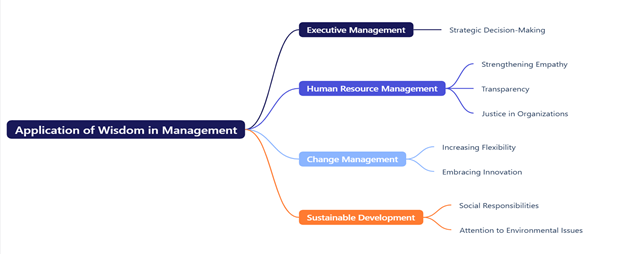
This research's conceptual model and final framework demonstrate that wisdom in management is not merely an individual trait but a broad and multidimensional approach to intelligent organization management. Ethical decision-making, wisdom-based leadership, and sustainable development are the three essential pillars of this model, which come together to enhance organizations' success in complex and competitive environments.
Conclusion
Research suggests that practical wisdom is essential for effective decision-making, sustainable leadership, and improved organizational performance. Wise managers look beyond mere quantitative analyses and data to consider the organization's human, cultural, and ethical dimensions and possess a comprehensive understanding of the consequences of their decisions. This approach minimizes organizational conflicts, boosts employee motivation, and reinforces a culture of learning and sustainable development within the organization.
The primary difference between managers who utilize practical wisdom and those who rely solely on numerical and data-driven analyses lies in their decision-making styles and the consideration of qualitative and human aspects of the organization. Wisdom in management enables leaders to anticipate the long-term consequences of their decisions, integrate ethical values into organizational processes, and leverage practical experience and knowledge to enhance organizational performance. This is particularly important during economic crises, rapid market changes, and technological advancements.
The research findings also demonstrate that practical wisdom plays a significant role in organizational financial performance, increased innovation, improved organizational interactions, and enhanced employee satisfaction. Organizations whose managers adhere to the principles of practical wisdom tend to excel in attracting and retaining talented employees, reducing turnover rates, increasing organizational trust, and enhancing productivity. Empathy, transparency, and consideration of the social implications of decisions are additional factors commonly observed in wise organizations.
Suggestions for Future Research
Given the growing significance of practical wisdom in management, leadership, and decision-making, future research could explore this concept more thoroughly in the following areas:
Empirical Examination of Wisdom's Impact on Organizational Performance: Quantitative and experimental studies could explore the effects of practical wisdom on organizational success, innovation enhancement, and improvement in strategic decision-making. Additionally, assessing the impact of wisdom on employee satisfaction, organizational commitment, and conflict reduction in the workplace could be beneficial.
Cross-Cultural Analysis of Wisdom in Management: Since wisdom can have different interpretations across cultures, comparative studies of practical wisdom in diverse cultural organizations could reveal how cultural and social factors influence the development and implementation of wisdom in organizational decision-making and leadership.
Development of Measurement Tools for Wisdom in Organizations: Considering the lack of standardized scales for measuring wisdom in management, future research could focus on developing more precise tools for assessing practical wisdom within organizations. Designing valid questionnaires and psychometric measurement models could help managers and researchers more accurately evaluate wisdom in organizational contexts.
Exploring the Relationship Between Wisdom and Technology in Management: In today's world, where digital technologies and artificial intelligence play a significant role in managerial decision-making, examining the relationship between wisdom and technology—particularly how wisdom influences decisions based on big data and AI systems—becomes crucial.
Designing Training Programs to Enhance Wisdom in Managers: Future research could develop and test effective training programs aimed at fostering practical wisdom in managers and organizational leaders. Investigating how educational courses in critical thinking, ethical decision-making, and self-awareness affect the development of practical wisdom among managers could pave the way for cultivating wise leaders in the future.
Investigating the Impact of Wisdom on Crisis Management and Decision-Making in Emergencies: Given the significance of practical wisdom in crises, such as the COVID-19 pandemic, economic crises, and climate change, future studies could examine the role of wisdom in crisis management and in enhancing organizational resilience when facing unforeseen challenges.
References
Adams, A. (2007). Developing leadership wisdom. International Journal of Leadership in Public Services, 3(2), 39–50. https://doi.org/10.1108/17479886200700012
Akgün, A. E., Keskin, H., & Kırçovalı, S. Y. (2019). Organizational wisdom practices and firm product innovation. Review of Managerial Science, 13, 57–91. https://doi.org/10.1007/s11846-017-0243-2
Alammar, F., & Pauleen, D. (2016). Exploring managers’ conceptions of wisdom as management practice. Journal of Management & Organization, 22(4), 550–565. https://doi.org/10.1017/jmo.2015.53
Ames, M. C. F. D. C., & Serafim, M. C. (2019). Teaching-learning practical wisdom (phronesis) in Administration: A Systematic Review. Revista de Administração Contemporânea, 23, 564–586. https://doi.org/10.1590/1982-7849rac2019180301
Andaji Garmaroudi, S. (2024). The relationship between wisdom as self-transcendence and employee adaptive performance: The mediating role of openness. All Dissertations. 3585.
https://open.clemson.edu/all_dissertations/3585
Anwar, J., Hasnu, S., & Janjua, S. Y. (2013). Knowledge, wisdom, leadership and vision: a conceptual framework for learning organizations. World Applied Sciences Journal, 28(1), 56–65. http://dx.doi.org/10.5829/idosi.wasj.2013.28.01.1932
Ardelt, M. (2003). Empirical assessment of a three-dimensional wisdom scale. Research on Aging, 25(3), 275–324. https://doi.org/10.1177/0164027503025003004 (Original work published 2003)
Bachmann, C., Habisch, A., & Dierksmeier, C. (2018). Practical wisdom: Management’s no longer forgotten virtue. Journal of Business Ethics, 153, 147–165. https://doi.org/10.1007/s10551-016-3417-y
Baden, D., & Higgs, M. (2015). Challenging the perceived wisdom of management theories and practice. Academy of Management Learning & Education, 14(4), 539–555, https://doi.org/10.5465/amle.2014.0170
Bierly, P. E., Kessler, E. H., & Christensen, E. W. (2000). Organizational learning, knowledge and wisdom. Journal of Organizational Change Management, l13(6), 595–618. https://doi.org/10.1108/09534810010378605
Billsberry, J., & Birnik, A. (2010). Management as a contextual practice: the need to blend science, skills and practical wisdom. Organization Management Journal, 7(2), 171–178. https://doi.org/10.1057/omj.2010.15
Bratianu, C., & Bejinaru, R. (2023a). From knowledge to wisdom: Looking beyond the knowledge hierarchy. Knowledge, 3(2), 196–214. https://doi.org/10.3390/knowledge3020014
Bratianu, C., & Bejinaru, R. (2023b). Wisdom management: A semantic analysis. Proceedings of the International Conference on Business Excellence, 17(1), 1167–1178. https://doi.org/10.2478/picbe-2023-0105
Caniglia, G., Freeth, R., Luederitz, C., Leventon, J., West, S. P., John, B., ... & Vogel, C. (2023). Practical wisdom and virtue ethics for knowledge co-production in sustainability science. Nature Sustainability, 6(5), 493–501. https://doi.org/10.1038/s41893-022-01040-1
Ciulla, J. B. (2004). Ethics and leadership effectiveness. The nature of leadership, 11(26), 302–327. https://www.researchgate.net/publication/265568882
Crosweller, M. (2022). Disaster management leadership and the need for virtue, mindfulness, and practical wisdom. Progress in Disaster Science, 16, 100248, https://doi.org/10.1016/j.pdisas.2022.100248
Cugueró-Escofet, N., & Rosanas, J. M. (2020a). The relative role of the intellectual and moral virtues in sustainable management decisions: The case of practical wisdom and justice. Sustainability, 12(3), 1156. https://doi.org/10.3390/su12031156
Cugueró-Escofet, N., & Rosanas, J. M. (2020b). Practical wisdom for sustainable management and knowledge Sharing. Sustainability, 12(10), 4173. https://doi.org/10.3390/su12104173
Dean Webster, J. (2007). Measuring the character strength of wisdom. The International Journal of Aging and Human Development, 65(2), 163–183. https://doi.org/10.2190/AG.65.2.d
den Uijl, H. (2022). Practical wisdom in governance: ambiguity, politics and democratization in supervising care institutions [Doctoral dissertation, Research and graduation internal, Vrije Universiteit Amsterdam]. Netherlands School for Public Administration (NSOB), https://research.vu.nl/en/publications/practical-wisdom-in-governance-ambiguity-politics-and-democratiza
Ekmekçi, A. K., Teraman, S. B. S., & Acar, P. (2014). Wisdom and management: A conceptual study on wisdom management. Procedia-Social and Behavioral Sciences, 150, 1199–1204. https://doi.org/10.1016/j.sbspro.2014.09.135
El Garah, W., Beekun, R.I., Habisch, A., Lenssen, G. and Loza Adaui, C. (2012). Practical wisdom for management from the Islamic tradition. Journal of Management Development, 31(10), 991–1000. https://doi.org/10.1108/02621711211281906
Ferrero, I., Rocchi, M., Pellegrini, M. M., & Reichert, E. (2020). Practical wisdom: A virtue for leaders. Bringing together Aquinas and authentic leadership. Business Ethics: A European Review, 29, 84–98. https://doi.org/10.1111/beer.12298
Gibson, P. S. (2008). Developing practical management wisdom. Journal of Management Development, 27(5), 528–536. https://doi.org/10.1108/02621710810871835
Glück, J. (2018). Measuring wisdom: Existing approaches, continuing challenges, and new developments. The Journals of Gerontology: Series B, 73(8), 1393–1403. https://doi.org/10.1093/geronb/gbx140
Glück, J., König, S., Naschenweng, K., Redzanowski, U., Dorner, L., Straßer, I., & Wiedermann, W. (2013). How to measure wisdom: Content, reliability, and validity of five measures. Frontiers in psychology, 4, 405. https://doi.org/10.3389/fpsyg.2013.00405
Gough, D. (2007). Weight of Evidence: a framework for the appraisal of the quality and relevance of evidence. Research Papers in Education, 22(2), 213–228. https://doi.org/10.1080/02671520701296189
Hoon, C. (2013). Meta-synthesis of qualitative case studies: An approach to theory building. Organizational Research Methods, 16(4), 522–556. https://doi.org/10.1177/1094428113484969
Hurst, D. K. (2013). Practical wisdom: Reinventing organizations by rediscovering ourselves. Management Research Review, 36(8), 759–766. https://doi.org/10.1108/MRR-11-2012-0256
Intezari, A., McKenna, B., & Rahmati, M. H. (2024). Conceptualizing and contextualizing “executive wisdom” as a framework for business leadership: A grounded theory approach. Business & Society, 0(0). https://doi.org/10.1177/00076503241255540
Intezari, A., Spiller, C., & Yang, S. Y. (2020). Introducing practical wisdom, leadership and culture: Indigenous, Asian and Middle-Eastern Perspectives. In Practical Wisdom, Leadership and Culture (pp. 1-10). Routledge. http://dx.doi.org/10.4324/9780429055508-1
Intezari, A., & Pauleen, D. J. (2014). Management wisdom in perspective: Are you virtuous enough to succeed in volatile times? Journal of Business Ethics, 120(3), 393–404. https://doi.org/10.1007/s10551-013-1666-6
Izak, M. (2013). The foolishness of wisdom: Towards an inclusive approach to wisdom in organization. Scandinavian Journal of Management, 29(1), 108–115, https://doi.org/10.1016/j.scaman.2012.07.002
Jakubik, M. (2021). How can practical wisdom manifest itself in five fundamental management and leadership practices?. Vilakshan-XIMB Journal of Management, 18(1), 3–25. https://doi.org/10.1108/XJM-08-2020-0078
Jakubik, M. (2022, June). Comparing knowledge management and wisdom management. Proceedings 17th International Conference on Knowledge Management, 36, 36–47. https://digital.library.unt.edu/ark:/67531/metadc2047080/
Jeste, D. V., Lee, E. E., Cassidy, C., Caspari, R., Gagneux, P., Glorioso, D., ... & Blazer, D. (2019). The new science of practical wisdom. Perspectives in Biology and Medicine, 62(2), 216–236. https://doi.org/10.1353/pbm.2019.0011
Karami, S., Parra-Martinez, A., Ghahremani, M., & Gentry, M. (2024). Development and validation of perception of wisdom exploratory rating scale: An instrument to examine teachers’ perceptions of wisdom. Education Sciences, 14(5), 542, https://doi.org/10.3390/educsci14050542
Khan, M. W., & Altaf, M. (2015). Use of practical wisdom through human capital in enhancing organizational innovativeness. Journal of Business and Management Research, 9(1), 261–269, https://www.semanticscholar.org/paper/Use-of-practical-wisdom-through-human-capital-in-Khan-Altaf/cdceaa2a18119b134f2d4acce22bfeace4bed24e
Kets de Vries, M. F. R. (2006). The leader on the couch: a clinical approach to changing people & organisations. 1st Edn. Hoboken, NJ: Jossey-Bass. https://onlinelibrary.wiley.com/doi/pdf/10.1002/9781119209027
Kristjánsson, K., Fowers, B., Darnell, C., & Pollard, D. (2021). Phronesis (Practical Wisdom) as a Type of Contextual Integrative Thinking. Review of General Psychology, 25(3), 239–257. https://doi.org/10.1177/10892680211023063
Küpers, W. M. (2007). Phenomenology and integral pheno‐practice of wisdom in leadership and organization. Social Epistemology, 21(2), 169–193. https://doi.org/10.1080/02691720701393509
McKenna, B., & Rooney, D. (2005). Wisdom management: Tensions between theory and practice in practice. https://espace.library.uq.edu.au/view/UQ:8839
McKenna, B., Rooney, D., & Boal, K. B. (2009). Wisdom principles as a meta-theoretical basis for evaluating leadership. The Leadership Quarterly, 20(2), 177–190, https://doi.org/10.1016/j.leaqua.2009.01.013
Mora Cortez, R., & Johnston, W. J. (2019). Cultivating organizational wisdom for value innovation. Journal of Business & Industrial Marketing, 34(6), 1171–1182. https://doi.org/10.1108/JBIM-11-2017-0292
Nonaka, I., Chia, R., Holt, R., & Peltokorpi, V. (2014). Wisdom, management and organization. Management Learning, 45(4), 365–376. https://doi.org/10.1177/1350507614542901
Nonaka, I., & Takeuchi, H. (2011). The wise leader. Harvard Business Review, 89(5), 58–146. https://pubmed.ncbi.nlm.nih.gov/21548419/
Nonaka, I., & Toyama, R. (2007). Strategic management as distributed practical wisdom (phronesis). Industrial and Corporate Change, 16(3), 371–394. https://doi.org/10.1093/icc/dtm014
Pauleen, D. J., Rooney, D., & Holden, N. J. (2010). Practical wisdom and the development of cross-cultural knowledge management: a global leadership perspective. European Journal of International Management, 4(4), 382–395. https://doi.org/10.1504/EJIM.2010.033608
Peltonen, T. (2022). Practical and theoretical wisdom in Management Scholarship: Re-assesing the Use and Appropriations of Aristotle’s philosophy. Philosophy of Management, 21(2), 163–178. https://doi.org/10.1007/s40926-021-00179-9
Pinheiro, P., Raposo, M., & Hernández, R. (2012). Measuring organizational wisdom applying an innovative model of analysis. Management Decision, 50(8), 1465–1487. https://doi.org/10.1108/00251741211262033
Rego, A., Meyer, M., Júnior, D. R., & Cunha, M. P. E. (2025). Wise leaders fostering employees’ speaking up behaviors: developing and validating a measure of leader-expressed practical wisdom. Review of Managerial Science, 19(1), 157–195. https://doi.org/10.1007/s11846-024-00740-6
Rocha, R. G., & Pinheiro, P. G. (2021). Organizational spirituality and knowledge management supporting organizational practical wisdom. Spirituality Studies, 7(1), 68–83, https://repository.essex.ac.uk/40243/
Rooney, D., & McKenna, B. (2007). Wisdom in organizations: Whence and whither. Social Epistemology, 21(2), 113–138. https://doi.org/10.1080/02691720701393434
Roos, J. (2017). Practical wisdom: making and teaching the governance case for sustainability. Journal of Cleaner Production, 140, 117–124, https://doi.org/10.1016/j.jclepro.2015.10.135
Rowley, J. (2006). What do we need to know about wisdom?. Management decision, 44(9), 1246–1257. https://doi.org/10.1108/00251740610707712
Rowley, J., & Slack, F. (2008). Conceptions of wisdom. Journal of Information Science, 35(1), 110–119. https://doi.org/10.1177/0165551508092269
Sattari Ardabili, F. (2021). Leadership effectiveness and employee planned behavior: exploring the role of practical wisdom management. Management and Business Research Quarterly, 36–44. https://doi.org/10.32038/mbrq.2021.20.03
Senge, P. (2006). Systems Citizenship: The Leadership Mandate for this millennium. Reflections 7(3), 1–8.
Steyn, F. (2019). Executive wisdom: a study of phronesis in modern management practice. https://hdl.handle.net/11427/31749
Suciu, M. C., Stativa, A., Bocaneala, A. M., Mituca, M., & Dumitrescu, D. (2022, August). Collaborative practical wisdom. Challenges and opportunities in a dynamic world. In European Conference on Knowledge Management (Vol. 23, No. 2, pp. 1175-1185), https://doi.org/10.34190/eckm.23.2.696
Thomas, M. L., Bangen, K. J., Palmer, B. W., Martin, A. S., Avanzino, J. A., Depp, C. A., ... & Jeste, D. V. (2019). A new scale for assessing wisdom based on common domains and a neurobiological model: The San Diego Wisdom Scale (SD-WISE). Journal of Psychiatric Research, 108, 40–47. https://doi.org/10.1016/j.jpsychires.2017.09.005
Thomas, M. L., Palmer, B. W., Lee, E. E., Liu, J., Daly, R., Tu, X. M., & Jeste, D. V. (2022). Abbreviated San Diego Wisdom Scale (SD-WISE-7) and Jeste-Thomas Wisdom Index (JTWI). International Psychogeriatrics, 34(7), 617–626. https://doi.org/10.1017/S1041610221002684
Trinh, M. P., & Castillo, E. A. (2020). Practical wisdom as an adaptive algorithm for leadership: Integrating Eastern and Western perspectives to navigate complexity and uncertainty. Business Ethics: A European Review, 29, 45–64, https://doi.org/10.1111/beer.12299
Webster, J. D. (2003). An exploratory analysis of a self-assessed wisdom scale. Journal of Adult Development, 10, 13–22. https://doi.org/10.1023/A:1020782619051
Winch, G. M., & Hajikazemi, S. (2025). Practical wisdom for leading projects; The case of early warning signs. Project Leadership and Society, 6, 100173, https://doi.org/10.1016/j.plas.2024.100173
Yang, S. Y. (2011). Wisdom displayed through leadership: Exploring leadership-related wisdom. The Leadership Quarterly, 22(4), 616–632, https://doi.org/10.1016/j.leaqua.2011.05.004
Zhang, K., Shi, J., Wang, F., & Ferrari, M. (2023). Wisdom: Meaning, structure, types, arguments, and future concerns. Current Psychology, 42(18), 15030–15051. https://doi.org/10.1007/s12144-022-02816-6

Page 1 of
Download Count : 76
Visit Count : 347
Keywords
Wise Management; Practical Wisdom; Decision-Making; Leadership; Meta-Analysis; Organizational Sustainability; Management Development


Author(s) Information


How to cite this article
Javadi, T., & Damayanti, R. (2025). The role of wisdom in managerial decision-making: A systematic review with a meta-analytic approach. European Journal of Studies in Management and Business, 34, 1-28. https://doi.org/10.32038/mbrq.2025.34.01
Acknowledgments
Not applicable.
Funding
Not applicable.
Conflict of Interests
No, there are no conflicting interests.
Open Access
This article is licensed under a Creative Commons Attribution 4.0 International License, which permits use, sharing, adaptation, distribution and reproduction in any medium or format, as long as you give appropriate credit to the original author(s) and the source, provide a link to the Creative Commons license, and indicate if changes were made. You may view a copy of Creative Commons Attribution 4.0 International License here: http://creativecommons.org/licenses/by/4.0/